


A behavior intervention plan can be thoughtfully developed, grounded in functional problem solving, aligned to the routines where behavior is happening, and supported by a team that is making a real effort to implement it.
The plan may be based on a solid hypothesis about the function of behavior. Staff may have the resources they need. The team may be using implementation checklists to support training and fidelity. Everyone may be doing a reasonably good job.
And still, the data may not move.
The challenging behavior is not decreasing. The replacement behavior is not increasing. The student is not building momentum.
When that happens, teams often assume the answer is to rewrite the whole plan. Add more strategies. Start over. Build a new document.
Usually, that is not the best first move.
Before rewriting a BIP, it is often more helpful to slow down and do an autopsy on the plan. Or maybe more accurately, try to resuscitate it. The goal is not to throw everything out. The goal is to figure out what is keeping a reasonable plan from getting traction.
If the plan was built on sound functional problem solving and the team is implementing it with a good-faith effort, there are often a few places worth examining before you decide the entire plan needs revision.
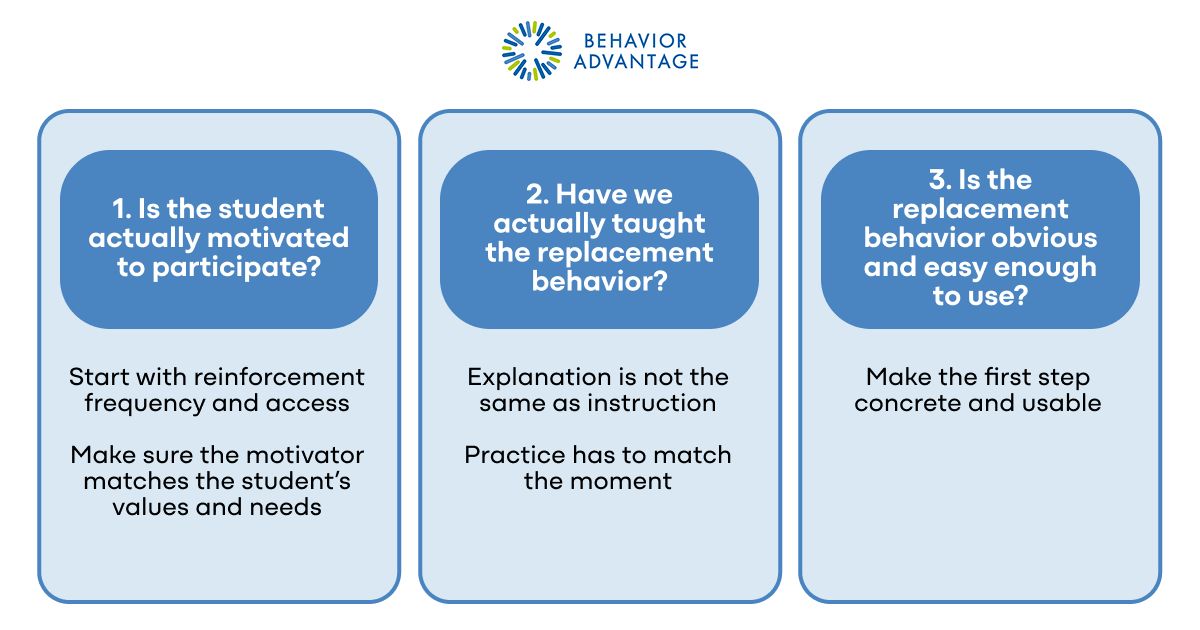
Here are three of the first things teams should look at.
1. Is the student actually motivated to participate?
Start with reinforcement frequency and access
One of the biggest reasons a plan stalls is that the student is not meaningfully motivated to participate in it.
That does not mean the student is unwilling. It often means the reinforcement for trying something new is too delayed, too difficult to access, or too far removed from the effort the plan requires.
In behavioral terms, we would look at the schedule of reinforcement.
If the payoff for using a new skill or making a better choice comes too late, many learners simply stop trying. That is not just true for students. It is true for all of us. When effort now is not connected to something reinforcing delivered much later, momentum is hard to build.
A common example comes up in check-in/check-out. Doesn’t sound familiar? Download our free Check-in Check-out sheets.
A student may have a strong relationship with the check-in/check-out coach. The teacher may be reviewing the point sheet consistently. The intervention may be positive and well organized. But when the team really looks at what is supposed to motivate the student, they discover something like this: if the student earns 80% or more of his points most days this week, then his dad will take him to the local pool.
That sounds motivating. The student loves swimming.
But once the team lifts up the hood, several problems become clear. First, the goal may be too hard. Typically, the student averages 57% of his points per day. The student rarely earns 80% of his points, which means he has never experienced the reward connected to the plan. Second, the reinforcement is too far out. A student is being asked to work hard all day, across multiple days, for something that may or may not happen later. Third, if swimming is already a highly valued family activity, there is a good chance the student may still get access to it anyway. In that case, it may not function as a meaningful reinforcer inside the plan.
The issue is not that the team chose something “wrong.” The issue is that the motivational system is not doing enough work.
Sometimes the answer is to make the reinforcement smaller, sooner, and easier to contact.
Make sure the motivator matches the student’s values and needs
It is also important to make sure the motivator actually aligns with what the student values. Teams sometimes default to generic rewards such as a small toy from a treasure box, but those kinds of items often lose value quickly and may not match the reason the behavior is happening in the first place. If a student’s behavior is consistently functioning to access adult or peer attention, a stronger motivator may be one-on-one time with a preferred adult, a structured peer activity, or another opportunity for connection. If the student is seeking independence or trying to avoid difficult work, a more meaningful option might be a homework pass, a shortened task, or another earned support that aligns with what the student is truly working to access.
When motivation is aligned with the student’s actual values and functional needs, it tends to have more staying power than small novelty items that are briefly exciting and then quickly lose their appeal.
Instead of a large reward that only happens after a long stretch of success, the team might create a daily opportunity. Maybe meeting the goal earns time with a preferred adult, a chance to play a quick game with the PE teacher after school, first choice in an activity, or another immediate and attainable payoff. It does not have to be big. It does have to matter, and it does have to happen often enough for the student to connect effort to outcome.
When a BIP is stalled, teams should ask:
- Is reinforcement happening soon enough after the desired behavior?
- Is the student actually able to earn it based on baseline performance and realistic early improvement?
- Is the current goal so high that the student never experiences success?
- Are we depending on a reward that is too delayed, too large, or too loosely connected to the daily work of the plan?
- Does the motivator actually align with what the student values and is trying to access or avoid?
Sometimes the first revision a plan needs is not more intervention. It is a better motivational engine.
2. Have we actually taught the replacement behavior?
Explanation is not the same as instruction
The second thing I would examine is whether the student has truly been taught what to do instead of the challenging behavior.
When teams are asked this question, the answer is often yes. And often, they mean it sincerely. The counselor has talked with the student about coping skills. Staff have reviewed calming strategies. Teachers have reminded the student to regulate, use their tools, or make a better choice.
But explanation is not the same as instruction.
And reminders are not the same as practice.
A plan can stall because the replacement behavior has been identified, but it has not been taught with enough specificity, enough repetition, or enough alignment to the routines where the problem behavior actually happens.
For example, a team may say a student needs to use self-regulation strategies instead of escalating in language arts. The counselor may be doing good work around emotional awareness and regulation. But if the student’s escalation tends to happen during a very specific moment, such as when the teacher gives corrective feedback on writing, then that is the routine that should shape instruction.
The replacement behavior cannot stay broad and abstract. It has to become concrete and tied to the exact context where things break down.
Instead of only teaching “use calming strategies,” the team might teach and rehearse a more specific response:
pause, take one breath, circle the sentence that needs revision, ask for help using a script, or request a short break appropriately.
Now the team is not just hoping the student generalizes a counseling lesson into a hard classroom moment. The team is directly teaching what to do in that moment.
Make sure to read our guide on How to Teach Replacement Behaviors in a BIP, if you are still unsure where to start.
Practice has to match the moment
This is where direct instruction and behavioral skills training matter. Students often need adults to model the skill, explain when to use it, rehearse it in realistic conditions, and provide feedback over time. A conversation about expectations is rarely enough.
When a plan is not working, teams should ask:
- Did we identify the replacement behavior clearly enough?
- Is the student being taught exactly what to do, not just what not to do?
- Have we practiced the skill in the same routine where the problem behavior occurs?
- Have adults modeled it, rehearsed it, and given feedback?
- Are we teaching a skill that matches the actual moment of difficulty?
Sometimes the plan does not need more strategies. It needs sharper behavioral skills teaching.
3. Is the replacement behavior obvious and easy enough to use?
Make the first step concrete and usable
A third thing to examine is whether the replacement behavior is obvious and easy enough for the student to use in real time.
This is closely related to instruction, but it deserves its own focus because many teams unintentionally choose replacement behaviors that are still too vague, too complex, or too effortful to compete with the student’s current habit.
For initial behavior change to occur, the replacement behavior has to be obvious to the student. The student should know exactly what to do in a very specific situation. Not in theory. Not in general. In the actual moment where the behavior usually goes off track.
It also has to be easy.
If the replacement behavior takes more language, more emotional control, more social risk, or more problem solving than the challenging behavior, the student will often default to the behavior they already know. Even if the replacement behavior is appropriate, it may still be too hard to access in the moment.
For example, a student may be in the habit of escalating into a full argument or meltdown when overwhelmed. That pattern may be disruptive, but from the student’s perspective it may also be familiar, efficient, and well rehearsed. If the replacement behavior is something broad like “use your coping skills” or “advocate appropriately,” that may still be too abstract to compete.
What seems simple to do when we are calm is not always easy to access when we are in distress. During emotional overload, many people have a harder time accessing organized language, problem-solving, and flexible communication.
A better starting point might be much simpler and much more visible: hand the teacher a break card, point to a help card, or use a pre-taught signal that communicates, “I need help,” “I need a break,” or “I’m having a hard time.”
That does not solve everything. But it gives the student a clear and manageable action that is easier to perform than a full escalation. And that is often where early momentum begins.
In many cases, the first replacement behavior does not need to be elegant. It needs to be usable.
When a BIP is stalled, teams should ask:
- Is the replacement behavior obvious to the student in the moment?
- Have we made it specific to the routine where the problem behavior occurs?
- Is it easier and faster than the challenging behavior?
- Have we reduced the language, effort, and complexity required to do it?
Sometimes the plan is not failing because the goal is wrong. It is failing because the first step is still too hard.
Resuscitate before you rewrite
Diagnose the friction point before replacing the plan
When a behavior plan is not producing progress, it is easy to assume the whole thing needs to be replaced. But often, the better move is to slow down and identify what part of the plan has not actually come to life yet.
If the BIP was built through functional problem solving, if the team has reasonable alignment around the routines and likely functions of behavior, and if implementation is getting a solid effort, the first step may not be writing a new plan.
It may be diagnosing the friction point.
Very often, that friction point lives in one of three places:
motivation
The student is not contacting reinforcement quickly enough, often enough, or meaningfully enough to sustain effort.
instruction
The replacement behavior has been identified, but it has not been taught and rehearsed with enough precision in the routines that matter most.
response effort
The replacement behavior is still too vague, too difficult, or too effortful to compete with the challenging behavior in the moment.
Those are not signs that the team failed. They are signs that the plan may need tuning before it needs replacement.A good BIP that is stuck does not always need a rewrite.
Sometimes it just needs resuscitation.
Our guide on How to Write a BIP that Works is a good place to start the process.
However, if you are still unsure about the process, get in touch, and we will walk you through it