


A systems-based approach to building confidence, consistency, and follow-through
This framework is designed for school administrators, MTSS/PBIS teams, behavior specialists, and instructional leaders responsible for onboarding new staff into consistent behavior support practices.
Hiring new staff is hard.
Keeping them confident and consistent in behavior support? Even harder.
Too often, onboarding looks like this:
- A quick tour
- A copy of a behavior plan
- “Let me know if you need anything.”
And then we wonder why implementation drifts or why a new hire feels overwhelmed, disengages, or leaves before they ever feel effective.
If we want consistent outcomes for students, we need consistent onboarding for adults.
This framework outlines a structured, but flexible approach to training new staff in behavior support over their first month. It’s designed to reduce overwhelm, clarify expectations, and build skill through rehearsal and coaching.
(You can download a companion onboarding checklist at the end of this article to make implementation simple and actionable.)
Why this matters
Without structure, behavior support becomes personality-dependent. Expectations shift from classroom to classroom. Crisis responses vary by adult. Even well-written plans are implemented inconsistently. Students experience that inconsistency immediately, from mixed signals to uneven follow-through.
Consistency isn’t something you hope a strong staff member brings. It’s something you build into your system.
One way leaders reduce inconsistency quickly is by pairing onboarding with a shared training pathway. That’s where the Behavior Advantage Professional Development Video Series can fit naturally. Instead of relying on “someone explaining it well,” leaders can assign short, consistent modules that create shared language, then use meeting time for practice, coaching, and building-specific routines.
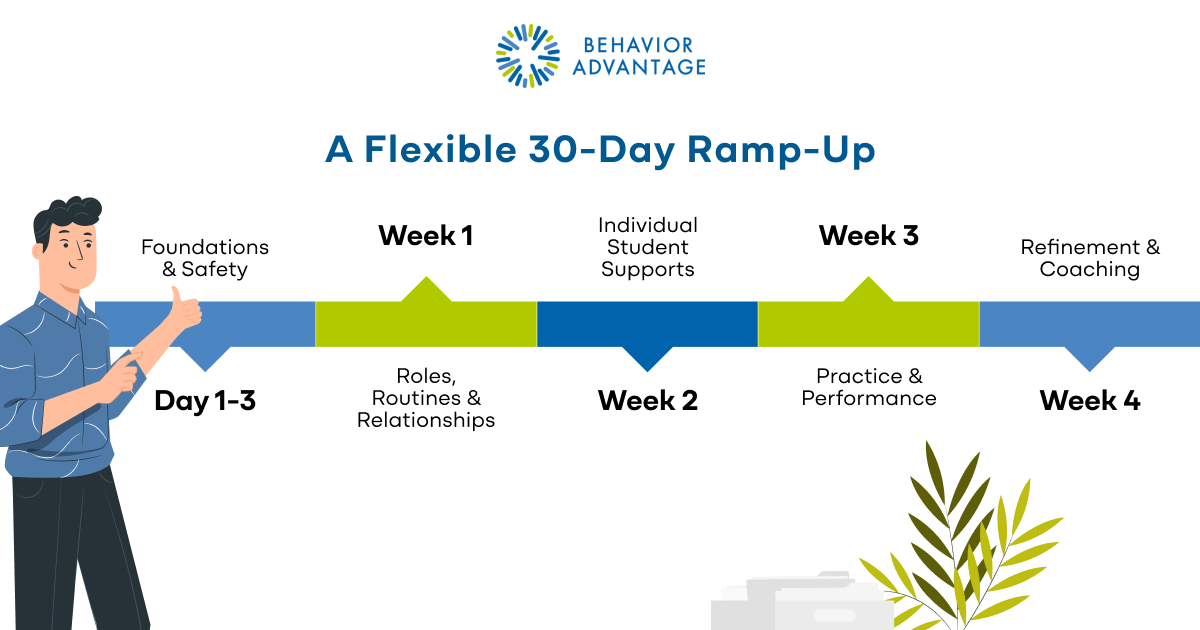
A Flexible 30-Day Ramp-Up
This is a suggested progression that schools can adapt to their unique context.
While written for school teams onboarding new hires, this framework can also be adapted at the district or program level to standardize expectations across buildings. District leaders can use this progression to create shared onboarding language, align coaching practices, and reduce variability between sites.
The goal is not to front-load information.
The goal is clarity, rehearsal, and confidence.
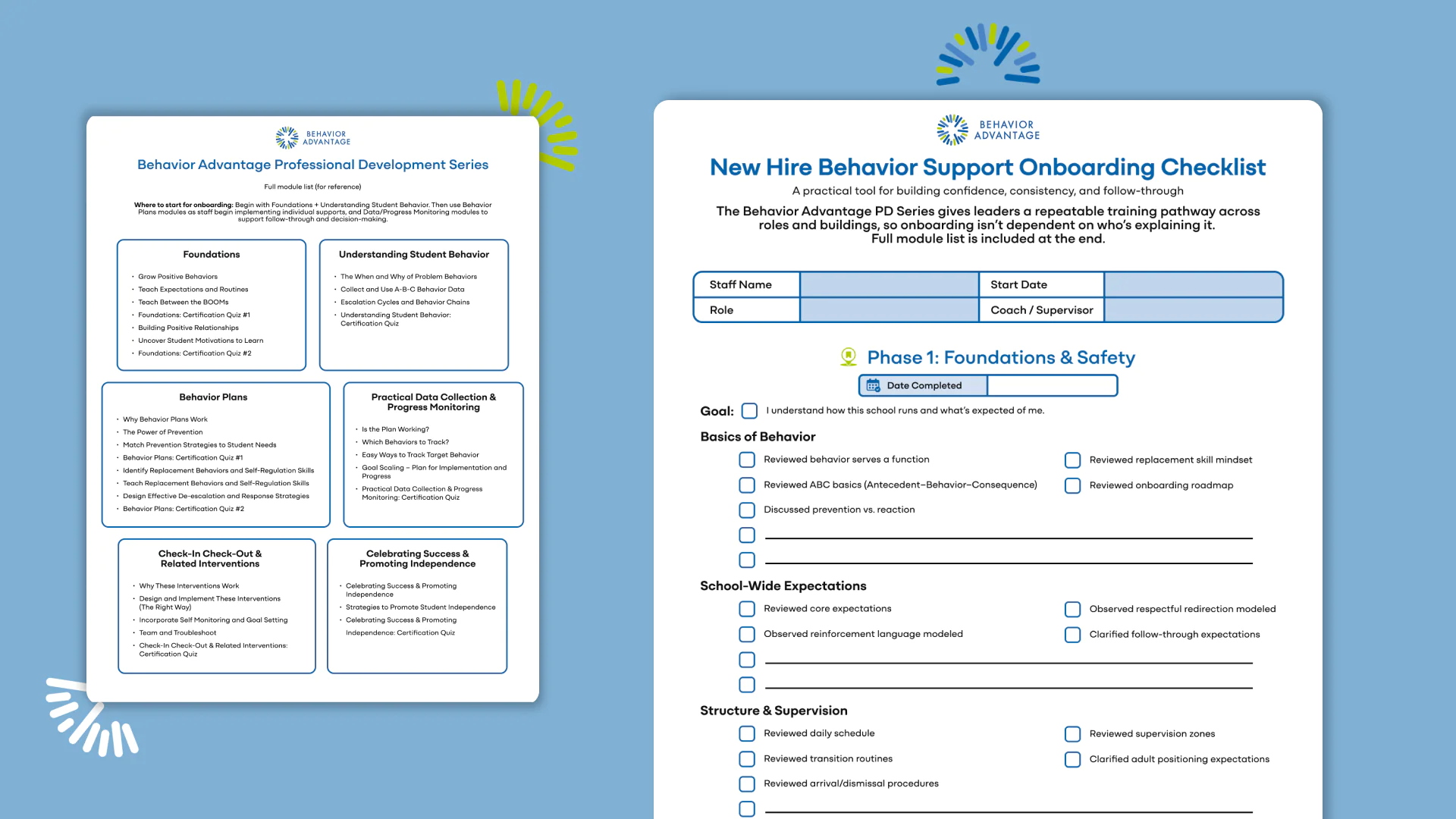
If you’re building or refining your onboarding system, download the New Hire Behavior Training Checklist to put this framework into action.
Day 1–3: Foundations & Safety
Goal:
“I understand how this school runs and what’s expected of me.”
The first few days should focus on predictability and psychological safety. Before managing complex behavior, new hires need to understand how behavior works and how your building operates.
Basics of Behavior
Start with one foundational idea: behavior serves a function. It is communication, not random noncompliance.
Review:
- ABC basics (Antecedent–Behavior–Consequence)
- The role of prevention
- Teaching replacement skills instead of relying on consequences
Many teams start Day 1–3 with the Behavior Advantage PD Series, using a few short, shared modules like Grow Positive Behaviors, The When and Why of Problem Behaviors, and Collect and Use A-B-C Behavior Data to establish a common foundation for how staff understands behavior. The value isn’t just completing training, it’s building a common baseline: what we mean by behavior as communication, how we use functional thinking to define patterns, and why prevention and replacement skills come first.
Then, instead of spending the first week reteaching basics to each new hire (or correcting mismatched approaches after a tough moment), leaders can use coaching time to focus on building-specific expectations and high-risk routines.
School-Wide Expectations
Review your core expectations and what they look like across settings. Model reinforcement language. Demonstrate respectful redirection.
Shared adult language creates shared student experiences.
This is a natural place to align with the PD Series module Teach Expectations and Routines so staff have a consistent model for what routines and reinforcement sound like across common school settings.
Structure, Supervision & High-Risk Times
Walk through schedules, transition routines, supervision zones, and arrival/dismissal procedures. Clarify where adults stand, what they monitor, and when they intervene. New hires should leave these first days knowing what “good supervision” looks like in your building, not just where to be, but what to scan for and how to respond before a situation snowballs.
To standardize early responses during high-risk routines, many teams lean on the PD Series to build a shared lens for escalation. Modules like The When and Why of Problem Behaviors and Escalation Cycles and Behavior Chains help adults identify common triggers, spot early warning signs, and respond with the same early steps before intensity rises. When everyone is looking for the same precursors and responding with the same early steps, transitions become smoother and adult follow-through becomes more predictable across settings.
Then, if a situation continues to intensify, staff can shift into crisis roles and procedures with confidence – because they’re not guessing what they’re seeing or what comes next.
Crisis Overview
Define crisis versus routine dysregulation. Clarify who leads, who clears peers, who calls for support, and who documents.
Even if a new hire never encounters a crisis, knowing the plan increases confidence.
Week 1: Roles, Routines & Relationships
Goal: “I know my role, the routines, and how to build safe, appropriate relationships.”
Week 1 moves from understanding the building to understanding how to operate within it.
Relationship Building (Not “Buddy-Buddy”)
Rapport is not about becoming a peer. It’s about becoming a steady, emotionally safe adult.
Healthy relationship-building includes:
- Greeting students by name
- Acknowledging effort
- Following up after difficult moments
- Maintaining calm tone during correction
- Being warm and firm simultaneously
It does not include:
- Ignoring behavior to be liked
- Lowering expectations to avoid conflict
- Oversharing personal information
When framed correctly, relationship-building protects staff from burnout. Adults who understand boundaries experience fewer power struggles and take behavior less personally, two key factors in retention.
If staff need concrete examples and strategies of how to build relationships with students, the PD Series supports this directly. Modules like Building Positive Relationships and Uncover Student Motivations to Learn show what “warmth with boundaries” looks and sounds like in real moments, especially when students test limits.
Clear Roles & Responsibilities
New hires should never wonder, “Is that my job?”
Clarify:
- Who leads instruction
- Who monitors transitions
- Who initiates de-escalation
- Who collects data
- Who communicates with families
- When leadership is looped in
Example:
During a lunch transition, one student refuses to line up. Without clear roles, multiple adults give directions and escalation grows. With defined roles, one leads the interaction, one moves peers, and one monitors the hallway. The system absorbs the disruption without chaos.
Role clarity supports calm decision-making.
Predictable Routines & Follow-Through
Routines make expectations repeatable.
Train shared language such as:
- “You have two choices…”
- “When you’re ready, we’ll…”
- “Our expectation is…”
A transition routine might include:
- Attention signal
- Clear direction with time
- Behavior-specific praise
- Pre-correction
- Calm follow-through
Follow-through means doing what you said—without added emotion. Not escalating. Not debating. Just predictable next steps.
Students trust consistency.
Teams often use a consistent model to standardize routines, especially when multiple adults support the same students across settings. When everyone anchors to the same expectations and scripts, coaching becomes more targeted, and routines stay consistent across adults and days.
Week 2: Individual Student Supports
Goal: “I can implement plans with confidence and build independence, not dependence.”
This phase shifts from general systems to individualized supports.
Accessing & Reading FBA/BIP Documents
Staff cannot implement what they cannot access.
During onboarding, clearly explain:
- Where plans are stored
- How updates are communicated
- Who to contact with questions
Then teach staff how to read a plan as a teaching document, not a discipline guide.
Help them identify:
- Function of behavior
- Replacement skills
- Preventative strategies
- Adult responses
- Data expectations
Understanding the “why” behind strategies strengthens fidelity.
This is another common support point: new staff often need help understanding the purpose of plans, not just the paperwork. The PD Series modules Why Behavior Plans Work and The Power of Prevention reinforce that plans are teaching tools, so staff don’t default to ‘consequences first’ when things get hard.
Role in Implementation
A strong plan breaks down when responsibilities are unclear.
Clarify who:
- Delivers pre-corrections
- Reinforces replacement skills
- Prompts during escalation
- Logs and reviews data
- Communicates concerns
New hires are not managing behavior. They are teaching skills.
Prompting, Fading & Independence
Prompting is a temporary support.
Train staff to:
- Use structured prompting hierarchies
- Allow processing time
- Fade support intentionally
- Reinforce independent attempts
The goal is movement from adult-directed to student-initiated.
Independence requires adults to step back strategically, not hover.
Consistency often slips here because prompting and fading can look slightly different from one adult to the next. The PD Series modules Identify Replacement Behaviors and Self-Regulation Skills and Teach Replacement Behaviors and Self-Regulation Skills help teams turn replacement behavior goals into shared, repeatable adult actions: what to prompt, how to prompt it, how long to wait, what to reinforce, and when to fade. When staff follow the same sequence, independence becomes a predictable, teachable process across settings.
As students build these skills, it also matters that everyone, staff, students, and families, recognizes progress and reinforces it. The PD Series module Celebrating Success and Promoting Independence helps teams plan what to celebrate (including small gains), fade supports without losing momentum, and keep independence moving forward across routines and settings.
Maintaining Student Dignity
Skill-building must preserve dignity.
Model:
- Private correction
- Neutral tone during escalation
- Professional language about students
- Protection of confidentiality
Dignity strengthens trust—and trust strengthens learning.
Week 3: Practice & Performance
Goal: “I’ve practiced before I’m under pressure.”
Adults do not execute skills they haven’t rehearsed.
Use Behavior Skills Training (BST) to ensure new staff don’t just hear expectations, they practice them.
Behavior Skills Training is a well-established, evidence-based training model within applied behavior analysis. Research consistently shows that adults are far more likely to implement strategies with fidelity when training includes active rehearsal and feedback—not just explanation.
BST includes four essential components:
Instruction
Clearly explain the skill, expectation, or routine. Define what it looks like, when it’s used, and why it matters. Adults need clarity before they can execute consistently.
Modeling
Demonstrate the skill in action. Show what effective language, tone, and positioning look like. Seeing the skill performed correctly reduces ambiguity and builds confidence.
Rehearsal
Provide structured practice. Role-play transitions, de-escalation moments, prompting sequences, and follow-through language. Adults should practice before they are under real pressure. Research shows that rehearsal significantly increases correct implementation compared to instruction alone.
Feedback
Offer immediate, specific coaching. Reinforce what was done well and clarify small adjustments. Feedback should be supportive, precise, and focused on skill growth—not evaluation.
The point is performance-based training, not just PD exposure.
BST works in school settings because most implementation problems are not “we didn’t know” problems, they’re:
- Under stress problems (crisis moments)
- In-the-moment language problems (“I know what to do… I can’t say it like that”)
- Consistency across adults problems
BST solves those by baking in practice and feedback until the response is fluent.
A school-friendly BST format (15–25 minutes)
This is the version administrators can actually run during a huddle, PLC, or team meeting.
Step 1: Pick one micro-skill (not a whole program)
Examples:
- Delivering a calm one-sentence prompt
- Offering a two-option choice
- Using behavior-specific praise
- Running a token or check-in routine
- Implementing a break card
- Following the First 30 Seconds de-escalation sequence
Step 2: Define the skill as observable steps (5–7 steps max)
Write it like a checklist:
- Lower voice
- Create space
- One calm sentence
- One choice
- Wait
Step 3: Model it (30–90 seconds)
Live demo or a short video clip.
Include a “common mistake” model too.
Step 4: Rehearse (2–4 quick reps each)
Rotate roles: staff, student, observer.
Use realistic scripts (the messy version, not the perfect version).
Step 5: Feedback (10–20 seconds each rep)
Keep it tight:
- One praise (“You lowered voice and reduced words, perfect.”)
- One correction (“Next rep: pause after the choice. Don’t fill the silence.”)
Then redo immediately.
Step 6: Quick plan for transfer (who, when, and where)
“Today: use it during arrival and hallway transition.”
“Admin or coach pops in for a 2-minute fidelity check.”
Practice builds confidence. Feedback builds precision.
Week 4: Refinement & Coaching
Goal: “I’m improving with support, not being evaluated.”
Observe routines in action. Provide specific feedback. Clarify look-fors. Celebrate progress. Adjust supports as needed.
Coaching sustains momentum. Confidence grows through supported refinement—not correction alone.
This is also where leaders benefit from pairing coaching with simple progress monitoring. When staff can see implementation improving, and student outcomes shifting, the work feels doable and worth continuing.
What to measure (so it doesn’t become “we trained it”)
BST pairs best with one simple fidelity measure:
- Did the adult do the steps? (yes/no per step)
and/or
- Did the student behavior change in the targeted routine?
If you only track student behavior but don’t track adult implementation, teams get stuck in blame or guessing.
Common onboarding pitfalls (and the fix)
- Too many skills at once: train one micro-skill per week
- No rehearsal: rehearsal is the intervention, protect time for it
- Feedback is vague (“Good job”): make it step-specific
- No in-context follow-up: do a 2-minute “look-for” walkthrough within 48 hours
- Training isn’t tied to a routine: always anchor to one routine (arrival, math, transitions)
Final Reflection for Leaders
Onboarding isn’t an event. It’s a ramp.
When adults feel prepared:
- They stay longer.
- They implement with greater consistency.
- They stay regulated under pressure.
- And students experience school as safer and more predictable.
And when adults are consistent, students feel safe.
If you’re looking to standardize behavior training across classrooms or buildings, the Behavior Advantage Professional Development Video Series aligns directly with the phases above, so staff build a shared foundation, rehearse high-leverage routines, and implement plans with greater consistency across roles and settings.
If you want to see how this looks in practice, a demo is often the simplest next step. We can walk through a sample 30-day onboarding pathway using the PD Series – how districts assign modules by week, build in quick BST reps during team meetings, and keep implementation consistent across buildings, roles, and routines.
Consistency is not personality-dependent.
It’s system-built.