


Schools everywhere are facing rising student behavior needs, staffing shortages, and increasing expectations around MTSS, equity, and data-driven decision-making. As a result, Tier 3 behavior interventions (the most individualized level of support) are more essential than ever.
But Tier 3 can quickly overwhelm a system if schools rely on individual expertise rather than a clear and predictable process. What teams need is a consistent, scalable way to identify students who need intensive supports, develop effective plans, and monitor progress over time.
This article introduces a practical, eight-phase playbook for building a sustainable Tier 3 system, and shows how digital tools like Behavior Advantage can strengthen consistency, efficiency, and follow-through.
Why Tier 3 Is More Than “Just a BIP”
Tier 3 interventions support the small percentage of students who need highly individualized, intensive help beyond universal and targeted strategies. These supports may include:
- Functional Behavior Assessments (FBA)
- Behavior Intervention Plans (BIP)
- Daily data monitoring
- Additional adult coaching or support
- Specialized instruction (social skills, coping skills, executive function)
- Wraparound services involving families and community agencies
- Tier 3 Needs a System, Not a Hero –
The challenge is not simply developing a BIP, it’s building a system that teams can follow consistently across classrooms, grade levels, and school sites.
That’s where the Tier 3 playbook can help.
Struggling to write a BIP? Make sure to check out our comprehensive guide.
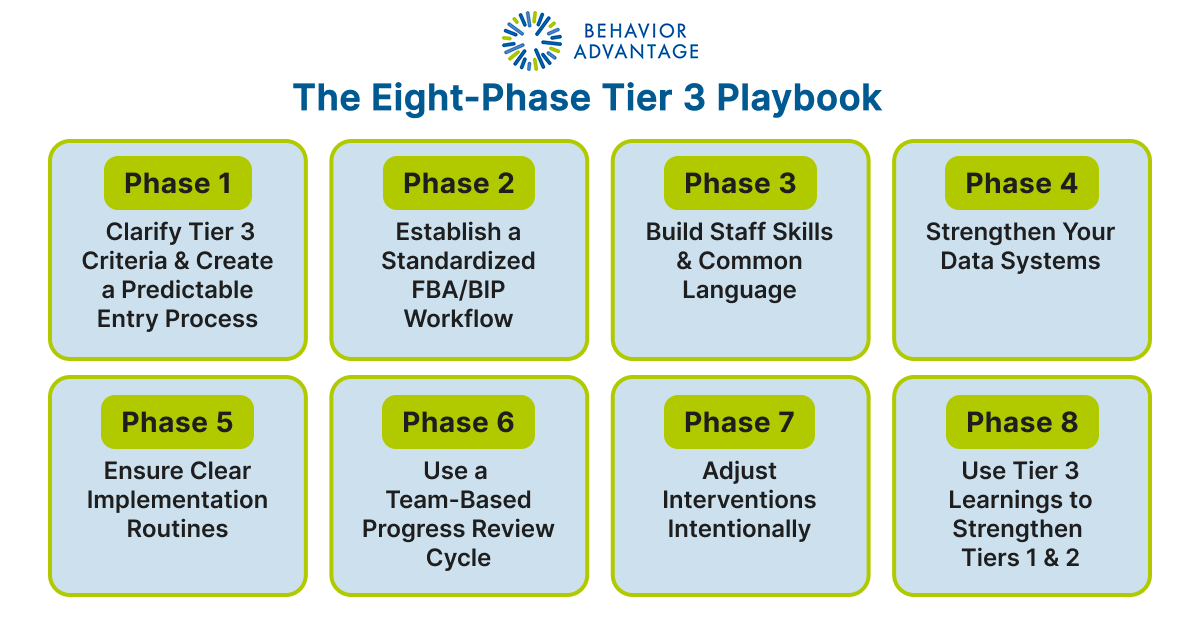
The Eight-Phase Tier 3 Playbook
Phase 1: Clarify Tier 3 Criteria & Create a Predictable Entry Process
Before a school can scale Tier 3 behavior interventions, everyone must share a common understanding of who qualifies and when to initiate the Tier 3 process. Without clear criteria, referrals vary widely across staff, leading to inconsistent and often inequitable access to support.
Schools can define Tier 3 entry based on:
- Lack of response to Tier 2 (with fidelity)
- Chronic or escalating concerns
- Behaviors that significantly disrupt learning
- Increasing safety risks
- Patterns across multiple settings or adults
To support consistency, many districts develop a simple Tier 3 Decision Rules Chart (included below), which helps teams make objective, data-based decisions.
Tier 3 Decision Rules Chart
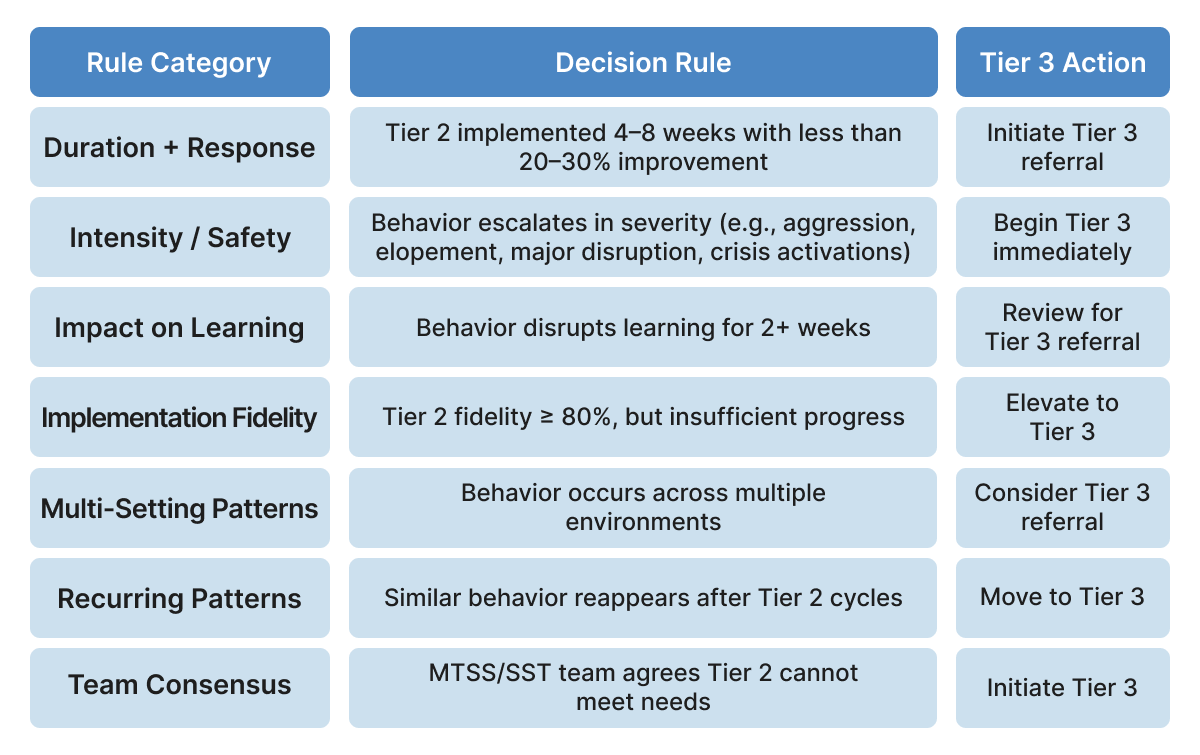
This tool helps ensure Tier 3 decisions are based on data, not frustration or subjective interpretation.
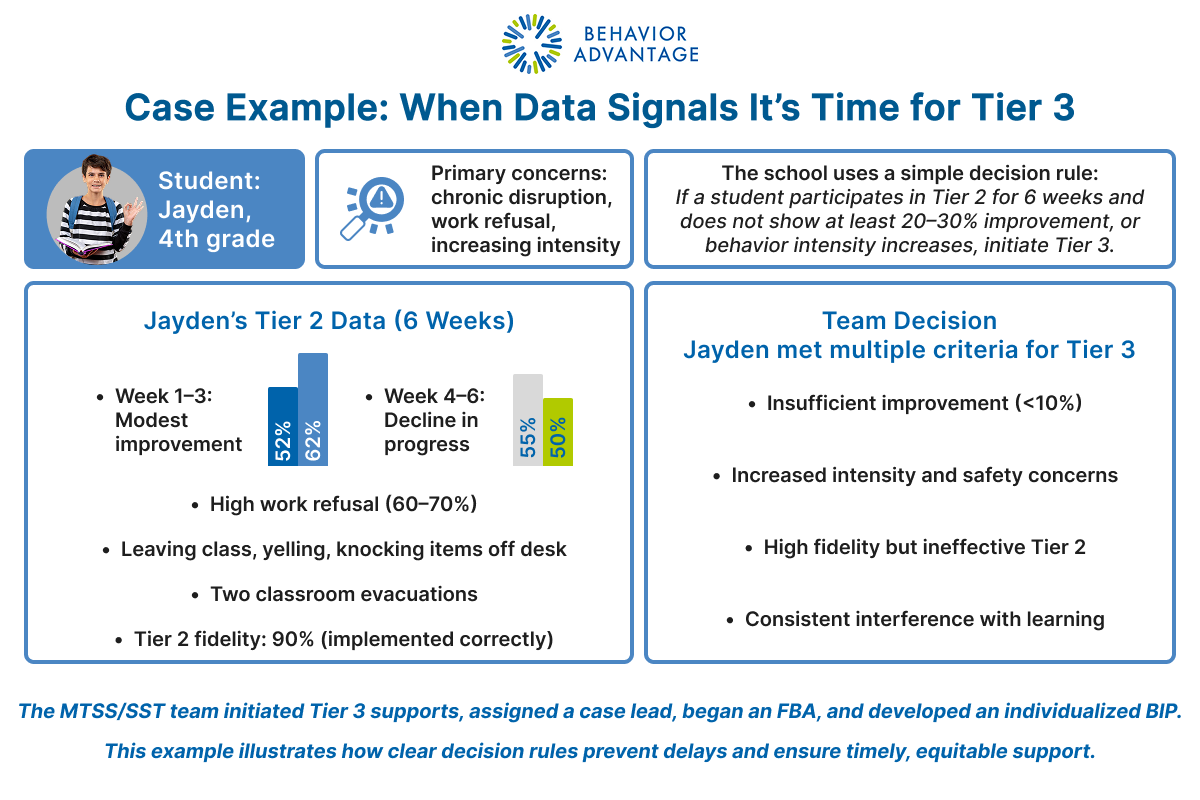
📘 Case Example: When Data Signals It’s Time for Tier 3
Phase 2: Establish a Standardized FBA/BIP Workflow
Scaling Tier 3 behavior interventions requires a consistent workflow so that every school follows the same steps:
- Define the behavior clearly
- Gather baseline data
- Conduct interviews with staff and student
- Observe across settings
- Identify the function of behavior
- Develop a tailored BIP with the team
- Train all responsible staff
- Begin implementation within 48–72 hours
- Review data on a predictable cycle
Behavior Advantage supports this phase through:
- Guided FBA and BIP builders
- Tools and suggestions to ensure completeness
- Strategy menus and resource libraries
- Automatic report generation
This reduces variation and strengthens plan quality, even for staff with limited behavior expertise.
In one our recent blogs, we explain the benefits of using behavior planning tools.
Phase 3: Build Staff Skills & Common Language
Tier 3 can’t fall on a single expert. Sustainable systems require shared knowledge across teachers, support staff, and administrators.
Helpful elements include:
- Short PD sessions during staff meetings
- Quick strategy videos
- Classroom modeling
- Behavior primers for all staff
- Clear role expectations (teacher, para, coach, admin)
Behavior Advantage offers ready-to-use PD videos and implementation guides that help teams get aligned quickly, especially valuable in districts with frequent turnover.
Phase 4: Strengthen Your Data Systems
Effective Tier 3 behavior interventions require consistent, practical data collection in a few primary areas:
- Fidelity Data – Is the plan being implemented as designed?
This helps teams confirm consistency, identify barriers, and avoid misreading “lack of progress” as a student issue rather than an implementation issue. Quick checklists or brief teacher self-ratings work well.
- Outcome (Progress Monitoring) Data – Is the plan working?
Teams track a few key behaviors (target and replacement) to see trends over time and determine if adjustments are needed.
Data should be easy to collect, easy to read, and easy to act on.
Behavior Advantage helps teams:
- Collect digital daily data
- Visualize progress in real time
- Access automatic graphs
- Organize documentation in one place
This reduces the burden on classroom staff and streamlines MTSS meetings.
Ready to learn more about MTSS? Our Implementation Guide is the right place to start.
Phase 5: Ensure Clear Implementation Routines
The difference between a good BIP and a successful BIP is implementation.
Schools should establish routines such as:
- Training the teacher within 48 hours
- Providing the BIP in a clear and concise format
- Giving staff simple checklists
- Conducting brief fidelity walkthroughs
- Modeling strategies for paras and support staff
Behavior Advantage embeds these checklists and resources within the BIP itself, making it easy for teams to stay aligned.
Phase 6: Use a Team-Based Progress Review Cycle
Tier 3 should behavior interventions not be a one-person job. Schools that sustain Tier 3 use routine team-based check-ins every 2–3 weeks:
- Review daily data
- Examine fidelity checklists
- Identify obstacles
- Update strategies
- Document decisions
Behavior Advantage’s auto-generated progress reports speed up these meetings, and BIPs can be copied and updated without overwriting prior versions – making revisions simple and well-organized.
Phase 7: Adjust Interventions Intentionally
Plans need to evolve as students grow.
Teams should adjust when:
- Progress is slow
- Fidelity is low
- New behaviors emerge
- Context changes (new class, new teacher, new routines)
Adjustments may include:
- Increasing reinforcement
- Teaching new replacement skills
- Modifying the environment
- Adding targeted skill instruction
- Providing specialized supports (SEL, counseling, mentoring)
Data, not emotion, should guide these decisions.
Phase 8: Use Tier 3 Learnings to Strengthen Tiers 1 & 2
Tier 3 cases often reveal system-level patterns:
- Common triggers such as transitions or peer conflict
- Skill deficits that multiple students share
- Need for clearer expectations or routines
- Staff needing more training in a specific strategy
These insights inform stronger Tier 1 and Tier 2 supports, reducing new Tier 3 referrals and creating a more preventative system.
Final Thoughts
Tier 3 does not need to overwhelm your system. By establishing a clear playbook, supported by consistent decision rules, simple data systems, and team-based routines, schools can provide intensive support that is:
- Effective
- Sustainable
- Equitable
- Scalable
Tools like Behavior Advantage help bring this structure to life by streamlining the FBA/BIP workflow, improving implementation consistency, and simplifying data review across teams.
With a shared process and the right tools, teams can move from reactive to proactive and ensure every student gets the support they need to thrive.
Ready to turn your Tier 3 work into a scalable system?
Schedule a demo of Behavior Advantage to see how this technology can support your workflow, promote consistency, and free up more time for staff to do what they do best: teach and support students.