


Behavior Intervention Plans are supposed to help teams support students more effectively.
But in practice, many plans become too broad, too wordy, or too hard to implement consistently. They try to cover too much at once. Roles get fuzzy. Strategies sound helpful on paper, but they do not always hold up in a real classroom routine.
That is where a practical, easy-to-use tool, like the BIP Essentials Template, can help.
A strong BIP should help teams focus on what matters most: a clearly defined target behavior, one target routine, hypothesized function, replacement behavior, practical prevention strategies, clear implementation roles, and simple progress monitoring.
The goal is not just to complete a form. The goal is to make student supports clearer, more usable, and more likely to work in real settings.
Start Smaller
One of the biggest shifts in effective behavior planning is moving away from trying to solve everything at once.
When a plan includes multiple behaviors, multiple settings, too many strategies, and unclear staff roles, it gets harder to implement consistently. Staff lose clarity. Data gets muddy. The student may experience a lot of adult effort, but not a lot of coordinated support.
A better starting point is often much smaller: one clearly defined behavior, one routine, one team, one plan for what happens next.
That kind of focus makes everything else easier. It helps teams define the behavior more clearly, identify the likely function, choose supports that fit the setting, and track whether anything is actually changing. It also fits the same practical approach behind our Behavior Plan Starter Kit, which is built to help teams move from planning to implementation without overcomplicating the process.
Get Clear First
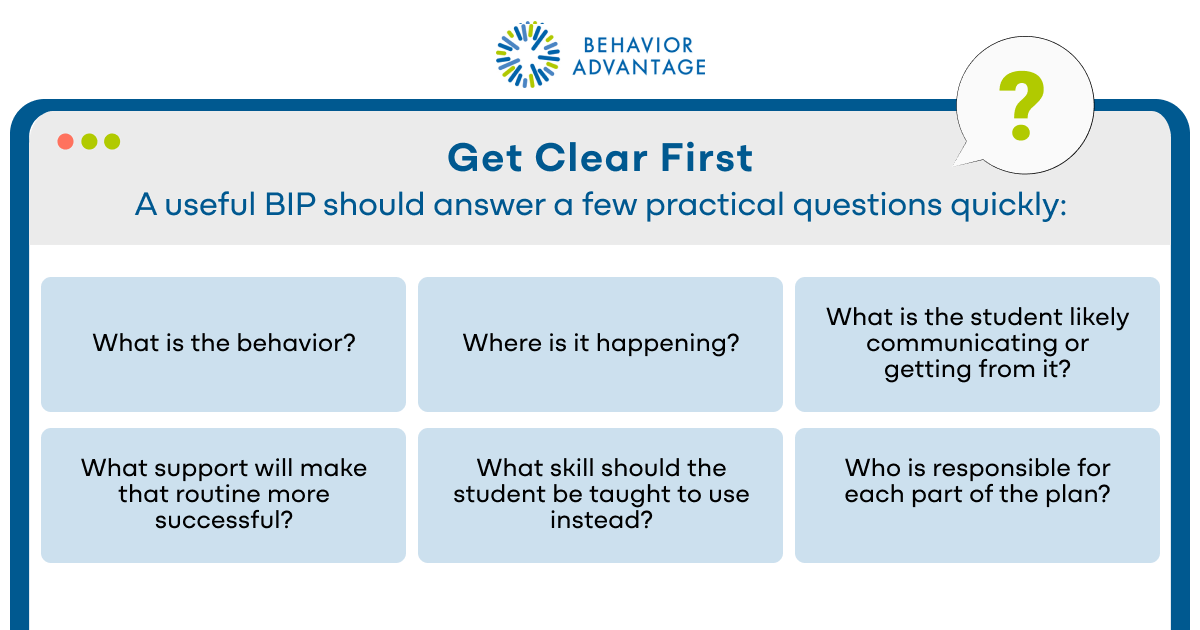
A useful BIP should answer a few practical questions quickly:
- What is the behavior?
- Where is it happening?
- What is the student likely communicating or getting from it?
- What support will make that routine more successful?
- What skill should the student be taught to use instead?
- Who is responsible for each part of the plan?
That is what a practical planning tool should help teams do.
It gives teams a clearer place to define the target behavior, identify the likely function, name the replacement behavior, and spell out who is doing what. That may sound simple, but in practice, that clarity is often the difference between a plan that gets written and a plan that gets used.
If a team is still trying to figure out the why behind the behavior, that is often a sign that the process needs to slow down before it speeds up. A Simple Functional Behavior Assessment Form can help teams get more specific about what the behavior looks like, where it happens, and what the student may be trying to gain or avoid before building a full intervention plan.
Lead with Prevention
One of the most important improvements in behavior planning is making sure teams do not jump straight to response strategies, or more reactive measures.
How we responding to problem behavior matters. Teams need a clear plan for what adults will do when behavior occurs, especially when escalation or safety is a concern. But response should not be the center of the plan. The goal should always be to lead with prevention and reduce the need for problem behavior in the first place and teach a more appropriate way for the student to get that need met.
That is where prevention comes in.
A strong prevention strategy is proactive, aligned to the likely function of the behavior, and realistic enough to use consistently in the routine where the behavior shows up.
This matters because many student behaviors become more intense when the environment is asking too much, moving too fast, or missing the support the student needs.
In most school settings, prevention strategies are carried out by classroom teachers because they live inside the routine itself. These may include visual supports, pre-corrections, structured choices, task adjustments, clearer transition routines, planned breaks, and check-ins before harder parts of the day.
These supports are not extra. They are often the part of the plan that gives everything else a chance to work.
Sometimes they are more than just a good first step. Sometimes they are the missing piece.
A student may not need a more layered plan, a more intensive response strategy, or more adult correction. The student may need a routine that is more predictable, a task that is more accessible, a clearer prompt before a hard transition, or a support that reduces the need for the behavior in the first place.
That is why prevention deserves so much attention. Sometimes prevention alone is not enough. But sometimes it is exactly what unlocks success.
Pause Before You Add More
One of the most useful habits in behavior planning is pausing before moving to the next layer.
After selecting prevention strategies, teams should stop and ask whether those supports, if implemented consistently, are likely to make a meaningful difference in the next 2 to 4 weeks. If the team believes prevention is enough to create change, they may not need to keep adding more to the plan right away.
That pause matters because it keeps teams from overbuilding.
It creates space to ask a simple question: have we already identified enough to move forward well? It keeps the focus on implementation, not just planning. It also reinforces something important: not every BIP needs every possible layer from the start.
Sometimes the best next step is not writing more. Sometimes the best next step is trying the plan with consistency and seeing whether the support already identified is the thing that helps the student succeed.
That same mindset is part of what makes a simpler workflow useful. Teams do not always need more forms, more strategies, or more language. Sometimes they need a clearer starting point, a smaller plan, and a better way to follow through.
Then Teach What to Do Instead
If a student is still struggling even with proactive supports in place, the next step is usually not to add more consequences.
The next step is to teach.
A replacement skill should meet the same need as the behavior. If a student is avoiding work, the replacement skill might be asking for help, requesting a break, or using a support card. If the behavior is connected to attention, the replacement may involve a more appropriate way to seek interaction or connection.
The key is that the replacement behavior has to work for the student. It has to be practical, usable, and connected to the same function.
That is why it helps to use a tool that keeps the replacement behavior front and center, rather than letting it get lost in the plan.
And this is another place where it helps to pause.
Once a team has identified both the prevention support and the replacement skill, they can stop and ask: is this enough? Do we need to keep building out the plan, or do we have enough to implement, monitor, and learn from?
That pause keeps the work grounded and intentional. It reminds teams that the goal is not to create the longest possible plan. The goal is to create the right plan.
A Real Example
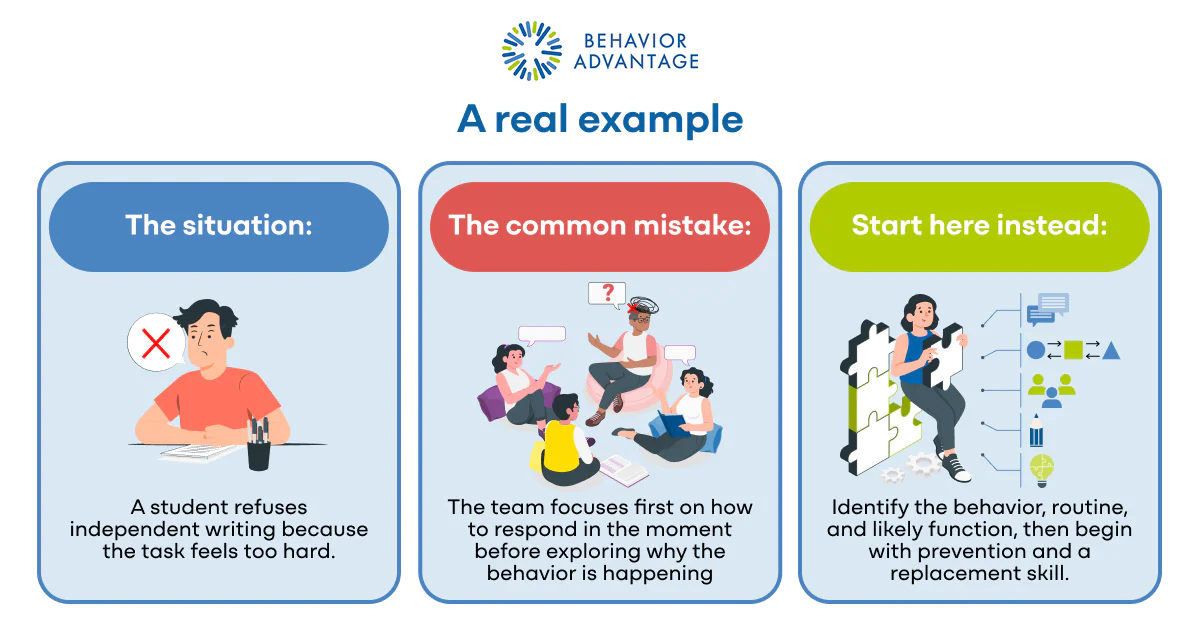
Imagine a fourth grader who hits the brakes every day when writing starts.
The class moves from the mini-lesson into independent work. Pencils come out. Notebooks open. Other students begin writing. This student stares at the page, slides down in the chair, puts their head on the desk, and mutters, “I’m not doing this.” On harder days, the paper gets crumpled, shoved away, or dropped to the floor.
A team could rush straight to response language. What should the teacher say? What happens if the paper gets ripped? What if the student refuses again tomorrow?
Those are fair questions. But they are not the best place to start.
A stronger team conversation sounds more like this:
The target behavior is work refusal during independent writing.
The routine is independent writing after whole-group instruction.
The likely function may be escape from a difficult task.
So the team starts with prevention.
The classroom teacher shortens the first chunk of writing, gives the student a visual model to get started, and checks in quietly before independent work begins. Now the task feels more doable before the student ever hits shutdown mode.
Then the team identifies a replacement skill. Instead of refusing, crumpling the paper, or shutting down, the student will be taught to ask for help or request a short break appropriately. That skill may be explicitly taught by resource teachers, special education teachers, clinicians, school psychologists, counselors, or other support staff, then prompted and reinforced by the classroom teacher in the actual routine.
Then the team pauses.
If the prevention strategy and replacement skill are both realistic and aligned, that may be enough to begin. The team may not need a longer, heavier plan yet. They can implement, collect simple data, and watch what changes.
That is what makes a BIP more usable. It matches support to the actual problem instead of assuming more paperwork will create better outcomes.
Response Still Matters
Teams need a clear response plan, especially when behavior can escalate quickly or involve safety concerns.
But response planning works better when it is built on top of a clear understanding of the behavior, the function, the prevention supports, and the replacement skill. It should not be the first or only part of the plan.
A useful response plan helps staff stay consistent. It helps them notice early signs, respond in a way that supports de-escalation, and avoid reactive patterns that accidentally reinforce the behavior.
And again, this is a place to pause and be thoughtful. Not every team needs to build out a highly detailed response sequence right away. But when a student’s behavior is escalating, creating safety concerns, or involving multiple adults in inconsistent responses, that added clarity becomes important.
The point is not to skip response planning. The point is to build it when it is needed, and to build it on a stronger foundation.
Keep Data Simple
Behavior change can be gradual. To know whether a plan is working, the team needs data.
That does not mean the data system needs to be complicated. In fact, simple data routines are often more effective because staff can actually sustain them.
The best data question is usually not, what could we track?
It’s, what can we track consistently enough to help us make a decision?
That might be a simple behavior tracking form. It might be a brief daily rating scale. It might be Check-In Check-Out sheets that give the team a quick picture of how the student is doing across the day. The point is not to build the perfect system. The point is to build one that staff will actually use.
And once the plan has been in place for a few weeks, the team should pause again.
What is the data showing? What are staff noticing? Is the student responding to the supports? Does the function still seem accurate? Is it time to continue, adjust, simplify, or fade?
That final pause is just as important as the first one. It keeps the team responsive instead of reactive.
Make Roles Obvious
Even a strong plan can fall apart if nobody is clear on who is doing what.
That is why role clarity matters so much.
When teams know who is leading implementation, supporting classroom prevention, teaching the replacement skill, collecting data, and reviewing progress, the plan becomes more than a document. It becomes a shared process.
That is often where momentum starts. Not with a perfect plan, but with a clear one.
And when teams need help turning the plan into day-to-day action, an Implementation Checklist can be the bridge between a well-written BIP and a plan people actually follow.
What Turns a BIP into a Usable Plan
School teams do not need more complexity. They need plans that are focused enough to implement, practical enough to sustain, and flexible enough to adjust as the team learns what the student actually needs.
In practice, that usually means:
- starting smaller
- getting clear on the function
- leading with prevention
- teaching a replacement skill
- pausing before adding more
- keeping data simple
- making roles obvious
If your team is looking for a simpler, more practical way to build behavior support plans, explore Behavior Advantage to see how the platform can support your team.