


Teachers play a central role in supporting students’ academic and social learning every day. At the same time, some of the most impactful work for students who need additional support happens outside the classroom, during counseling sessions, social skills groups, and one-on-one conversations focused on social-emotional growth and mental health.
Counselors, social workers, school psychologists, and mental health clinicians do exceptional work helping students build insight, coping skills, emotional regulation, and trust with adults.
Yet many teams quietly recognize a familiar challenge when it comes to SEL and mental health.
What works in a counseling session doesn’t always show up in the classroom.
Not because the therapy wasn’t effective, but because there isn’t always a clear plan for generalization. In school settings, generalization refers to a student’s ability to apply skills learned in counseling or intervention sessions in everyday classroom routines, especially during moments of stress or transition. When this transfer isn’t explicitly planned, students may know the skill but struggle to use it outside the therapeutic setting.
This is the gap behavior plans are uniquely suited to fill.
Behavior Plans as a Generalization Playbook
Behavior plans are often seen as the responsibility of teachers, administrators, or behavior specialists. Many mental health professionals don’t view them as part of their craft, and understandably so. Their work centers on relationship, insight, and therapeutic change.
But behavior plans aren’t meant to replace therapy.
They are meant to extend it.
A well-designed behavior plan translates therapeutic insight into clear, actionable guidance for the adults who interact with a student all day long. It answers a critical question.
What should adults do, consistently and intentionally, to help these skills show up across settings?
When counselors and clinicians contribute to behavior plans, effective strategies stop living in one room and start traveling with the student.
If you want to learn more about what makes a BIP effective, read our comprehensive guide.
Moving Beyond the “Firefighter” Model
In many schools, clinicians are most visible during moments of crisis.
A student escalates.
A classroom destabilizes.Safety is at risk.
Clinicians are called in, and they’re often excellent at de-escalation.
But when clinicians are primarily used in reactive moments, we unintentionally reinforce a firefighter model. Put out the fire, then wait for the next one.
What’s often missing is “fireproofing,” the proactive work of identifying prevention strategies and teaching replacement skills before escalation occurs.
The very skills that make clinicians effective during crises, calm presence, relational attunement, precise language, are the same skills that can prevent escalation when applied earlier and more intentionally.
Behavior plans create space for that shift.
Where Clinicians Add Unique Value
Building Relationships
Counselors and therapists are often the strongest relationship builders in the building, especially for students who struggle to trust adults. They naturally learn what motivates a student, how to engage them, and what helps them feel safe.
When those insights are captured in a behavior plan, they no longer live with one person or in one setting. They become shared, actionable strategies that guide teachers and staff to build quality connections with a student throughout the day, including:
- How to start conversations
- Topics that spark engagement
- Tone, pacing, and approach that work
- Ways to connect during daily routines
Relationship building moves from a vague goal to a teachable strategy.
Teaching SEL and Coping Skills
Counseling sessions are often where teams discover how a student best learns to practice coping, self-regulation, persistence, or emotional control. Maybe it was visual supports, rehearsal, goal-linking, or a specific motivational approach that made the difference.
Behavior plans allow those discoveries to be translated into:
- How replacement behaviors are taught
- How skills are practiced and reinforced
- What prompts and supports work best
This makes it far more likely those skills generalize beyond the counseling room.
Want to find out more about SEL goals – check out our article dedicated to this topic.
Trauma-Informed Guidance
Mental health professionals often recognize triggers others miss. Tone of voice, proximity, body language, or power dynamics that escalate a student.
Behavior plans are a natural place to clarify:
- What to do
- What to avoid
- How to approach moments of stress safely
This protects relationships, reduces unintentional harm, and increases consistency.
Clinicians as Contributors and Coaches
When clinicians help develop behavior plans and step into classrooms to model strategies, something powerful happens.
They become not just crisis responders, but behavior coaches.
They support teams in implementing prevention strategies, relationship building, skills instruction and consistent adult responses among other things.
Behavior plans capture this guidance so it doesn’t depend on one person being present in the moment. The plan becomes a shared playbook the team can carry forward together.
A Team-Based, Preventive Approach
Behavior plans don’t need to begin with a crisis.
They can exist on a continuum, from simple plans focused on trust and connection to more comprehensive plans addressing skill building, de-escalation, and safety.
When counselors, educators, administrators, and support staff collaborate around a shared plan:
- Intervention moves upstream
- Teaching replaces reacting
- Consistency replaces guesswork
- Ownership is shared across the team
What’s Next: Turning Insight Into Action
Closing the generalization gap doesn’t require starting from scratch. It often starts with more intentional coordination around students you are already supporting.
Start with one student.
If a student is participating in counseling or therapy but continues to struggle with behavior throughout the school day, bring the therapist and classroom teacher together. Ensure the teacher understands the specific skills being taught in therapy, and discuss when and how those skills could be practiced, prompted, and reinforced during classroom routines.
Use behavior plans as the bridge.
If the student has a Behavior Intervention Plan, or the team is developing one, make sure the clinician is actively involved. Clinicians are well positioned to help identify replacement behaviors, coping strategies, and other essential SEL skills that align with the function of the student’s current challenges. Capturing these skills in a behavior plan helps translate therapeutic work into consistent classroom support.
Create clear classroom action steps.
SEL and coping skills may be introduced in therapy, but for meaningful and lasting outcomes, teachers need clear guidance. Identify how skills will be taught, what prompts or cues staff should use, and how progress will be observed or tracked during the school day. Clarity reduces guesswork and increases consistency.
Think practice, not perfection.
Generalization happens through repeated, supported practice. Small, consistent opportunities to use skills in real classroom moments are far more impactful than expecting students to independently transfer skills under stress.
When teams align therapeutic insight with classroom action, behavior plans become more than documents. They become tools that help skills learned in supportive settings show up where students need them most.
Ready to Put This Into Practice?
Closing the generalization gap doesn’t require more meetings or more paperwork. It requires clearer translation between therapeutic insight and classroom action.
To support that work, we created a practical, counselor-friendly resource designed to help clinicians turn what’s working in counseling into consistent, teachable strategies across the school day.
From Counseling to Classroom: A Practical Guide for Making SEL and Mental Health Skills Stick
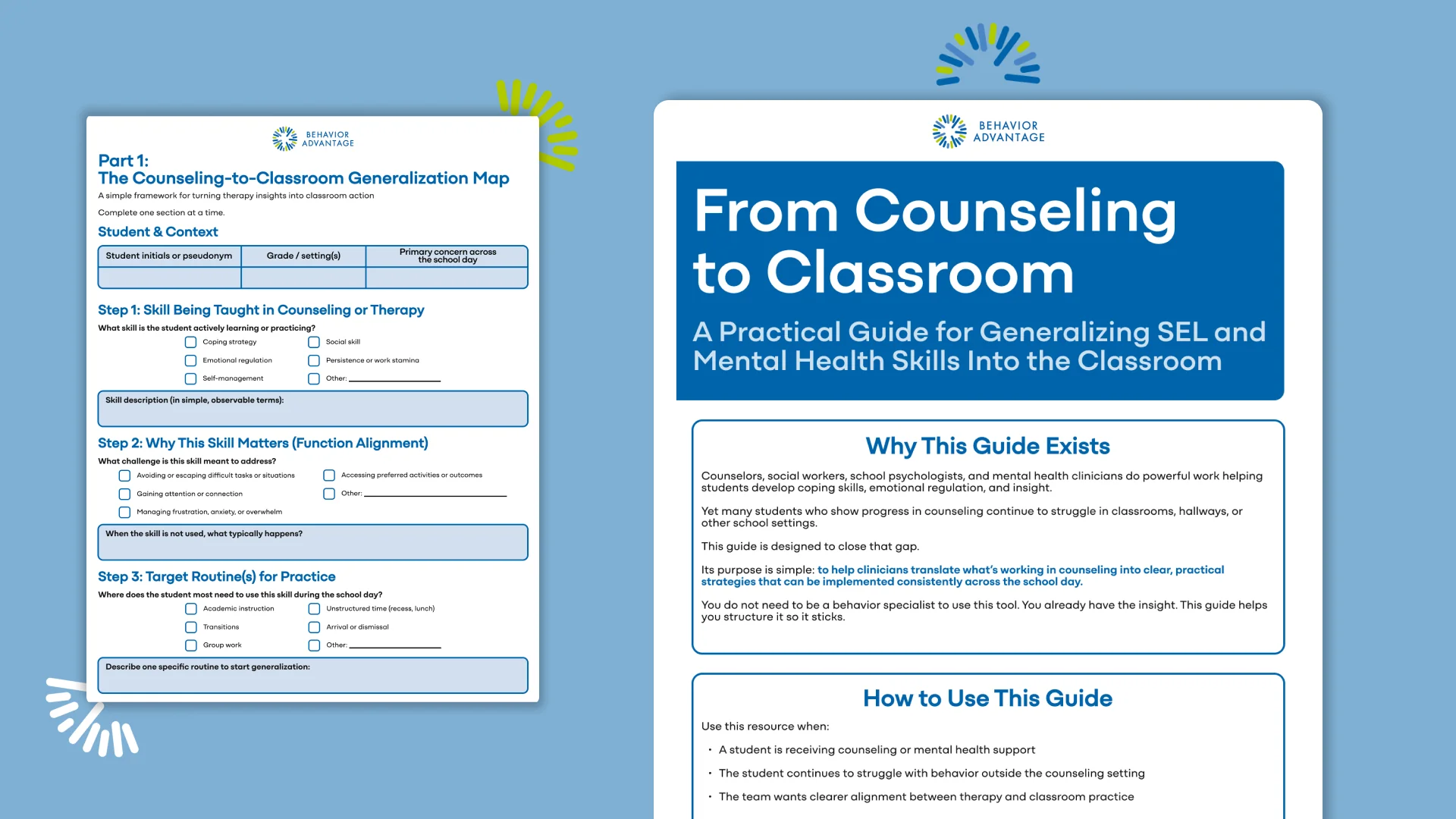
Inside, you’ll find:
- A simple tool to map therapy skills to classroom routines
- A checklist for embedding SEL and coping skills into behavior plans
- A sample case example showing how counseling insights show up in a plan
- Coaching prompts to help teams implement prevention and teaching strategies, not just crisis response
This resource is designed for counselors, social workers, school psychologists, and mental health clinicians who want their work to generalize beyond the counseling office and into the places students need it most.
Closing Thought
Mental health professionals already have the skills schools need.
Behavior plans give those skills structure, so they can be taught, coached, implemented, and sustained across settings.
When clinicians are invited to shape prevention and teaching, not just crisis response, behavior plans stop being reactive documents and start becoming tools for lasting change.
They don’t replace therapy.
They help it stick.
Reach out to learn more about how Behavior Advantage can help your team achieve its gooals.