


Family engagement can be the difference between a plan that looks good on paper and a plan that actually works in practice. In MTSS, that success depends on alignment between school and home, not just well-written plans. When families understand the system, trust the process, and feel included in decision-making, teams can move faster and more effectively. Supports are implemented more consistently, communication improves, and students benefit from adults working together instead of in parallel.
It’s one of the most important parts of MTSS, and one of the easiest parts to oversimplify when teams are stretched thin.
In many schools, family engagement often gets narrowed to open house attendance, newsletters, or signed forms. Not because teams don’t care, but because staff are balancing so many competing demands. Those efforts can still play an important role, but they don’t fully reflect what family engagement looks like in an MTSS framework. In MTSS, family engagement is not an extra task to squeeze in when there’s time. It is part of how schools build consistency, strengthen support plans, and make better decisions for students.
The goal is not to make every family engage in the same way. The goal is to build a system that makes engagement more accessible, more meaningful, and more useful.
The Building Blocks of Strong Family Engagement
Before getting into specific strategies, it helps to define what strong family engagement looks like in MTSS. These building blocks can guide decisions at the classroom, school, and district level.
-
Make Communication Two-Way
Families need more than updates. They need space to ask questions, share what they’re seeing at home, and help teams understand what is (and is not) working outside of school. Even small opportunities for response can shift communication from “informing” to partnering.
-
Include Families Early in Decision-Making
Families are much more likely to engage when they are included early – especially when supports are being selected, adjusted, or reviewed. If their input only comes after the plan is already set, engagement can feel performative rather than meaningful.
-
Use Culturally and Linguistically Responsive Practices
Family engagement is stronger when communication is understandable, respectful, and accessible. That includes language access, but it also includes tone, examples, timing, and awareness of family experiences with schools and systems.
-
Provide Tiered Pathways for Engagement
Just like student support, family engagement in MTSS works better when schools offer multiple levels and pathways of support. Some families may respond to a quick weekly text. Others may need a phone call, translated materials, or a more individualized check-in. The goal is not to “tier families,” but to tier the school’s engagement supports.
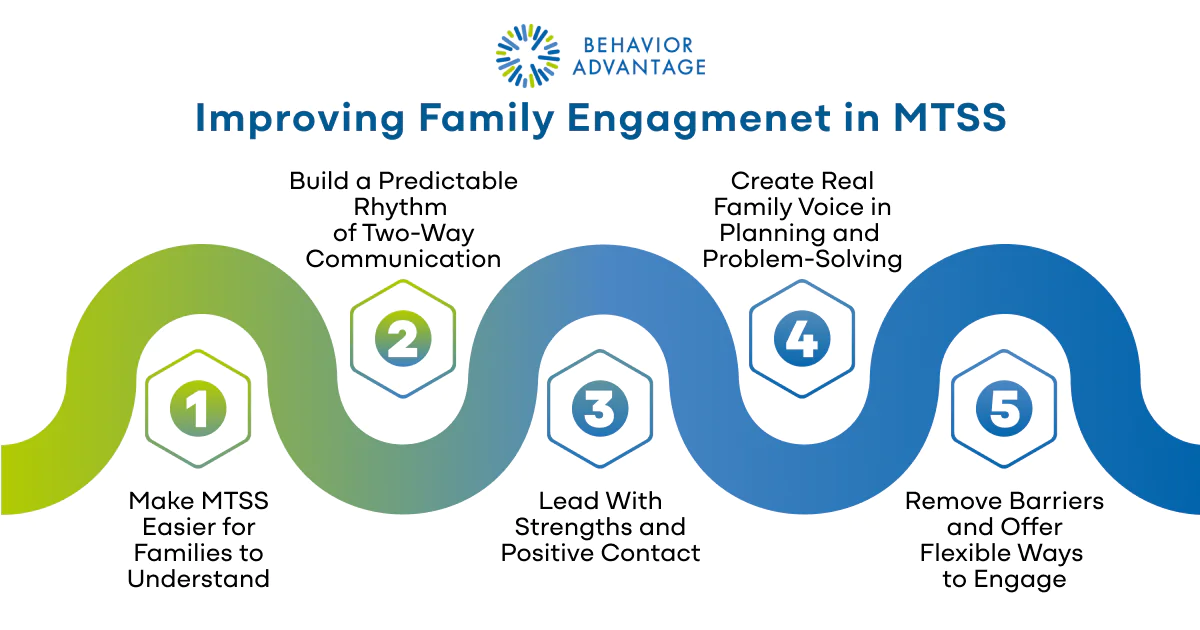
These building blocks create the foundation. Now let’s look at what it can look like in practice. The five strategies below are designed to help teams strengthen family engagement in realistic, sustainable ways without adding unnecessary complexity.
1) Make MTSS Easier for Families to Understand
One of the biggest barriers to family engagement is not resistance; it’s confusion.
MTSS language can feel unfamiliar or overly technical. Terms like intervention, progress monitoring, Tier 2 support, fidelity, and data review are common in school teams, but not always clear to families. When communication is full of system language and short on explanation, families may disengage simply because they are not sure what is happening or what their role is.
That is why one of the most effective strategies is also one of the simplest: explain the system in plain language.
Families do not need a graduate-level overview. They need clear answers to practical questions, such as:
- What is MTSS?
- How do schools decide when extra support is needed?
- What data is reviewed?
- What happens if a strategy is working?
- What happens if it isn’t?
- How can families be involved?
This can be done through a short family-facing handout, a one-page visual, a short video, or a simple explanation during meetings. The format matters less than the clarity.
When families understand how the system works, they are more likely to participate in decisions, respond to updates, and stay engaged over time. Clarity builds confidence, and confidence makes partnership easier.
2) Build a Predictable Rhythm of Two-Way Communication
If communication only happens when there is a problem, family engagement in MTSS will always feel harder than it needs to be.
In busy school settings, outreach can become reactive. Teams reach out when behavior escalates, a concern grows, or a meeting is needed. Those conversations are important, but when they are the only communication families receive, it can create a pattern where contact from school feels stressful or negative.
A more sustainable approach is to create a predictable communication rhythm that includes both updates and opportunities for family input.
This does not have to be complicated. In fact, consistency matters more than length. A short, repeatable format often works best:
- what the team is seeing
- what skill or support is being targeted
- what is improving
- what the team is trying next
- one question for family input
That last piece is what turns communication into partnership.
For example, instead of sending only a status update, teams might ask:
- “What are you noticing at home during transitions?”
- “Does this strategy feel realistic for your family?”
- “Have you noticed anything that helps when your child gets frustrated?”
These questions communicate respect. They also improve decision-making by giving teams more complete information.
Predictable communication builds trust over time. Families know what to expect, staff have a structure to follow, and problem-solving becomes more collaborative instead of last-minute.
A simple tool can help make this easier. For students receiving Tier 2 supports, CICO sheets can also serve as a quick communication bridge between school and home, not just a tracking form.
3) Lead With Strengths and Positive Contact
One of the fastest ways to improve family engagement in MTSS is to change the starting point of communication.
When families mostly hear from school about concerns, corrections, or problems, it becomes harder to build trust. Even necessary conversations can feel tense when there is no relationship foundation underneath them.
That is why positive contact matters so much.
This is not about generic praise or “feel-good” messaging. It is about sharing specific, meaningful observations that help families see progress, effort, and growth. For example, a staff member might reach out to share that a student:
- used a replacement skill during a frustrating moment
- recovered more quickly after redirection
- stayed engaged during a routine that has been difficult
- had a strong peer interaction
- asked for help appropriately
This kind of outreach does three important things. First, it shows families that the team sees the whole child, not just the challenge. Second, it creates trust that makes later problem-solving conversations more productive. Third, it models positive family feedback to the student, giving families specific language to recognize effort and growth, which can be a powerful boost for student modification and positive behavior at school.
For schools, the key is making positive contact a system, not just a nice idea. If it depends only on memory or good intentions, it will be inconsistent. A simple tracker, rotating outreach goal, or team reminder can make a big difference.
Positive communication doesn’t replace hard conversations. It helps you have them with more trust and clarity.
4) Create Real Family Voice in Planning and Problem-Solving
Family engagement in MTSS becomes much more meaningful when families are part of the planning process, not just updated after decisions are made.
This is especially important in MTSS because families often have information the school team does not. They may notice patterns that happen before school, after school, during transitions, or around routines that affect the student’s day. They may know which language helps regulate, what tends to escalate stress, or what supports are realistic at home.
Without that insight, teams can end up building plans that look solid on paper but are harder to implement consistently across settings.
Creating real family voice starts with structure. Instead of broad questions like “Do you have any concerns?” try more specific prompts that invite useful input:
- “What tends to help your child calm down when they’re frustrated?”
- “Are there times of day that are usually more difficult?”
- “What language works best when your child is upset?”
- “What feels realistic for home routines right now?”
It also helps to close the loop. Families are more likely to stay engaged when they can see how their input shaped the plan. A quick summary such as, “Based on what you shared, we’re going to…” makes family voice visible and reinforces that their role matters.
At the school level, this can be strengthened even further through family representation in MTSS/PBIS planning conversations, feedback groups, or improvement efforts. Even small changes in how teams invite, use, and respond to family input can make partnership feel more authentic and make plans more workable across settings.
If your team is working on making planning conversations more collaborative, a structured planning tool can help. Our Behavior Plan Starter Kit can make it easier to capture family input, clarify team decisions, and keep the conversation focused on what is workable across settings.
5) Remove Barriers and Offer Flexible Ways to Engage
Sometimes the issue is not whether families care. It is whether the school’s engagement process is workable.
Many families are navigating work schedules, transportation needs, childcare, technology issues, language barriers, or past experiences that make school interactions feel difficult. When schools offer only one way to participate, engagement naturally drops, even among families who want to be involved.
That is why flexibility is such an important MTSS family engagement strategy.
Flexible engagement does not mean lowering expectations. It means making partnership more accessible and realistic. Schools can support this by offering options like:
- text, phone, email, paper notes, or app-based communication
- virtual or in-person meetings
- shorter check-ins instead of only full meetings
- flexible meeting times when possible
- translated materials and interpretation support
- written summaries for families who cannot attend live
A simple but powerful practice is to ask families directly what works best for them:
- “What is the best way to reach you?”
- “What times are usually easiest?”
- “Would you prefer a call, text, or meeting?”
- “Would a quick written summary be helpful?”
Those questions signal respect, and they often improve follow-through right away.
When schools widen the path to engagement, more families can participate in ways that fit their reality, and teams get better information to support students well.
Of course, even with strong strategies in place, family engagement can still break down when teams fall into a few common patterns, especially under time pressure.
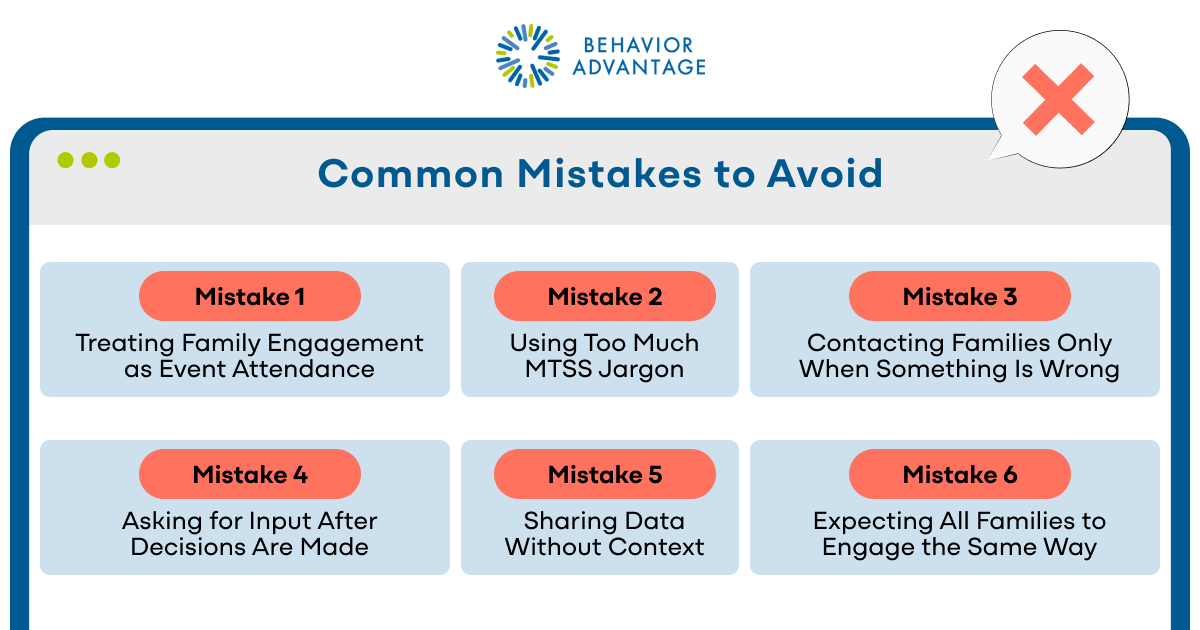
Common Mistakes to Avoid
Even strong teams with good intentions can fall into habits that weaken family engagement. The good news is that most of these are fixable once they are visible.
Mistake 1: Treating Family Engagement as Event Attendance
Open houses, family nights, and school events can be great, but they are only one part of engagement. A family who cannot attend an evening event may still be highly engaged through phone calls, texts, home routines, or meeting participation. If we only measure attendance, we miss a lot of meaningful partnership.
Mistake 2: Using Too Much MTSS Jargon
Families should not need a glossary to understand what support their child is receiving. Technical language can create distance quickly. Clear, plain-language communication helps families feel included and confident enough to engage.
Mistake 3: Contacting Families Only When Something Is Wrong
When communication is mostly corrective, trust stays fragile. Positive outreach and routine updates create the relationship foundation that makes problem-solving conversations easier and more productive.
Mistake 4: Asking for Input After Decisions Are Made
Families can usually tell when input is being collected just to “check a box.” If you want real partnership, invite family voice early enough for it to actually shape the plan.
Mistake 5: Expecting All Families to Engage the Same Way
Some families are quick to respond to text. Others prefer phone calls or in-person conversations. A one-size-fits-all approach limits engagement and can unintentionally exclude families who would participate with a different option.
Mistake 6: Sharing Data Without Context
A graph by itself does not create engagement. Families need support understanding what the data means, what trend the team sees, and what decision or adjustment comes next.
Avoiding these common pitfalls does not require a complete reset. In most cases, small shifts in communication, timing, and structure can make family engagement feel more effective and more manageable for everyone involved.
What Stronger Family Engagement Makes Possible
Family engagement in MTSS is not about adding one more thing to an already full plate. It is about improving how schools communicate, collaborate, and make decisions with families so support plans are stronger and more sustainable.
When schools make MTSS easier to understand, build predictable two-way communication, lead with strengths, create real family voice, and remove access barriers, family engagement becomes more doable for staff and more meaningful for families.
And that is where MTSS gets stronger: not just in the plan itself, but in the consistency, trust, and collaboration around it.