
Behavior planning is becoming a foundational competency for general education classroom teachers.
That competency means a working understanding of how behavior is supported, taught, and monitored, held in plain language by the teachers closest to students every day. It is not a specialist-only function, and it is not just a niche skill held by a few people in a building.
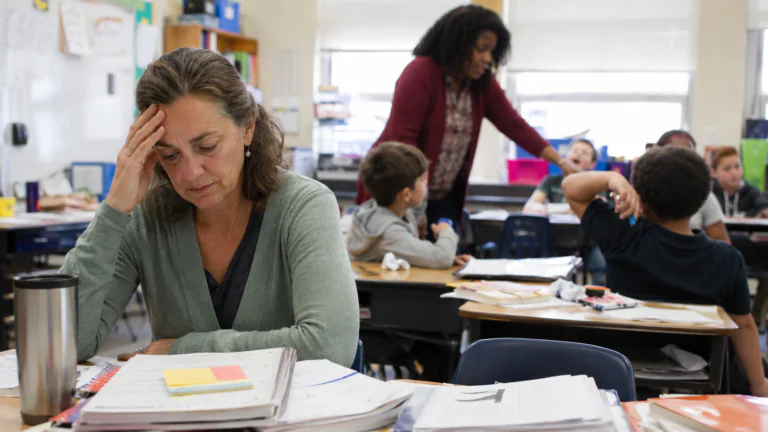
Where that shift hasn’t happened, the gap between specialists who write behavior plans and general education teachers who carry them out is one of the most common reasons school behavior systems struggle. Plans drift. Implementation gets uneven. Referrals climb. Teachers feel asked to deliver something they were never fully brought into.
For administrators, this gap usually shows up first in the data. More referrals. More repeat incidents. More students moving toward intensive supports without the lighter, earlier supports doing the work they should. Behind those numbers is a quieter pattern: general education teachers were never given a shared framework for thinking about behavior, so the system leans on specialists to do work that should belong to the whole building.
This piece is a plain-language guide to that shared framework. It will not turn anyone into a behavior specialist. It will give general education teachers, and the leaders who support them, a working foundation that makes every classroom stronger and every referral better informed.
1. Why behavior planning belongs in general education
General education teachers spend more direct time with students than any other adult in a school. They see the routines where behavior tends to break down. They know what helps a particular student get started. They notice when something has shifted, often before anyone else does.
That proximity matters. In most schools, the general education classroom is the primary delivery system for behavior support. Whether or not anyone has called it that, every general education teacher is doing some version of behavior planning every day by adjusting the routine, prompting expectations, reinforcing the behaviors they want to see more of, and redirecting the ones they don’t.
The question is not whether it is happening. It is whether it is happening with a shared system.
When teachers do not have that system or framework, two things tend to follow. Planning becomes the property of specialists, which makes it feel separate from instruction. And when a plan is eventually written, the teacher most responsible for carrying it out has not been part of building it. Both patterns weaken implementation and put more pressure on Tier 3 supports to solve problems that could have been addressed earlier.
Strong classroom behavior support starts with a teacher who has the language and the tools to think about behavior the same way they think about reading or math instruction.
2. What behavior planning actually is
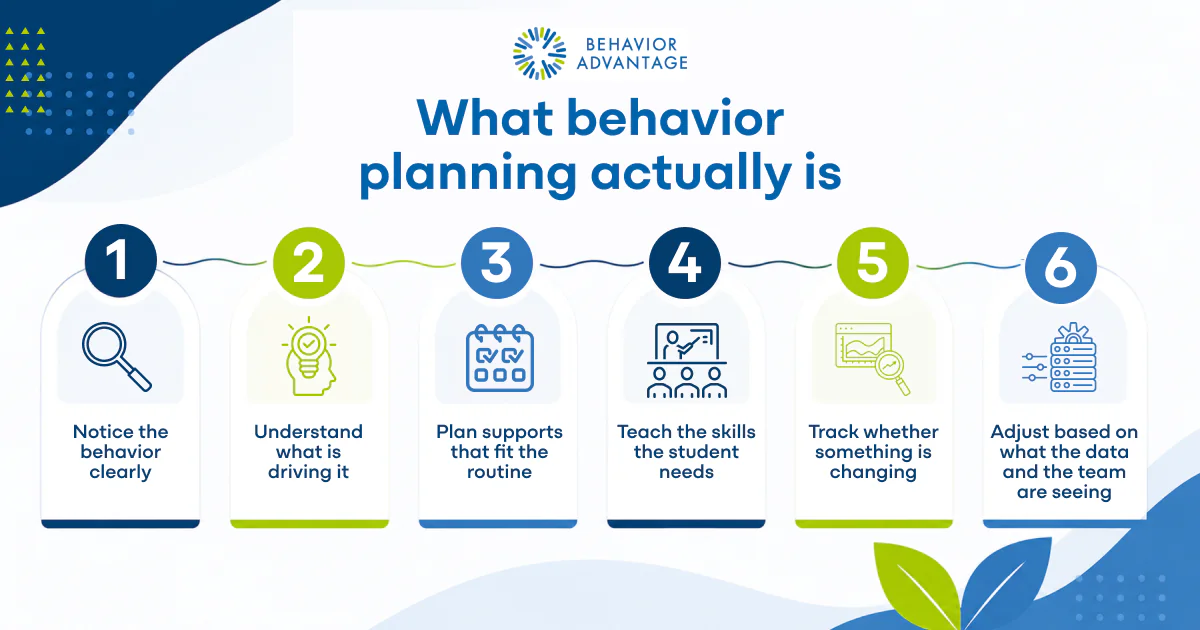
Behavior planning is not a form. It is not a meeting. It is a process for understanding, supporting, and changing student behavior over time.
The basic loop looks like this:
- Notice the behavior clearly
- Understand what is driving it
- Plan supports that fit the routine
- Teach the skills the student needs
- Track whether something is changing
- Adjust based on what the data and the team are seeing
That loop scales. The same logic applies to a teacher rethinking how she runs the morning meeting, a school team developing a Tier 2 check-in for a small group, and a behavior specialist building a formal Behavior Intervention Plan for a student with significant needs. The depth changes. The framework does not.
The reason this matters for general education teachers is that most behavior never needs to climb the tier ladder if the early steps of that loop are done well. Behavior intervention plan basics are not just for specialists. They are the same principles a teacher can use to make a Tuesday afternoon writing block work better.
3. The most useful concept a teacher can understand: function
If a general education teacher learns one thing about behavior, it should be this: behavior is communication. Every behavior is the student trying to get something or get away from something.
This is what behavior science calls function, or the underlying need being communicated through the behavior. It is the single most useful idea in classroom behavior support.
For day-to-day classroom thinking, two patterns capture most of what teachers see:
- Avoidance. The student is trying to get away from something. That might be a task, a transition, a correction, a social situation, or an uncomfortable internal state like overwhelm or frustration.
- Access. The student is trying to get something. That might be attention from an adult or a peer, a preferred item or activity, or a specific outcome the student wants.
Two students can show identical-looking behavior for very different reasons. One student may put their head down because the work feels impossible. Another may put their head down because the room feels too loud. The behavior looks the same. The support that helps each student does not.
Teachers who think functionally are also less likely to default to consequences that accidentally reinforce the behavior. Sending a student into the hall to take a break may calm the room, but if the student was trying to escape a difficult task, the response just confirmed that the behavior works.
A teacher does not need to conduct a formal Functional Behavior Assessment to think functionally. They need a habit of asking, what is this student trying to get or get away from? Asking that question, or thinking functionally, reframes almost every behavior situation that comes up in a classroom.
4. The three-part structure of behavior support
Once a teacher has a working sense of function, the next foundation is the way behavior support is organized. The simplest framework, and the one most useful for general education classrooms, has three parts.
Prevent. Most classroom behavior strategies live here. Pre-corrections before a hard transition. Predictable routines. Visual supports. Structured choices. Planned check-ins with a student who tends to struggle in a particular block. The antecedent (what comes right before the behavior) is one of the most powerful tools a teacher has, because changing it changes the conditions the student is responding to in the first place.
Teach. The replacement behavior (what the team wants the student to do instead) has to be taught, not just expected. Telling a student to use coping skills is not the same as teaching them how to ask for a break, signal for help, or pause before responding. Replacement skills need modeling, rehearsal, and reinforcement, and they need to be taught in calm moments so the student has the skill ready when the hard moments come. The skill also has to fit the moment where the old behavior usually shows up and help the student meet the underlying need behind it.
Respond. When behavior happens, what do adults do? A consistent, calm response keeps the situation from escalating and keeps the team aligned. Response matters. But it should not be the center of the plan. Built on top of strong prevention and teaching, response becomes one piece of a larger system. Built without them, response often becomes the whole system, and that is when behavior planning starts to feel reactive, unproductive, and overly punitive.
The order matters. Lead with prevention. Build response on top of a strong foundation. Do not start with consequences.
5. Where this lives in MTSS and why general education anchors it
Most schools already use a multi-tiered framework to organize student support. The same logic applies to behavior. Tier 1 is universal: the routines, expectations, and classroom practices that benefit every student. Tier 2 is targeted: small-group supports for students who need more. Tier 3 is intensive: individualized plans for students with the most significant needs.
The vast majority of student behavior is supported at Tier 1 and Tier 2. That means general education teachers are the primary delivery system for most behavior support that happens in a school.
That has a practical implication. When a teacher is asking for help with one student, the most useful first move is sometimes not a referral. It is to look at the routine that a student is struggling in and ask whether the routine itself is set up to help every student succeed. Strengthening the classroom environment around a struggling student often gives the team better information about what level of support that student actually needs.
This is the argument behind When One Student Isn’t the Whole Story: Using a Classroom Support Plan Before Jumping Straight to Tier 3. When a referred student is struggling, several other students in the same routine are often drifting too. The sharper response is rarely a longer plan for one student. It is a focused, time-limited support for the routine where behavior keeps breaking down.
The structure is simple – one expectation, one routine, one or two evidence-based strategies, a short window to monitor – and it gives general education teachers a Tier 1 and Tier 2 tool they can use without waiting for a specialist to arrive.
6. Simple data, used well
Behavior planning includes data, but data does not always have to mean clipboards and spreadsheets.
Most general education teachers already track behavior informally. They notice trends. They remember which days went sideways. They can tell a colleague which routine is hardest. The shift behavior planning asks for is to make a small piece of that noticing more deliberate, so the team can tell whether a support is actually working.
A simple daily rating can be enough. A check-in card. A tally for one specific behavior in one specific block. The goal is sustainability, not precision. Data a teacher cannot keep up with is data the team will not use.
What the data is tracking matters more than how complex the system is. A useful tracking routine usually answers two questions: is the target behavior decreasing, and is the replacement behavior increasing? When the answer to either question is unclear, the team lacks the objective information needed to know whether the support is working, and progress monitoring will need to be sharpened before the next decision.
This is also one of the most common places general education teachers get left out. Specialists might collect or analyze the data, but fail to include the teacher in the process or review of the results. Building the data routine with the teacher from the start keeps the people closest to the student closest to what the data shows.
7. Common pitfalls when teachers do not have a planning foundation
When a general education teacher has not been brought into the behavior planning frame, certain patterns repeat across schools. None of them reflect a lack of effort. All of them reflect a structural gap.
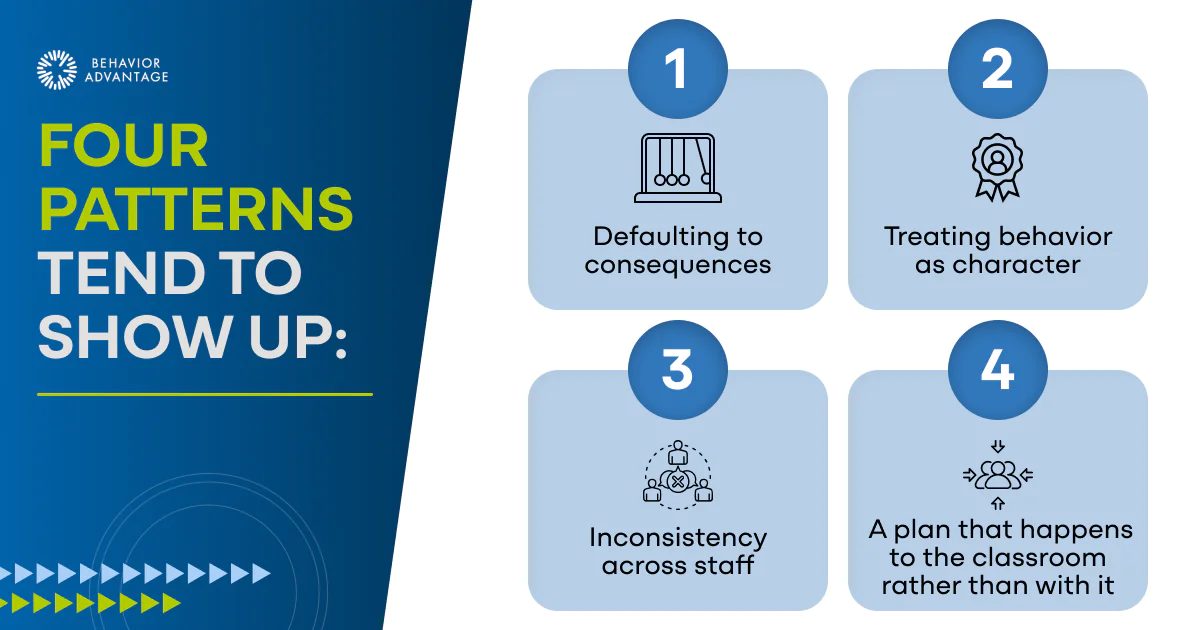
Four patterns tend to show up:
- Defaulting to consequences. Without a functional thinking lens, behavior gets read as a discipline issue rather than a skill-and-context issue. The response becomes whatever stops the challenging behavior, even when it accidentally reinforces the behavior.
- Treating behavior as character. Students get described as defiant, manipulative, or lazy. Those labels make collaboration harder and obscure the question of what skill the student is missing or what condition is creating the challenge.
- Inconsistency across staff. Without a shared system, every adult in the room responds slightly differently. The student learns that the old behavior still works some of the time, which is exactly what keeps the pattern alive.
- A plan that happens to the classroom rather than with it. Especially among teachers, the behavior plan can feel like something handed down rather than co-built. That is not a personality problem. It is what happens when planning lives somewhere other than where implementation lives.
Each of these is fixable, but not by asking individual teachers to try harder. They are fixed by giving teachers the foundation, the tools, and the team-based structure they need to be active participants in behavior planning rather than passive recipients of finished plans.
8. What leaders can do to build this capacity
Building a behavior planning foundation across a building or district is a leadership decision. It does not require new positions or major reform. It requires a few practical moves done consistently.
A shared language. When teachers, specialists, and administrators all use the same words and ask the same questions – what is our plan? How will we follow the plan? How will we know if the plan is working? – collaboration gets faster and plans hold up across staff and settings. The most efficient time to build that shared language is when staff are first onboarded, which is why a practical framework for onboarding school staff in behavior support is one of the highest-leverage moves a leader can make.
A team-based workflow. The most reliable way to bring general education teachers into behavior planning is to design the process so they are part of the build, not the audience for it. The Behavior Plan Starter Kit is built around exactly this idea of a simple, repeatable workflow that keeps the classroom teacher in the room from the first conversation.
Light-touch tools that match the work. When the support a student needs sits at the classroom level, teachers benefit from a tool designed for that level. The Classroom Support Plan is a downloadable template general education teachers can use to document and monitor added supports inside one routine. It captures the four basic decisions – which expectation, which routine, which one or two strategies, what timeframe – and gives the teacher a simple way to track whether the plan is working.
Time and protection. Even the best framework will not survive a school year without protected time for collaboration, brief retraining when needed, and leadership signals that behavior planning is part of the work, not an add-on.
These two tools sit at different points in the support continuum. The Classroom Support Plan empowers the general education teacher to act early, locally, and with intention. The Starter Kit gives the team a shared workflow when the support needs to go deeper. Together, they make general education classrooms the first and strongest layer of behavior support, not the place where breakdowns are surfaced for someone else to fix.
A foundation, not a specialty
Behavior planning is not a side function held by a small group of specialists. In modern schools, it is a foundational competency for general education classrooms, and the schools that treat it that way see stronger implementation, more consistent support across staff, and better outcomes for students.
That foundation does not require turning every teacher into a behavior specialist. It requires shared language, simple tools, and a team-based process that includes the people closest to the student from the start.
Behavior Advantage was built to support exactly this kind of work. The platform brings together the workflow, the resources, and the team-based structure schools need to make behavior planning practical across general education classrooms, not just inside the formal BIP process. If your team is exploring how to build that foundation across a building or district, the Behavior Advantage team would be glad to walk through what it can look like in your setting.