

Picture this.
A team has just wrapped up a BIP meeting for a third grader who has been leaving the classroom multiple times a day. The FBA is done. The function is clear. The plan is written. Everyone around the table agrees it’s solid. The school psychologist feels good about the strategies. The teacher feels heard. The parent signs the document.
And then everyone goes back to their day.
Two weeks later, the student is still leaving the classroom. The teacher is frustrated. The school psychologist is fielding calls. The administrator is being pulled in. And the family is getting daily notes home about behavior, with no idea what changed.
What went wrong? Not the plan. The plan was fine. What went wrong was everything that came after the meeting. The training that didn’t happen. The roles that were never defined. The follow-up that no one owned. The paraeducator was handed a copy of the document on a Monday morning and expected to figure it out.
This is one of the most common – and most preventable – breakdowns in school-based behavior support. Strong BIP implementation isn’t just about writing a good document. It’s about building a team that knows how to carry it out, consistently, across every setting, and over time. As we’ve written about before, the process behind the plan matters just as much as the plan itself. And a big part of that process is knowing who owns what.
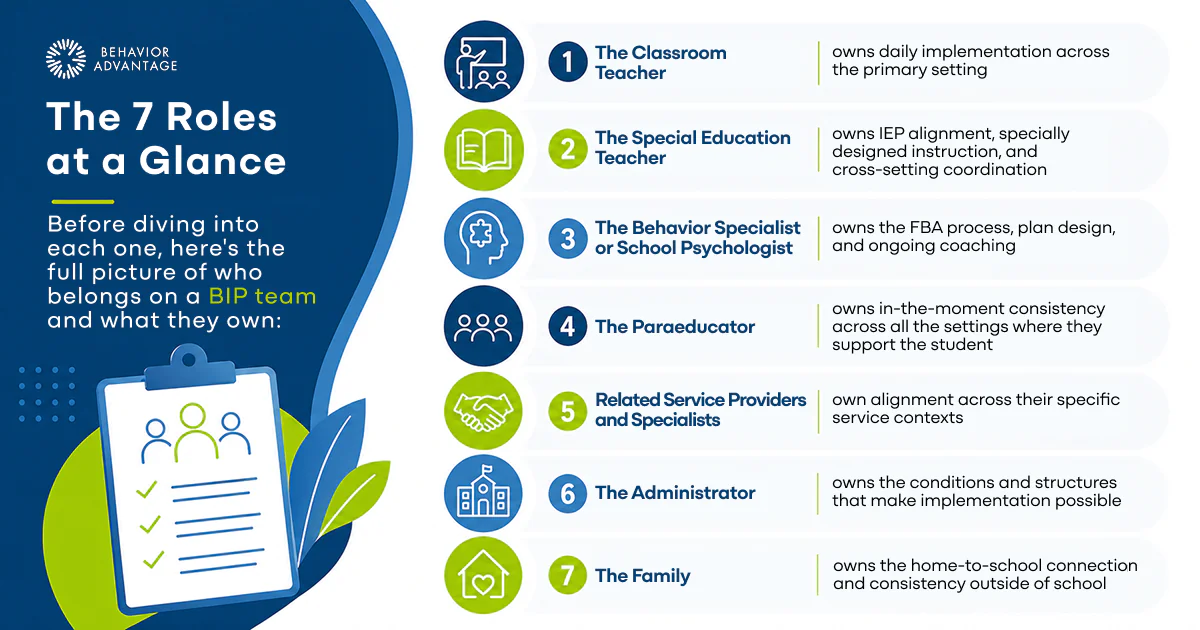
The 7 Roles at a Glance
Before diving into each one, here’s the full picture of who belongs on a BIP team and what they own:
- The Classroom Teacher owns daily implementation across the primary setting
- The Special Education Teacher owns IEP alignment, specially designed instruction, and cross-setting coordination
- The Behavior Specialist or School Psychologist owns the FBA process, plan design, and ongoing coaching
- The Paraeducator owns in-the-moment consistency across all the settings where they support the student
- Related Service Providers and Specialists own alignment across their specific service contexts
- The Administrator owns the conditions and structures that make implementation possible
- The Family owns the home-to-school connection and consistency outside of school
Every school and district looks a little different. Not every team will have all seven roles filled, and some people will wear more than one hat. What matters is that the team has an honest conversation about who is owning what, so nothing falls through the cracks by assumption.
These roles don’t operate independently. They’re most effective when they’re connected, and when each person understands how their piece fits into the larger picture.
Why Role Clarity Matters More Than Most Teams Realize
It’s a pattern many school teams will recognize. The team agrees on the plan. Everyone nods. The document is signed. And then implementation begins with very little structure for who does what.
The classroom teacher assumes the specialist is tracking data. The specialist assumes the teacher is reinforcing the replacement behavior. The administrator approves the plan but never learns whether it’s being carried out. The family receives a copy of the document but no guidance on how to support it at home.
Within a few weeks, the plan starts to drift. This isn’t a failure of effort. It’s a failure of structure.
Think about a student whose BIP targets verbal outbursts during unstructured time. The plan identifies attention as the likely function and outlines prevention strategies: pre-corrections before lunch, a visual schedule for transitions, a morning check-in with a trusted adult. Those strategies make sense. But if the teacher is implementing them but the paraeducator doesn’t know they exist, the student is getting something very different depending on who’s nearby. Inconsistency doesn’t just slow progress. It can actually strengthen the disruptive behavior, because the student learns that the old pattern still works some of the time.
That consistency is what makes behavior support effective. Not the form. Not the language in the document. The team.
Role 1: The Classroom Teacher
The Primary Implementer
The classroom teacher is often the person who knows the student best in the context where behavior is most likely to occur. That puts the teacher at the center of day-to-day implementation.
Consider a fifth grader whose BIP addresses task refusal during independent work. The function is escape. The plan includes pre-corrections before work time, a break request card, and a first-then visual. For those strategies to work, the teacher has to use them consistently, every day, often before the behavior ever starts. The teacher is responsible for:
- Putting prevention strategies in place before the behavior is likely to occur
- Prompting the replacement behavior when appropriate
- Delivering reinforcement consistently and as the plan describes
- Responding to behavior in a way that matches the plan rather than improvising in the moment
- Noticing what’s working and communicating that with the team
A teacher who understands the why behind the plan will implement it with far more consistency than a teacher who was simply told what to do. Effective teams don’t hand the teacher a plan and walk away. They make sure the teacher has been trained, has had a chance to ask questions, and has support to work through barriers as they come up.
Role 2: The Special Education Teacher
The Bridge Between Services and Supports
The special education teacher is often one of the most important connectors on a BIP team, and one of the most underestimated. They know the student across multiple settings, understand how the specially designed instruction (SDI) the student is receiving needs to align with behavioral supports, and are frequently the person other staff turn to when they have questions.
Think about a student receiving both general education and resource room services. The BIP is in place and the classroom teacher is implementing it well. But in the resource room, the student encounters different expectations and routines, and a different adult who may or may not know the plan. The special education teacher is the person positioned to close that gap, making sure both settings are using the same language, the same responses, and sharing data back to the team. Their role typically includes:
- Ensuring behavioral supports are aligned with IEP goals and services
- Coordinating communication across general and special education settings
- Providing specially designed instruction that supports replacement behavior or skill development
- Contributing data that reflects the student’s performance across settings
When the special education teacher is an active, informed member of the BIP team, implementation becomes more coherent across the student’s entire school day.
Role 3: The Behavior Specialist or School Psychologist
The Architect and Coach
If the classroom teacher is the primary implementer, the behavior specialist or school psychologist is the person who builds the framework and keeps it sound.
Go back to that third grader who was leaving the classroom. The school psychologist led the FBA, developed the hypothesis around escape, and helped design a plan with a break request system and modified task demands. That part went well. But what happened next mattered just as much. Did the school psychologist model how to prompt the break card? Did they check in after the first week? Did they help the paraeducator understand her role before the plan went live?
This role is responsible for leading the FBA process, building a plan that is both function-based and realistic, training staff through modeling and practice rather than explanation alone, providing ongoing coaching, and facilitating problem-solving when things aren’t moving in the right direction. Tools like the Simple Functional Behavior Assessment Form can help teams gather observations and build a shared understanding of function before moving into plan development. The behavior specialist’s value is their ability to translate clinical expertise into something a busy teacher can actually use on a Tuesday afternoon when three other things are happening at once.
One more piece worth naming: data. Teachers and paraeducators are often the ones collecting it, and that makes sense. But someone needs to own what happens with it — reviewing it, bringing it back to the team, and using it to drive decisions. That responsibility typically sits with the behavior specialist or school psychologist. When data collection is asked of frontline staff but analysis belongs to no one, progress monitoring stops meaning anything.
Role 4: The Paraeducator
The Closest Adult in the Room
Paraeducators are often the most overlooked member of the BIP team. And one of the most important.
Here’s a scenario that plays out in schools more often than most teams realize. A student has a BIP for elopement. The teacher has been trained. She knows to use calm, neutral language, to offer a movement break before transitions, and to avoid a chase response that might reinforce the behavior. Things are starting to improve. But during afternoon specials, a paraeducator is the adult in the room. She wasn’t at the BIP meeting, received only a hallway summary, and when the student heads for the door, her instinct is to follow quickly and redirect loudly. That one inconsistency is enough to keep the behavior pattern alive.
In many schools, paraeducators spend more direct time with students than any other adult. And yet, they’re regularly excluded from planning meetings or handed a plan with a brief explanation and an expectation that they’ll figure it out. Strong BIP implementation requires that paraeducators be:
- Included in planning conversations or thoroughly briefed before implementation begins
- Trained on the same strategies the teacher is using, with the same level of preparation
- Given a clear picture of their role across every setting where they support the student
- Looped into communication and data collection from the start
Paraeducators bring important observational knowledge. They notice things that don’t always make it into a meeting.Treating them as partners, not just support staff, strengthens the plan and the team. The Behavior Advantage Implementation Checklist can be a useful tool here, helping teams clarify roles, confirm training has happened, and monitor whether strategies are being carried out consistently across all the adults involved.
Role 5: Related Service Providers and Specialists
Aligned, Not Separate
Students with BIPs often receive services from speech-language pathologists, occupational therapists, counselors, social workers, and others. Each provider works with the student in a different context, and each of those contexts is an opportunity for the plan to hold or fall apart.
Counselors deserve a specific mention here. The processing and relationship-building work that happens in a counseling space is genuinely valuable, and it’s often doing things for a student that the classroom simply can’t. The challenge is that what happens in that space doesn’t always travel back to the rest of the team. A student may be developing real coping skills with their counselor, but if the classroom teacher doesn’t know that, those skills don’t get reinforced where they’re needed most. Keeping that insight connected to the broader plan is exactly what the From Counseling to Classroom: A Practical Guide was designed to support.
Strong BIP implementation asks all related service providers to review the plan, align their responses with what the broader team is doing, and communicate when they’re seeing something different in their setting. This doesn’t require anyone to change their service model. It requires a shared understanding of the plan and a commitment to staying connected to it. The free BIP template from Behavior Advantage gives teams a consistent format that’s easy to share across all providers.
Role 6: The Administrator
The Structure Builder
Administrators don’t typically implement behavior plans directly. But they have more influence over implementation quality than almost anyone else on the team, because they shape the conditions where implementation happens.
Here’s what that looks like in practice. A BIP for a student engaging in elopement requires a morning check-in, a specific seating arrangement, and a communication log between the teacher and paraeducator. Within two weeks, check-ins are inconsistent because the teacher has arrival duty. The seating was changed by a substitute and never reset. The communication log was never created because no one clarified whose job it was. Each of those barriers had an administrative solution. An administrator who actively supports behavior planning:
- Creates time for team meetings and review cycles beyond the initial BIP meeting
- Ensures relevant staff are included in training and that coverage is available
- Communicates that behavior support is a priority, not an add-on
- Removes logistical barriers that get in the way of consistent implementation
- Reviews implementation data alongside student outcome data
When leadership is engaged, the message to staff is clear: this matters, and you’re not doing it alone.
Role 7: The Family
The Home-to-School Connection
Families are often described as partners in BIP planning. In practice, they’re sometimes the least informed member of the team. They sign documents but may leave the meeting without fully understanding what the plan involves or what they’re expected to do at home.
Consider a family whose child has a BIP for task refusal. At school, the team uses a first-then structure, offers limited choices, and avoids power struggles when the student shuts down. Progress is slow but real. At home, parents are responding with extended negotiations and sometimes just giving in – not because they’re unsupportive, but because no one explained the function of the behavior or why a consistent approach at home reinforces what the school team is building.
Behavior doesn’t stay inside the school building. Family involvement in BIP implementation might look like using the same language around the target and replacement behavior, reinforcing strategies being built at school, and communicating with the team when they notice changes. For this to work, teams have to do more than share a document. Presenting a behavior plan to a family is its own skill. It requires plain language, genuine space for questions, and an approach that treats families as partners in the process, not just recipients of information. The Behavior Plan Presentation Checklist supports that human-centered approach, helping teams make sure families leave the meeting feeling informed, included, and ready to be part of the plan.
What It Looks Like When All 7 Roles Work Together
Come back to that third grader who kept leaving the classroom. Same student. Same function. Same plan. But this time with all seven roles in place.
The classroom teacher is using the pre-corrections and break request card and understands why. The special education teacher has aligned strategies across the resource room and is sharing data with the team. The school psychologist modeled the plan before implementation and checks in every two weeks. The paraeducator was included in planning and is using the same responses in every setting. The occupational therapist reinforces the break request routine during OT. The principal cleared a scheduling conflict that was making the morning routine harder. The family knows what the break card looks like and sends a quick note to the teacher once a week.
That’s what team-based implementation looks like. Not a perfect plan. A connected team.
BIPs don’t succeed because they’re written correctly. They succeed because a team of adults, with clear roles, shared training, and consistent follow-through, carries them out day after day, across every setting, over time. That’s what makes behavior intervention work. Not the plan on paper. The people who bring it to life.
Strong behavior support starts with a strong team process. If your school or district is ready to build that, get in touch to see how Behavior Advantage can help.