


Teaching is demanding work under the best of circumstances. Teachers are asked to deliver strong instruction, manage transitions, respond to emotional needs, support students with learning differences, communicate with families, and keep a classroom of students moving forward, often all within the same hour.
When behavior is going well, all of that is more manageable. When it is not, even a well-planned lesson can be nearly impossible to deliver.
Most conversations about teacher burnout focus on workload, compensation, and administrative burden. Those are genuine concerns, but there is another driver that gets less attention: student behavior. It is a topic that can feel uncomfortable to name directly, and when it does come up, it is often reframed as a classroom management issue rather than a systems and support problem. But the experience of managing persistent, escalating, or unresponsive behavior without adequate support, clear plans, or consistent follow-through from the team around a teacher is a significant source of strain for many educators.
Research has consistently shown that behavioral challenges are among the top reasons experienced teachers report wanting to leave the profession. Not new teachers. Experienced ones. Teachers with eight, ten, fifteen years in the classroom who mentor others, take on the hardest-to-serve students, and carry knowledge that cannot be replaced with a hiring cycle. When those educators leave, schools lose far more than a staff member.
Why behavior wears teachers down
Burnout connected to student behavior rarely comes from a single dramatic incident. More often, it builds slowly from patterns that go unaddressed for too long.
A student is struggling during a specific routine. The behavior is disruptive, but not severe enough to trigger a formal process. The teacher manages it as best they can, day after day, without a clear plan or consistent support. Over time, the cumulative weight of that reactive cycle, never quite resolving and never quite improving, takes a significant toll.
Many teachers are burning out not because of extreme or severe behavior, but because moderate, persistent behavior is going unaddressed at the classroom level for months at a time. Teams often wait until behavior becomes significant enough to warrant a formal referral before stepping in with structured support. In the meantime, the teacher is left managing the situation alone, without a clear strategy or a way to gauge whether anything is improving.
When the same student continues to struggle through the same routine, and the teacher has no team backing and no plan, confidence erodes. Skilled educators who cannot get traction with a particular student start to question their own effectiveness. That doubt is quieter than a crisis, but it can be just as damaging over time.
The problem with how schools typically respond
Most schools are not ignoring this. Administrators and support staff provide professional development on trauma-informed practices and de-escalation, and work to connect teachers with the school psychologist, behavior specialist, and other resources. These are genuine efforts, and they are not without value.
The difficulty is that they often do not address what teachers actually need in the moment.
Teachers generally do not lack knowledge. What they are missing is a system around them that supports consistent, practical implementation with specific students in specific routines. A two-hour professional development session does not tell a teacher what to do Monday morning when a student begins escalating during independent work. A referral to a specialist helps, but only if the specialist has the time and only if what they recommend can be carried out consistently by every adult who works with that student.
There is also a tendency to wait until a student’s behavior is significant enough to warrant a Tier 3 response before bringing in structured behavior support. By then, the pattern is often well established, the teacher is already worn down, and the intervention requires considerably more effort to implement. Intervening earlier, with simpler and more targeted support, is both more effective for students and more sustainable for teachers.
What earlier support looks like in practice
One of the most underused tools in behavior support is a classroom-level plan focused on a specific routine where behavior is consistently breaking down.
Rather than waiting for a student to be referred for a full Functional Behavior Assessment (FBA) or Behavior Intervention Plan (BIP), a behavior specialist or school psychologist can work directly with a teacher to identify one expectation, one routine, and one or two evidence-based strategies to implement for a few weeks. The goal is not to solve everything at once. It is to bring the temperature down in a specific part of the day, create more predictability for students, and give the teacher something concrete and manageable to implement.
This approach is described in more detail in our post on using a classroom support plan before jumping straight to Tier 3. When behavior specialists work alongside classroom teachers in this way, coaching proactively around a specific routine rather than waiting for a formal referral, teachers feel more supported, students get earlier access to intervention, and the behavior is less likely to escalate into something that requires a more intensive response.
This kind of early, collaborative support also gives teams better information. After a few weeks of focused implementation, the team can reassess: Did the routine improve? Is the student responding to class-wide support, or do they need something more individualized? That is a more informed starting point than waiting until a student is in crisis.
When individual plans are needed, implementation is everything
For students who do need individualized behavior support, the quality of the plan matters, but consistent implementation matters more. Research on implementation fidelity consistently shows that whether a plan is actually used as designed, by everyone who works with a student, is one of the strongest predictors of whether a behavior intervention effectively addresses a student’s needs and results in meaningful behavior change.
In most schools, implementation breaks down not because educators do not care, but because plans are not built for the reality of a busy classroom. A twelve-page document written in clinical language may be thorough, but it is unlikely to be referenced mid-lesson by a teacher managing 25 students. A paraprofessional stepping in for the first time might not interpret detailed technical language without training and support. When a plan is too complex to use consistently, it quietly gets set aside, and the teacher is back to responding reactively.
Without regular check-ins, coaching, or progress monitoring, implementation drifts over time. Staff fall back on what feels natural. The plan lives in a binder while the student continues to struggle and the teacher continues to manage the situation alone.
What sustainable behavior support requires
For behavior support to be sustainable for teachers and for students, a few things need to be in place.
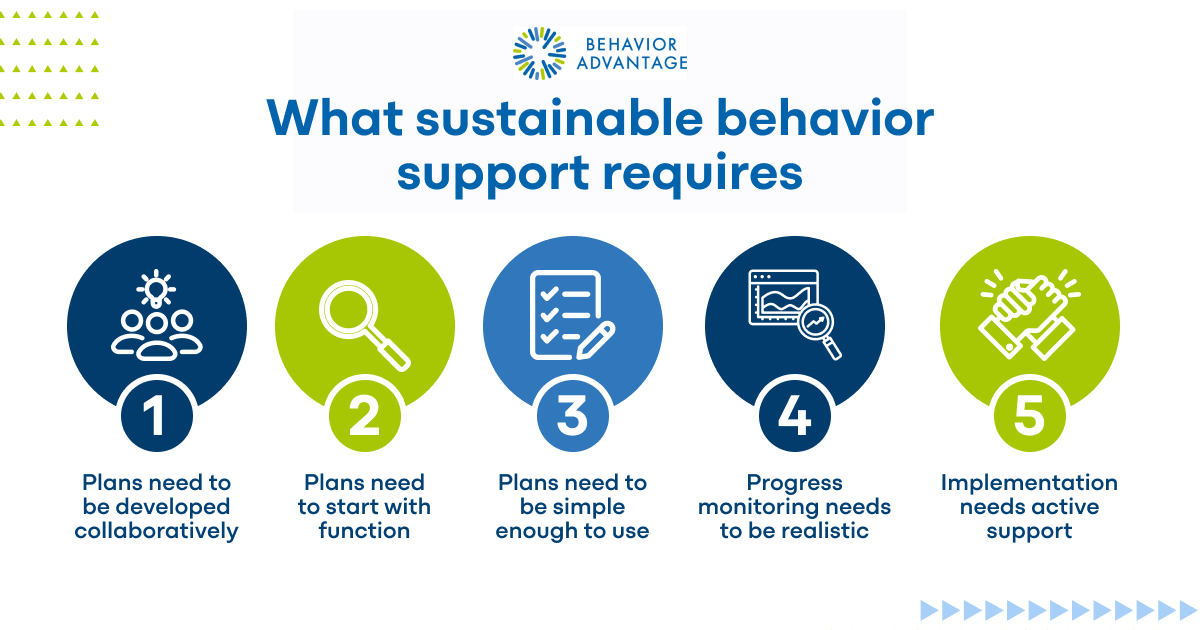
Plans need to be developed collaboratively. A teacher who is overwhelmed and close to the problem often struggles to generate new strategies on their own. They may know their student well, but exhaustion and proximity make it hard to think clearly about what to try differently. At the same time, a plan written solely by a school psychologist or behavior specialist, with teacher feedback incorporated at the end, misses something important. Specialists bring knowledge of evidence-based strategies and behavior principles, but the teacher brings irreplaceable knowledge of the student, the classroom, and the daily context that makes or breaks any plan. Meaningful collaboration means building the plan together from the beginning, not handing it over for review once it has already been written.
Plans need to start with function. Before any strategy is selected, the team should understand why the behavior is happening. A student avoiding a difficult task and a student seeking peer attention may look similar on the surface, but they need very different responses. Skipping that analysis and jumping to interventions is one of the most common reasons plans do not hold. The Simple FBA Form is a practical starting point for teams working through that process. For teams dealing specifically with access-seeking behavior, this blog on managing access behaviors walks through function-based strategies in more depth.
Plans need to be simple enough to use. The goal is a plan that every adult who works with a student can actually follow, not just the specialists who wrote it. The shift toward simpler, stronger behavior intervention plans describes what that looks like and why it leads to better outcomes. A simpler plan implemented consistently by five adults is more effective than a comprehensive one used by one.
Progress monitoring needs to be realistic. Without data, it is difficult to know whether a plan is actually working or whether the team is just riding out the natural variation in student behavior. Behavior change is rarely linear. There will be good days and harder days, but tracked consistently over time, data helps a team see through those fluctuations and identify whether things are genuinely improving. Tracking one clearly defined behavior each day generates more useful information than trying to track six things inconsistently. The question for any team should be: what can every adult on the team realistically observe and record?
Implementation needs active support. Behavior plans do not implement themselves. When roles are unclear and no one is checking in, even well-designed plans drift. Schools that build internal capacity to coach teachers through implementation rather than leaving them to figure it out alone see more consistent results. Growing your own behavior coach describes a practical model for doing this without adding to specialist caseloads.
What changes when support is in place
When teachers have a clear, practical plan and are supported to follow it consistently, something shifts in the day-to-day experience of the classroom.
The teacher is not improvising every incident. The uncertainty that comes from not knowing what to do, or whether anyone else is doing anything, is reduced. Data tells the team whether the plan is working, and the team reviews it together rather than leaving one person to figure it out alone.
Hard days still happen. But when behavior support is practical, collaborative, and consistently followed through, teachers are more likely to feel equipped rather than isolated, and the work becomes more sustainable over time. The difference between an educator who stays and one who quietly moves on is often not about passion or commitment. It is about whether the system around them made the hardest parts of the job feel manageable.
Schools and districts that invest in earlier intervention, simpler plans, and genuine team collaboration are not just improving outcomes for students. They are creating conditions where experienced teachers want to stay, maintaining the valuable relationships, consistency, and expertise that schools depend on.
If your school is navigating increasing behavioral complexity, losing experienced staff, or looking for more sustainable ways to support both students and teachers, we would welcome a conversation.
Behavior Advantage was built to help educational teams make behavior support more practical, consistent, and sustainable so specialists can extend their impact, and every adult in the building can show up for students with clarity and confidence.
Schedule a conversation to learn more.