


A function-based, proactive approach to reducing disruption by teaching what to do instead.
Disruptive behavior in students is often doing an important job: communicating a need. When a student doesn’t yet have the words, or the tolerance, to ask, wait, or handle “not yet,” they may use louder, faster behaviors to get what they’re trying to access. In school settings, this commonly shows up as access behavior: problem behavior that helps a student get an item, activity, attention, or a preferred routine.
The good news is we don’t have to guess or rely on trial-and-error. When we treat behavior as communication and respond with function-based, evidence-informed behavior intervention strategies, we can reduce disruptions while teaching skills that stick.
In this article, you’ll find clear steps and practical behavior intervention strategies that teams can use right away: how to name and define behaviors, teach replacement skills (requesting, waiting, and coping), build proactive classroom supports (visuals, scheduled breaks, calming routines), and use simple data tracking to monitor progress and adjust the plan, while strengthening relationships with students and families along the way.
What “access behavior” can look like across grade levels
Access-maintained behavior tends to show up during predictable moments: being told “no” or “not now,” ending a preferred activity, waiting, transitions, or starting a task that feels hard.This pattern is especially common in younger students, but the same function can show up across grade levels.
It may look different depending on age, but the function can be the same:
- Elementary: crying, yelling, grabbing, leaving the area, throwing materials
- Middle school: arguing, refusing, attention-seeking comments, disrupting peers, phone-related conflict
- High school: skipping class, shutting down, verbal escalation, leaving early, conflict when access is denied (phone, friends, preferred locations)
The key isn’t the form of the behavior, it’s what reliably happens next (the consequence). If the behavior often results in the student getting something they want (or getting a preferred routine back), access is likely part of the function.
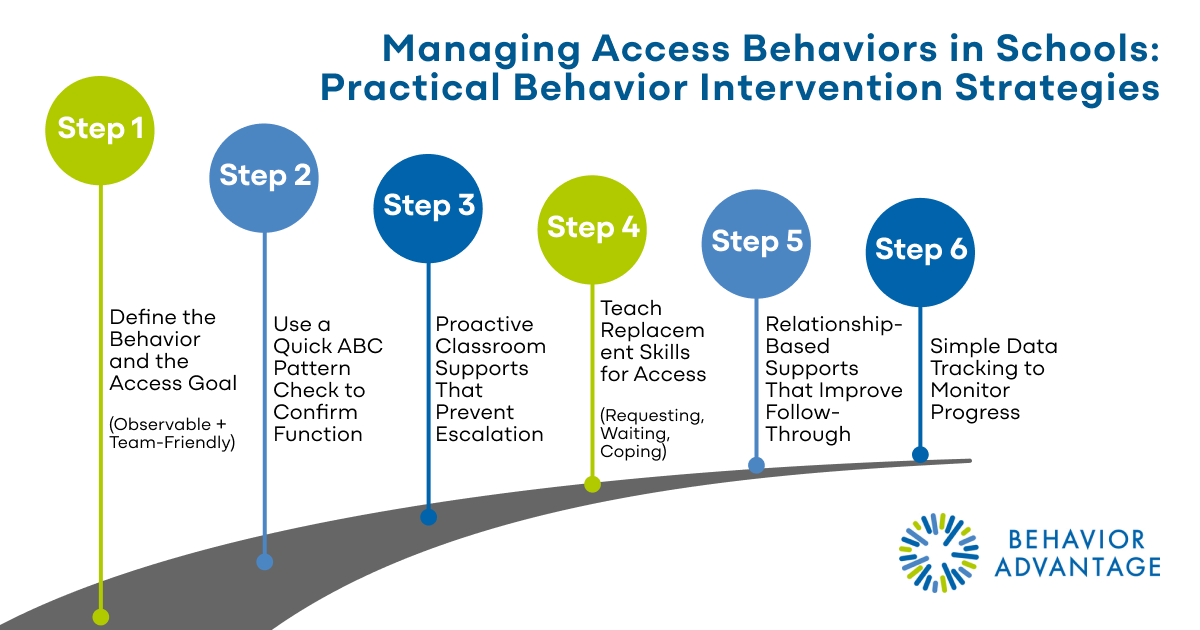
Step 1: Define the Behavior and the Access Goal (Observable + Team-Friendly)
Before changing anything, get clear about what you’re seeing. Avoid labels and focus on actions you can count. When teams define behavior the same way, interventions and data become much easier to align.
Behavior intervention strategy groundwork (define + clarify function):
- Replace labels (“She’s disrespectful”) with observable actions (e.g., “Uses profanity and refuses to put the phone away when asked.”)
- Complete this sentence: “This behavior helps the student get ____.”
- Sort the access goal into one bucket: items/tangibles, activities, attention, preferred routines/spaces
- Ask the team: “When this happens, what does the student typically get within the next 30 seconds?”
If you want an easy place to capture this information as a team, our free Simple Functional Behavior Assessment (FBA) Form is a great starting point.
Once the behavior is defined in observable terms, patterns show up faster, and that’s where function-based thinking becomes useful.
Step 2: Use a Quick ABC Pattern Check to Confirm Function
You don’t need a long report to start function-based support. A quick ABC check helps you see what’s reliably triggering the behavior, and what’s keeping it going.
- A (Antecedent): Identify what happens right before (denied request, waiting, transition, demand, attention removed)
- B (Behavior): Define the behavior in observable terms (what you can see/hear)
- C (Consequence): Note what happens right after (access to item/activity/attention, extra help, preferred routine returns)
- If consequences typically include access, prioritize teaching a replacement skill that meets the same need
When you know what access the student is working for, the next move is prevention: tighten supports around common triggers before they escalate.
Step 3: Proactive Classroom Supports That Prevent Escalation
Access behavior is more likely when the day feels unpredictable: “When do I get it?” “How do I get it?” “What happens if I can’t?” Proactive supports reduce those questions, and the urgency that can come with them. And yes, these supports can be just as effective for older students when they’re designed in an age-respectful way (think: an agenda on the board, a quick “when/then” or “first/then” statement, a discreet signal, or a planned reset routine).
Behavior intervention strategies to use here:
- Use visuals to increase predictability (schedule/agenda, First/Then or When/Then, visual choices, “available/not available” cues).
- Use count-down warnings prior to transitions away from preferred items/activities.
- Teach calming routines when students are calm (3-breath script, movement reset, grounding routine, calm menu with 2–3 options).
- Use brief pre-corrections before known trigger moments (“Remember: if you want ____, you can ask or use your signal.”).
Proactive supports lower the temperature in the moment. Replacement skills create long-term change.
When possible, especially with older students, build these supports with the student to increase buy-in (co-create the calm menu, agree on a discreet signal, or set a realistic break plan). Just as important, teach and rehearse the supports ahead of time. Review them with the student before implementation so they’re ready to use them when things get hard.
Step 4: Teach Replacement Skills for Access (Requesting, Waiting, Coping)
If access is the goal, teach a replacement response that gets access more appropriately, and more reliably. Skills stick best when they’re explicitly taught, practiced often, and reinforced quickly at first.
Behavior intervention strategies to use here:
- Teach Functional Communication Training (FCT) requests (e.g., “Can I have ___?” “Can I take a break?” “Can I have 2 minutes?” “Can you help me?” “Can I do this after ___?”)
- Offer structured choice (two options you can honor: start with #1 or #2, write or type, work here or at the back table, break now or after first 5)
- Teach a waiting/tolerance routine (“Not yet” + visual timer/clear time + “while you wait” plan + follow through)
- Reinforce early requests fast enough that the student learns: this works
Skills build faster in the context of trust, which is why relationships are not an “extra.” If your team is working to make sure replacement skills don’t stay stuck in the plan, our blog How to Teach Replacement Behaviors in a BIP: Turning Plans into Practice breaks down what effective teaching and follow-through looks like in real school moments.
Step 5: Relationship-Based Supports That Improve Follow-Through
Even the best strategy works better inside a supportive relationship. Connection doesn’t replace boundaries, it helps students tolerate them.
Behavior intervention strategies to use here:
- Build one-on-one “connection deposits” (short check-ins before known triggers, specific feedback when skills show up).
- Use peer supports to reduce reliance on adult support, increase independence and engagement, and expand opportunities to practice skills across settings (partner roles, clear group norms, and reinforcing peers for staying engaged). Over time, well-designed peer supports also strengthen an inclusive school culture. For practical, evidence-based ways to set this up, read Peer-Based Supports in Schools: A Practical, Evidence-Based Approach.
- Partner with families using consistent language + 1–2 shared tools (the request phrase, the waiting routine, a simple reinforcement plan).
Step 6: Simple Data Tracking to Monitor Progress
Data doesn’t have to be heavy to be useful. Track one or two measures that tell you whether replacement skills are increasing and disruption is decreasing.
If you’re looking to get started, download our free Behavior Tracking Form.
Data points that show skill growth:
- Track # of appropriate requests (replacement skill)
- Track # of successful waits (tolerance skill)
- Track frequency and/or duration of the target behavior (as needed)
- Review weekly: What’s improving? What needs more teaching? Is the wait time too long? Is reinforcement strong enough?
It’s tempting to track only the challenging behaviors you want to reduce. But remember, what gets measured gets managed. When teams intentionally measure the replacement skills they’re teaching, the focus shifts to skill growth. It also makes it easier to spot patterns over time, see whether implementation is working, and make timely adjustments based on what the data is showing.
If requesting and waiting are increasing, you’re building the foundation, even if behavior hasn’t disappeared yet. If you’ve found these tips helpful, make sure to check out our List of 20 Behavior Intervention Strategies.
Common Pitfalls (and How to Avoid Them)
Even strong behavior intervention strategies can fall flat if a few predictable problems show up. Here are the most common ones teams run into when addressing access behavior and what to do instead.
When escalation becomes the fastest path to access.
If a student gets the item, attention, or preferred routine most quickly after disruption, the behavior is being reinforced (even when adults don’t mean for it to happen). The fix isn’t “be tougher”, it’s to make the replacement skill work more reliably. Reinforce appropriate requests quickly at first, and use a consistent “not yet” routine with follow-through.
When expectations vary by adult, setting, or time of day.
Access behavior often spikes when students learn the “rules” change depending on who’s in charge. A simple shared script helps: what adults say when access isn’t available, what the wait routine looks like, and how the student earns access through the replacement skill.
When waiting demands increase too quickly.
The ability to tolerate delayed or denied access is teachable. It’s a skill we can strengthen through clear routines, practice, and reinforcement, but it has to be built gradually.If the wait jumps from 30 seconds to 10 minutes, you’ll often see an increase in disruption. Start with short waits that lead to success, then gradually extend time as the student shows they can handle it.
When data only tracks problem behavior (and misses skill growth).
If teams only track frequency/duration of disruptions, they may miss the first signs the plan is working: more appropriate requests, more successful waits, smoother transitions. Make at least one data point about the replacement skill.
Putting It Together: A School-Friendly, Function-Based Plan
A function-based access plan works best when it’s built around clarity and consistency. Start with a clear, observable definition of the behavior and a realistic hypothesis about the function, specifically, what the student is gaining access to. From there, pair proactive supports (visuals, scheduled breaks, calming routines) with replacement skills that meet the same need (requesting, waiting, coping). The plan should also spell out consistent adult responses across settings so the student isn’t learning different “rules” with different adults.
Finally, keep it workable: track one or two simple data points, review them on a short cadence, and adjust quickly. When relationship-building and family alignment are included; shared language, shared routines, and shared expectations, implementation is stronger and skills generalize faster.
The Path Forward
When students use disruptive behavior to gain access, it’s not because they’re “trying to be difficult.” It’s because the behavior has been an effective way to communicate and meet a need.
The path forward is clarity and skill-building: make access predictable, teach students how to request, help them practice waiting and coping, and use simple data to adjust the plan. With consistent supports and strong relationships, disruptive access behavior becomes less necessary, because students have better tools that work.
If you’re looking for a practical place to begin, our Simple BIP Template is a great starting point.
Want help making behavior intervention strategies more consistent across adults, settings, and teams? Reach out to schedule a quick walkthrough of Behavior Advantage. We’ll show you how schools document clear, function-based plans, teach replacement skills with follow-through, track what’s working, and build a system that doesn’t depend on who’s in the room.