


Why This Matters More Than Ever
If you talk to almost any school team right now, you will hear a similar pattern.
Students are struggling with regulation.
Behaviors are escalating more quickly.
Staff are working hard to respond consistently, but it feels difficult to keep up.
At the same time, schools are doing what they have always done. They are writing behavior plans. They are implementing interventions and behavior supports. They are using tiered systems of support.
And yet, something still feels off.
Plans look solid on paper, but implementation breaks down.
Strategies are in place, but they do not always lead to lasting change.
Staff feel stretched, and students continue to struggle.
This is not because teams are not trying.
It is because many traditional approaches to behavior do not fully account for what students are bringing with them into the classroom each day.
More and more, educators are recognizing a reality that has always been there but is now harder to ignore.
Students’ experiences outside of school, along with their ongoing emotional and physiological responses to those experiences, directly impact how they behave, learn, and interact in school.
Trauma can affect a student’s ability to:
- Regulate emotions
- Feel safe in relationships
- Process feedback
- Engage in learning
When those factors are in play, behavior is no longer just about rules or expectations. It becomes about regulation, safety, and communication.
When behavior is misunderstood, even well-intended responses can unintentionally escalate situations or reinforce patterns over time.
This is where trauma-informed behavior support becomes essential.
Not as another initiative, but as a shift in how we approach behavior within the systems we already have.
It Is Not Another Program. It Is a Shift in Practice.
One of the most important things to understand about trauma-informed behavior support is this.
It is not a separate initiative.
It is not a binder, a checklist, or a one-time training.
It is a way of delivering the supports you already have more effectively, more consistently, and with a deeper understanding of student needs.
Many schools today would describe themselves as trauma-informed. In many cases, that is true at the level of awareness. Staff understand that trauma exists and that it can affect students.
But awareness alone does not change outcomes.
The real shift happens when those ideas are embedded into everyday practice.
Trauma-informed systems are built around a few core principles:
- Safety
- Predictability
- Connection
- Empowerment
These are not new ideas.
What changes is how intentionally they are built into:
- Classroom routines
- Behavior expectations
- Intervention systems
- Adult responses
When these principles are consistently applied, schools begin to feel different for students and for staff.
Classrooms feel more predictable.
Responses feel more consistent.
Relationships become stronger.
Over time, behavior begins to improve because it is being supported more effectively.
Behavior Is Communication: A Different Starting Point
At the heart of trauma-informed practice is a shift in how we interpret behavior.
From a positive behavior support perspective, we often say:
Behavior is communication.
This reflects the idea that behavior serves a function. It helps a student get a need met, avoid something difficult, or respond to their environment.
Your own work around behavior planning reinforces this. Strong plans are built by identifying function and aligning strategies to that function, not just reacting to behavior .
As outlined in our article, “Behavior Intervention Plan Examples: Real School Scenarios and Key Takeaways,” strong plans are built by identifying the function of behavior and aligning prevention, teaching, and response strategies accordingly.
Trauma-informed research deepens this understanding.
It emphasizes that many behaviors are adaptive responses to stress, adversity, or past experiences, not simply problems to eliminate.
In other words, what we see in the classroom is often a student doing their best to cope, regulate, or protect themselves based on what they have learned.
When we bring these perspectives together, a clearer picture emerges.
Behavior is not random.
Behavior is not just defiance.
Behavior is information.
It may reflect:
- Unmet needs
- Lagging skills, especially in regulation or communication
- Responses to stress, overwhelm, or perceived threat
For example:
- A student who shuts down may be overwhelmed
- A student who becomes disruptive may be seeking connection or escape
- A student who escalates quickly may be struggling to regulate
When behavior is viewed through a compliance lens, these responses are often interpreted as willful or oppositional.
When viewed through a functional and trauma-informed lens, they become meaningful and actionable.
Instead of asking how do we stop this, we begin asking:
- What is the function of this behavior
- What skill is missing
- What support does this student need
This shift is critical not only for effective intervention, but also for avoiding re-traumatization.
When behavior is misunderstood, responses can escalate situations, damage relationships, and reinforce patterns.
When behavior is understood, responses become more supportive, more consistent, and more effective over time.
MTSS-B: Trauma-Informed Practices
One of the biggest misconceptions about trauma-informed practice is that it requires something entirely new.
In reality, most schools already have the right structure in place.
That structure is MTSS-B.
The opportunity is not to replace MTSS-B, but to strengthen how it is used.
A trauma-informed approach does not change the tiers. It changes how behavior supports are designed, delivered, and experienced by students.
At a systems level, this means embedding key principles like safety, predictability, connection, and empowerment into everyday practice. It also means ensuring supports are not only well-designed, but consistently implemented in ways that build trust and reduce escalation.
Within MTSS-B, this shift becomes clear across each tier.
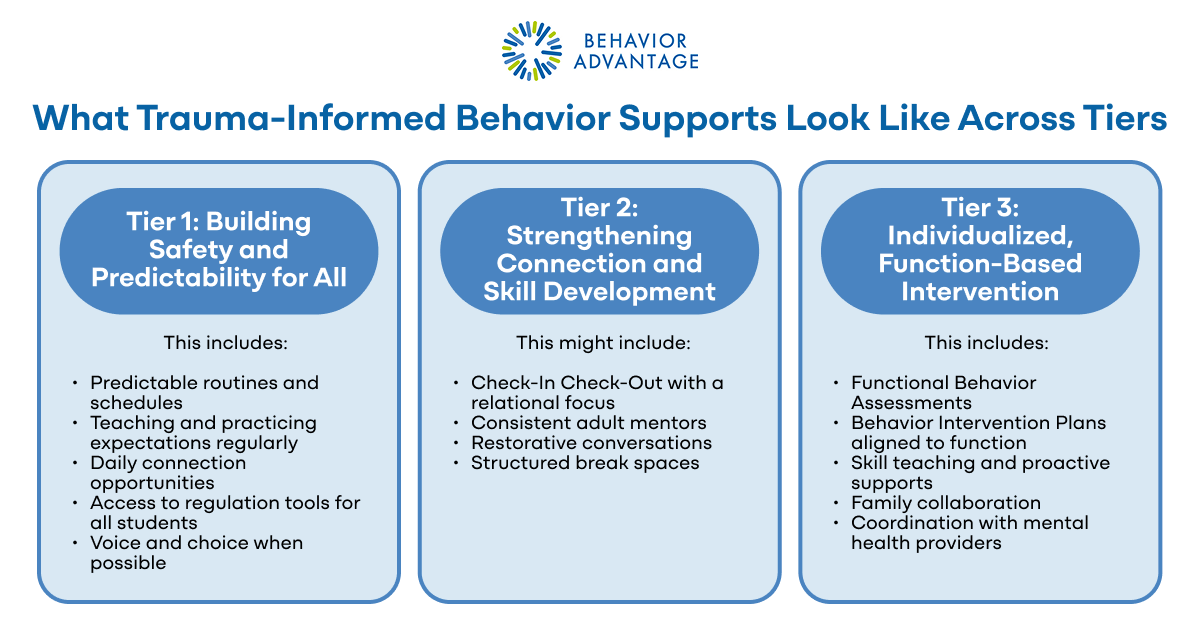
At Tier 1, the focus is on creating environments where students feel safe, know what to expect, and experience consistent adult responses. Expectations are taught and practiced, routines are predictable, and regulation supports are available to all students.
At Tier 2, supports become more targeted, with an emphasis on connection and skill development. Interventions like Check-In Check-Out provide regular feedback, encouragement, and opportunities to build relationships.
At Tier 3, supports become more individualized and precise. Teams use tools like Functional Behavior Assessments to better understand behavior in context. Behavior Intervention Plans are then designed to teach skills, provide proactive supports, and guide consistent adult responses.
As outlined in “Behavior Intervention Plan Examples: Real School Scenarios and Key Takeaways,” effective plans align strategies to the function of behavior and clearly define how supports will be implemented.
Similarly, “How to Write a Behavior Intervention Plan that Works” highlights the importance of prevention, skill-building, and consistency across all interventions.
Across all tiers, one of the most important shifts is this:
The focus moves from reacting to behavior to preventing, teaching, and supporting behavior.
This aligns with strong behavior planning practices, where teams prioritize:
- Prevention through predictable environments
- Teaching replacement behaviors and regulation skills
- Consistent, supportive responses
This is also reinforced in “What Is a BIP (Behavior Intervention Plan) – Explained With Examples,” which emphasizes proactive supports and teaching alternative behaviors.
When these elements are in place, MTSS-B becomes more than a structure.
It becomes a system that supports student regulation, builds relationships, and improves outcomes over time.
When Tier 1 is implemented with consistency, it acts as both a foundation and a funnel. Most students are supported at the universal level, allowing teams to more clearly identify who needs additional support.
As described in “What Is a Behavior Planning Tool?” systems that provide clear structure and practical guidance help teams move from planning to consistent implementation.
Trauma-informed practice strengthens that foundation by ensuring supports at every tier are meaningful, consistent, and aligned with how students learn and respond to their environment.
What Trauma-Informed Behavior Supports Look Like Across Tiers
Tier 1: Building Safety and Predictability for All
At the universal level, trauma-informed practice focuses on creating environments that reduce anxiety and support regulation.
This includes:
- Predictable routines and schedules
- Teaching and practicing expectations regularly
- Daily connection opportunities
- Access to regulation tools for all students
- Voice and choice when possible
These supports benefit all students and reduce the likelihood of escalation.
Tier 2: Strengthening Connection and Skill Development
At Tier 2, the focus shifts toward additional support.
This might include:
- Check-In Check-Out with a relational focus
- Consistent adult mentors
- Restorative conversations
- Structured break spaces
Strong relationships are not an extra support. They are often the intervention itself.
Tier 3: Individualized, Function-Based Intervention
At Tier 3, supports become more individualized.
This includes:
- Functional Behavior Assessments
- Behavior Intervention Plans aligned to function
- Skill teaching and proactive supports
- Family collaboration
- Coordination with mental health providers
As emphasized in “The Role of Behavior Intervention Plans in Special Education,” meaningful behavior change requires thoughtful planning, consistent implementation, and supportive environments.
Practical Strategies That Support Regulation and Learning
Trauma-informed practice does not require entirely new strategies.
It requires more intentional use of the strategies teams already know.
Examples include:
Behavior-specific praise
Clear, specific feedback builds confidence and reinforces desired behavior.
Teaching behavior like academic content
Skills must be modeled, practiced, and shaped over time.
Pre-correction
Prompt expected behavior before challenges occur.
Behavior momentum
Start with success to build engagement.
Proactive access to breaks
Breaks support regulation and prevent escalation.
Reframing compliance
Focus on readiness and safety, not control.
As described in “Behavior Planning Tools: Templates, Strategy Banks, and Implementation Systems,” effective behavior support tools help teams move from planning to consistent implementation, which is where real change happens.
The Role of Adult Mindset
No system works without consistent adult implementation.
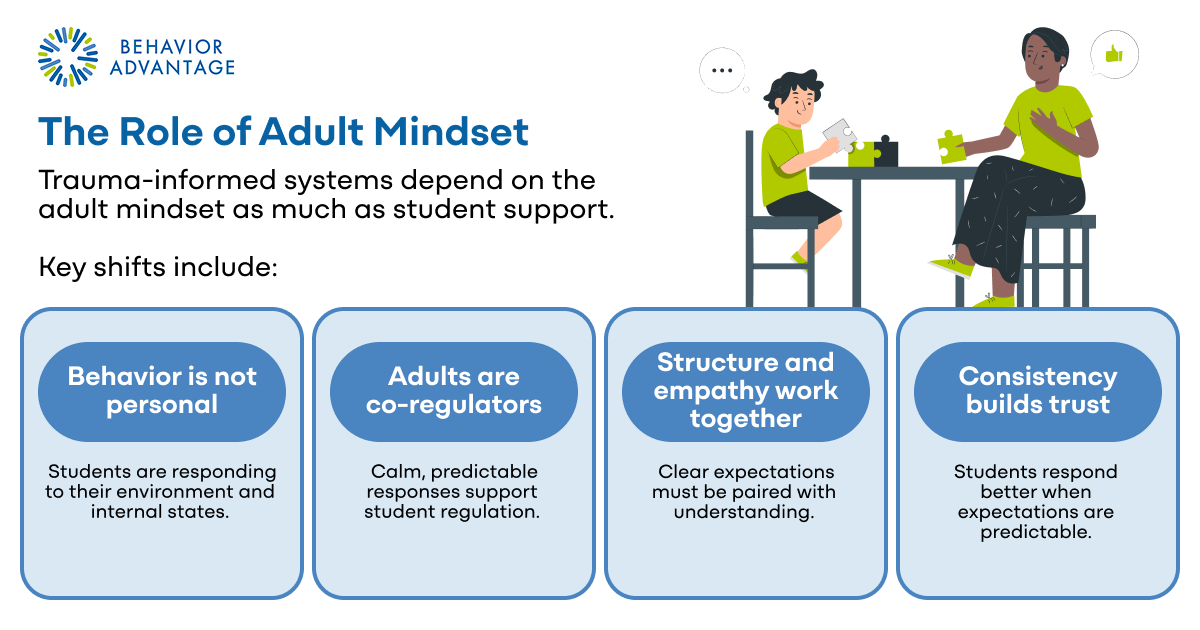
Trauma-informed systems depend on the adult mindset as much as student support.
Key shifts include:
Behavior is not personal
Students are responding to their environment and internal states.
Adults are co-regulators
Calm, predictable responses support student regulation.
Structure and empathy work together
Clear expectations must be paired with understanding.
Consistency builds trust
Students respond better when expectations are predictable.
When systems are clear and practical, staff are more likely to implement them consistently, which improves outcomes over time.
What This Looks Like in Practice
Teaching Expectations
Before, expectations are posted once and correction happens after mistakes.
After, expectations are modeled, practiced, and reinforced regularly.
Check-In Check-Out
Before, the focus was on points and compliance.
After, the focus is on connection and reflection.
FBA and BIP
Before, the goal centered around stopping behavior.
After, the focus is on understanding needs and teaching skills.
These are not major overhauls.
They are intentional shifts that improve clarity, consistency, and connection.
Avoiding Re-Traumatization
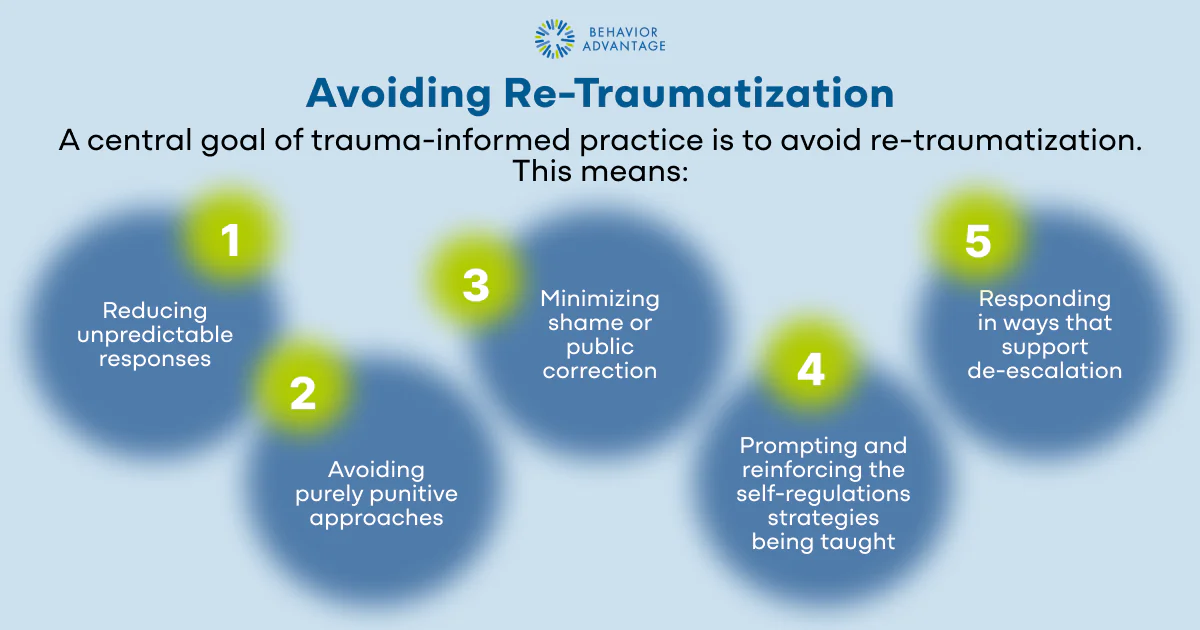
A central goal of trauma-informed practice is to avoid re-traumatization.
This means:
- Reducing unpredictable responses
- Avoiding purely punitive approaches
- Minimizing shame or public correction
- Prompting and reinforcing the self-regulations strategies being taught
- Responding in ways that support de-escalation
When students feel safe, they are more open to feedback, learning, and connection.
That is where meaningful behavior change happens.
Final Thought
Trauma-informed behavior support is not about doing more.
It is about doing the work differently.
When schools shift from control to understanding, from reaction to prevention, and from compliance to connection, they create systems that support both students and staff.
In those systems, students, especially those with the greatest needs, have a better opportunity to succeed.
CTA
If your team is looking for practical ways to apply trauma-informed, function-based behavior supports within MTSS-B, Behavior Advantage provides tools, templates, and training designed to support consistent implementation across all tiers. Feel free to schedule a demo to meet with a member of the Behavior Advantage team of experienced school clinicians to learn more.