


A Behavior Intervention Plan (BIP) is a written plan for supporting behavior change. More than that, it is a set of instructions written for adults to follow.
A strong BIP should make it clear:
- what behavior the team is addressing
- what supports adults have in place to prevent problem behavior and support success
- what replacement skill will be taught
- how adults will respond when behavior occurs
- how the team will know whether the plan is working
That’s what makes a plan useful. It is not just a form to complete. It is a practical guide for what adults will do, say, notice, teach, and reinforce across the school day.
And while behavior plans may live in forms, district systems, or online platforms, the quality of the plan depends much more on the thinking behind it than the format itself. Strong behavior planning depends on the teaming process, not just the form being used. This idea is explored further in our blog, Beyond the Form: Why Process Matters More than Paperwork in Behavior Planning.
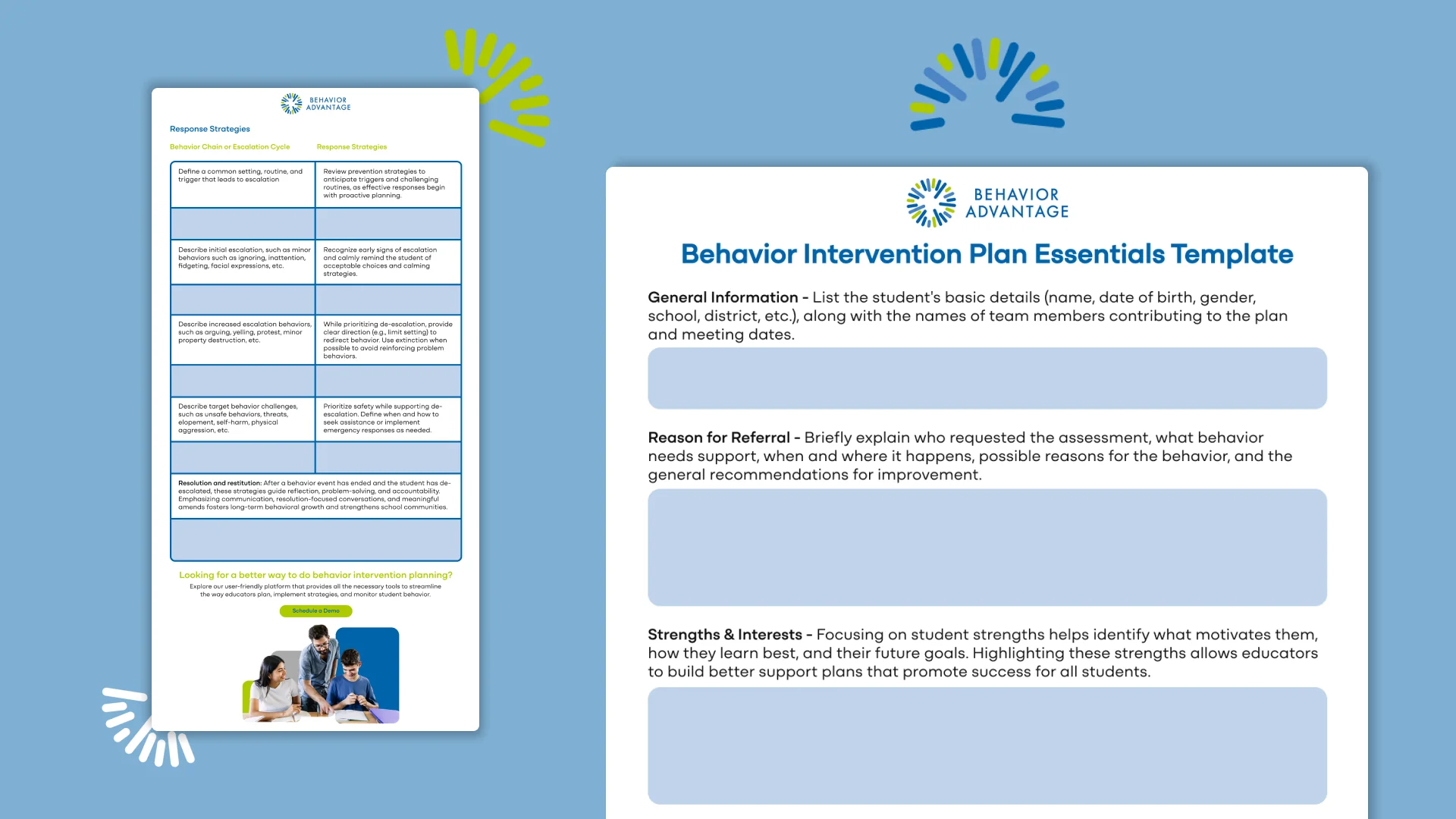
This free Behavior Intervention plan template is a great first step in designing a practical plan to support positive behavior change. Click the image below to grab your copy!
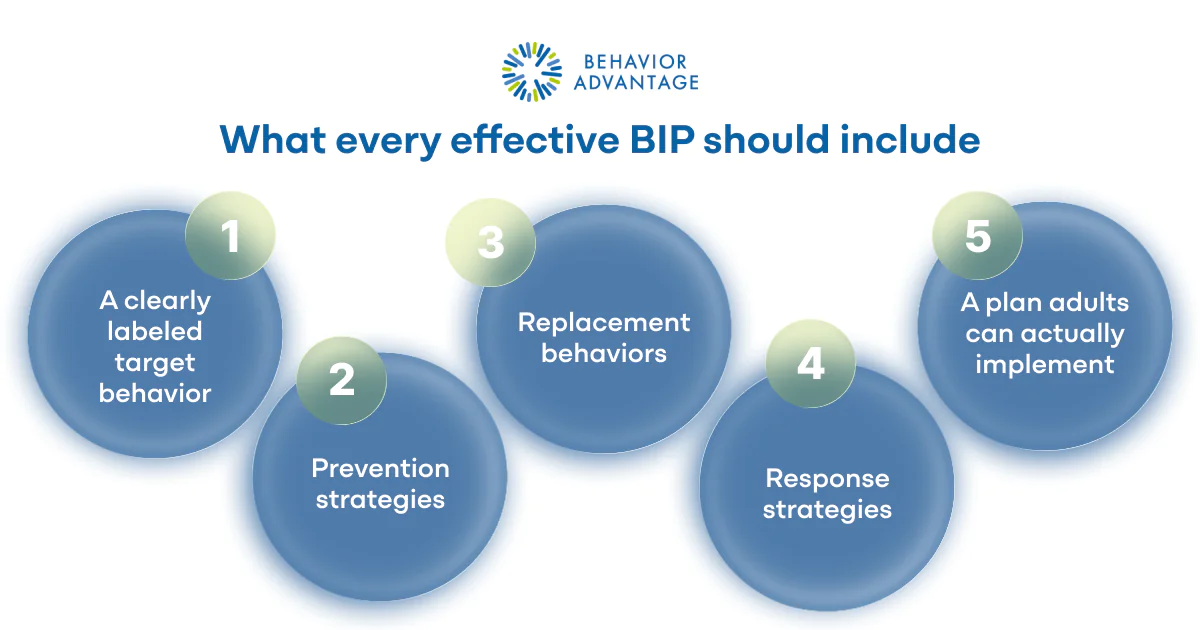
What every effective BIP should include
Most strong plans include the same core ingredients, even when the student, setting, and form look different.
1. A clearly labeled target behavior
Every plan should include a clearly labeled target behavior for decrease.
This matters because the behavior label helps teams organize their thinking, but the definition is what makes the plan usable. Staff need to know exactly what they are looking for.
A good target behavior is:
- observable
- measurable
- specific
- written in neutral language
For example:
Too vague:
Student is disrespectful during class.
Clearer target behavior for decrease:
Calling out during instruction
Student speaks out during teacher-led instruction without being called on, including answering over peers, making unrelated comments, or calling across the room to the teacher three or more times during a 15-minute lesson.
Or:
Too vague:
Student is non-compliant with work.
Clearer target behavior for decrease:
Task refusal during independent work
Student does not begin assigned work within two minutes of direction and may put head down, push materials away, verbally refuse, or remain seated without engaging.
Teams still working to move from broad concerns to clear behavior definitions may also find, 5 Target Behavior Examples & Definitions to Improve BIPs helpful.
2. Prevention strategies
One of the most important parts of the BIP is the section that outlines what supports adults have in place to prevent the behavior from happening.
Instead of focusing only on what adults do after behavior happens, the plan should clarify the supports already in motion beforehand. These may include:
- pre-corrections
- visual supports
- changes to task length or difficulty
- transition supports
- check-ins
- relationship-building and positive connection
- environmental adjustments
- routines for prompting and reinforcement
This is where the plan starts to feel supportive instead of reactive.
For a student who struggles during whole-group instruction, prevention might include:
- previewing expectations before the lesson starts
- increasing opportunities to respond
- giving quiet prompts instead of public corrections
- reinforcing participation early
For a student who shuts down during independent work, prevention might include:
- reducing the amount of work shown at one time
- offering a choice of where to start
- checking for understanding before sending the student off independently
- using a first-then structure
3. Replacement behaviors
Behavior communicates important information.
A student’s behavior is telling us something about what they need, what feels hard, what is maintaining the behavior, or what skill may be missing. A strong plan should identify what the student can do instead to communicate that need in a more effective and sustainable way.
This section should clearly describe the replacement behavior to teach and reinforce.
That might include:
- asking for help
- requesting a break
- using a taught coping strategy
- following a participation routine
- using appropriate language during conflict
- starting with one problem and checking in
This is one of the biggest shifts in strong behavior planning: the plan is not only about reducing behavior. It is also about teaching a more effective skill.
Replacement behaviors are strongest when they are grounded in likely function, not just in what sounds appropriate on paper.
- Response strategies
Even strong prevention and teaching do not eliminate the need for a response plan.
Adults still need to know:
- what to do
- what to say
- how to stay regulated
- how to respond consistently across staff
- what escalation cues matter
- when safety planning is needed
A good response section should feel clear and realistic, not vague or overly wordy.
For example, responses might include:
- brief neutral redirection
- prompting the replacement behavior
- minimizing attention to the problem behavior
- reinforcing the expected behavior as soon as it occurs
- using a pre-planned escalation response if behavior intensifies
The exact response should still match the likely function, setting, and level of intensity.
And if a student’s behavior can escalate to unsafe levels, the crisis response plan should also define what staff will do if safety becomes a concern.
5. A plan adults can actually implement
This is where many plans fall apart.
A BIP can have all the correct headings and still be hard to use. If the strategies are too broad, too vague, or too disconnected from the classroom, staff may leave the meeting with a document but not a real plan.
A usable BIP should answer questions like:
- What exactly are we watching for?
- What supports should already be in place?
- What are we teaching instead?
- How should adults respond?
- Who is responsible for what?
- How will we know if this is helping?
If staff cannot read the plan and quickly figure out what to do, the plan probably needs revision. That matters because implementation is often where good ideas either become daily practice or quietly fall apart.
Tools like the Behavior Advantage Implementation Checklist can support that work by helping teams train, implement, and monitor BIPs with greater consistency.
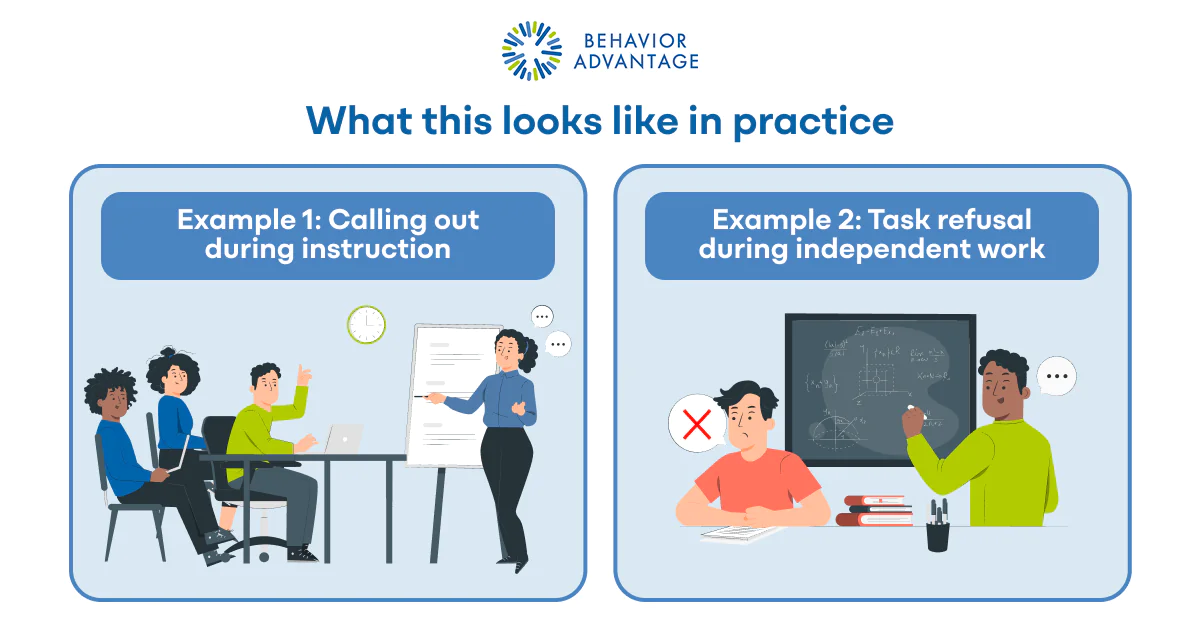
What this looks like in practice
Sometimes the teacher’s first description is emotional, broad, or not yet measurable, and that’s okay.
That first description still matters. It tells us what is feeling hard in the moment, and the teacher’s voice needs to be heard because it helps shape the conversation. It is often the starting point. Then, through a solid, supportive teaming process, the team can collectively work toward a more objective, observable, and usable definition.
BIP Example 1: Calling out during instruction
A teacher may initially describe a student as “disruptive during lessons.”
That concern is important. It tells us the behavior is affecting instruction and feels significant enough to bring to the team. But through a structured planning process, the team can move from that initial concern to a target behavior they can define, observe, and respond to consistently.
Target behavior for decrease:
Calling out during teacher-led instruction
Student speaks out during whole-group instruction without being called on, including answering over peers, making unrelated comments, or calling across the room to the teacher three or more times during a 15-minute lesson.
Examples of prevention strategies:
A team may identify several possible prevention strategies, but putting all of them in place at once would not be realistic for most teachers. Instead, it may be more helpful to review a range of options with the teacher, consider what is manageable within that classroom, and choose two or three supports that feel both reasonable and likely to make a difference.
- preview participation expectations before instruction
- use a visual reminder for hand raising
- increase opportunities to respond
- provide quiet prompts
- reinforce appropriate participation early in the lesson
Replacement behavior to teach:
- raise hand and wait to be called on
- jot down a thought to share later
- follow the classroom discussion routine
Adult response:
- give a brief, neutral prompt back to the routine
- avoid a long verbal exchange
- reinforce the expected behavior quickly when it appears
These supports make sense if the calling out is being maintained by adult or peer attention, or if the student has difficulty waiting appropriately to participate.
BIP Example 2: Task refusal during independent work
A team may say a student is “non-compliant” during math or writing.
Again, that starting point tells us something important. It reflects staff frustration and signals that the current expectation is not working well for the student in that moment. But through a thoughtful team process, that concern can be shaped into a definition that is clearer, more objective, and much more useful for planning.
Target behavior for decrease:
Task refusal during independent work
Student does not begin assigned independent work within two minutes of direction and may put head down, push materials away, verbally refuse, or remain seated without engaging.
Supports adults have in place to prevent the behavior:
Rather than expecting staff to implement every possible support, the team can work with the teacher to choose a few strategies that feel realistic and useful in that setting.
- reduce the amount of work shown at one time
- offer a choice of which item or section to start with
- check for understanding before independent work begins
- provide a quick teacher check-in at the start
- use a first-then visual or verbal prompt
Replacement behavior to teach:
- ask for help
- say “I don’t know how to start”
- request a short break appropriately
- complete the first item and then check in
Adult response:
- calmly restate the direction
- offer one of the pre-planned supports
- prompt the replacement behavior
- reinforce any movement toward starting
If the behavior is maintained by escape, these supports would better match the likely function while also giving the student more appropriate ways to access support.
Tracking progress over time
A behavior plan is only as strong as the team’s ability to notice whether it is actually helping.
That does not always require a complicated system. It does require a consistent, practical way to collect useful information over time. When that data is graphed, it can help the team see trends more clearly across both good days and hard days, rather than relying on individual moments or general impressions. That makes it easier to tell whether behavior is improving over time and whether the current supports are working.
Depending on the plan, teams might monitor:
- frequency of the target behavior
- duration
- number of prompts needed
- successful use of the replacement behavior
- daily points or check-ins across settings
The Sample Behavior Tracking Form and Check-In Check-Out (CICO) Sheets can give teams a repeatable way to see whether the plan is making a difference over time.
When a BIP starts to work
A strong BIP should make adults feel clearer, not more overwhelmed.
It should help the team move from:
“This behavior is a problem”
to:
“We know what we are seeing, what supports are in place, what we are teaching, and how we are responding.”
That is the shift.
When a plan is built that way, it becomes much more than paperwork. It becomes a shared roadmap that helps adults act with more clarity, more consistency, and more purpose.
Want to see how this process can look in practice? Get in touch to explore Behavior Advantage.