

Despite years of strong Positive Behavioral Interventions and Supports (PBIS) implementation, many districts still find themselves wrestling with persistent disproportionality in discipline. Even with clear expectations and solid systems, some student groups continue to experience higher rates of office referrals, instructional removals, and Tier 2/3 placements. These patterns often show up among students with disabilities, multilingual learners, and other groups depending on the local context.
It’s understandable that this feels frustrating, especially for teams who have invested time, training, and energy into building positive, consistent environments. But disproportionality doesn’t mean PBIS isn’t working. More often, it signals that the system needs a closer look through an equity-focused lens.
PBIS was designed for this kind of continuous improvement. When schools align their practices, data routines, and adult expectations with intention and consistency, the research is clear: PBIS can significantly reduce exclusionary discipline and lead to more equitable outcomes.
Across national PBIS publications, the message is consistent: there’s no shortcut to reducing disproportionality. It takes a layered approach and strong collaboration across districts and school teams. When systems are aligned, data is used intentionally, and staff receive ongoing, not one-time, support, meaningful progress becomes possible.
Below is a practical roadmap that brings together PBIS principles, intentional data use, and strong educator supports to promote equity across all tiers.
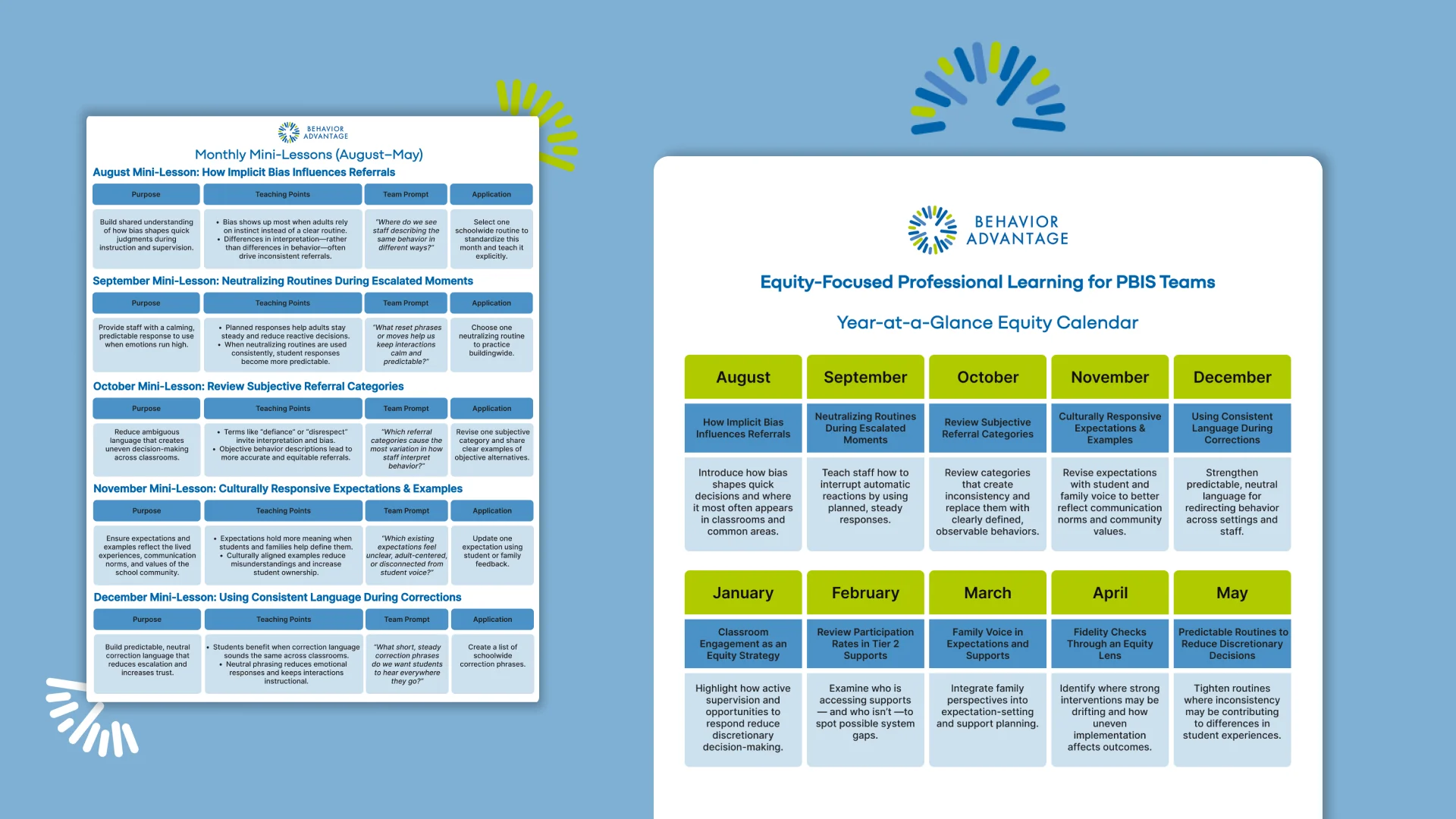
Download our Equity-Focused PBIS Calendar & Monthly Mini-Lessons
A Tiered PBIS Approach to Reducing Disproportionality
Because PBIS is inherently a multi-tiered system, equity efforts of PBIS must also be tiered. Here’s what that work looks like at Tier1.
Tier 1 PBIS: Strengthening Universal Systems That Promote Equity
Even in strong PBIS schools, inequities often begin at Tier 1. Universal practices set the conditions that either prevent, or unintentionally reinforce, disproportionality.
Common Challenges:
- Gaps in cultural understanding
- Unclear or inconsistently taught expectations
- Inconsistent or varying routines
- Subjective behavioral definitions
- Variation in instructional quality
- Inconsistent responses across staff
Key Tier 1 Strategies
1. Teach expectations that are culturally aligned and relevant
Revisit expectations to ensure they reflect the community’s values – not just the adults’. Student and family voice is essential.
Example: A middle school revises its PBIS expectations after student focus groups reveal that “Be Respectful” feels vague and adult-centered. Students and families help define what respect looks like in their community. For example:
- “Use a calm tone with peers and adults”
- “Ask questions when something doesn’t make sense”
These become the taught and modeled behaviors across classrooms.
2. Increase predictability through strong routines
When routines and instruction vary widely, staff judgment (and bias) fills the gap.
Example: A school identifies that transitions between recess and class generate high referrals, particularly for specific student groups. Staff implement a consistent routine:
- 1 whistle = freeze
- 2 whistles = line up
- Teacher greets students at the door and acknowledges 3 positive transitions
Within one month, transition-related referrals decrease, including a decrease in disproportionality data.
3. Reduce or revise subjective referral categories
Referral categories like “defiance”, “disrespect”, and the vague category of “other” consistently predict disproportionality because they rely heavily on adult interpretation rather than observable, measurable behaviors.
Example: The PBIS team removes “defiance” from the referral form and replaces it with clearly defined behaviors such as:
- “Left the area without permission”
- “Did not follow a specific request after two prompts”
Teachers receive training, leading to more consistent referral patterns and fewer disparities.
4. Increase active supervision and Opportunities to Respond (OTR)
Classrooms with high engagement and frequent opportunities to respond consistently show fewer referrals for all students.
Example: Walkthroughs reveal long stretches of passive instruction. Teachers shift to more active practices – choral responses, whiteboard checks, partner shares, and frequent proximity scanning. As engagement increases, referrals for “off-task” behavior decrease across grade levels.
5. Provide district-led PD on implicit bias and culturally responsive PBIS
This must be ongoing, not a one-and-done workshop. Embed it into coaching and PBIS team structures.
Example: The district adds monthly 10-minute PD segments to PBIS meetings, covering:
- how implicit bias influences referrals
- neutralizing routines
- culturally responsive examples of expectations
Teachers report using more consistent, neutral language, and teams see fewer emotion-driven referrals.
6. Establish a consistent discipline flowchart
Predictability supports equity. When staff “guess” how to respond, inequity grows.
Example: A school replaces inconsistent, teacher-by-teacher consequences with a clear flowchart showing:
- which behaviors are staff-managed vs. office-managed
- the steps to take before writing a referral
- required documentation
The result: more predictable discipline and fewer disparities.
Tier 2 PBIS: Targeted Supports That Reduce Emerging Gaps
Disproportionality often shows up quietly in Tier 2 – either through over-representation (certain groups receiving more CICO referrals) or under-representation (students who need support but aren’t being identified). Both patterns signal system issues, not student issues.
Key Tier 2 Strategies
1. Establish objective entry and exit criteria
Reduce the reliance on teacher discretion alone. Clear, published entry and exit criteria help ensure equitable access – and our free MTSS Referral Form offers a simple starting point for creating that process.
Example:
- CICO entry criteria: Students Score 2+ major referrals in 30 days, or flagged by universal screener
- CICO exit criteria: Student meets goals for 4 consecutive weeks and the teacher/family agree this is best for the student
2. Review participation rates across student groups
Monthly Tier 2 meetings include a quick slide showing CICO participation by grade, race/ethnicity, gender, disability status, and EL status.
Example:
- A school notices a specific demographic group of learners receiving Tier 2 supports but only account for 22% of enrollment.
- The team reviews referral sources and screening practices
- A school observes that female students are rarely referred, despite similar screening scores.
- The team checks for underidentification and ensures teachers and teams understand criteria for referrals.
3. Use fidelity tools to support CICO and small-group interventions
Even strong interventions drift without routine checks. When fidelity drops, outcomes become uneven. Organized, graphed, and consistently monitored CICO data helps maintain fidelity, improve outcomes, and guide next steps.
Example:
- Coaches complete a 5-minute weekly CICO fidelity check, ensuring morning check-ins, point sheet delivery, and end-of-day feedback occur
- Graphs show a student’s point card data dipping and the team discovers scheduled feedback isn’t being delivered consistently.
- A check-in and supportive guidance and coaching are provided
4. Ensure Tier 2 interventions are culturally responsive
Align reinforcers, feedback, meeting scripts, and home communication with student and family preferences to strengthen engagement.
Example:
- Reinforcer menus include options suggested by students and families – things like time with peers, music playlists, cultural foods, or leadership roles – so motivation feels authentic, not generic.
- Small-group examples and scenarios also reflect students’ cultural, linguistic, and community experiences, helping the intervention feel relevant and respectful.
5. Use data to coach teachers – not to evaluate them
Most disproportionality patterns at Tier 2 reflect system drift or inconsistent routines. Clinicians and coaches can use data to guide, not judge, implementation.
Example:
- Teams celebrate when fidelity improves, not just when student points increase.
- A coach meets with a teacher privately, saying: “It looks like feedback is happening 2–3 times per day instead of the planned 5 – how can I support you?”
Tier 3 PBIS: Individualized Supports with an Equity Lens
Tier 3 is often where disproportionality becomes most visible – through over-referrals for special education, punitive consequences, repeated removals, or inconsistent follow-through on plans. Strong Tier 3 systems build on the foundations of Tiers 1 and 2 by ensuring individualized supports reflect student and family perspectives and are implemented with consistency across settings.
Key Tier 3 Strategies
1. Conduct culturally responsive FBAs
Go beyond surface-level interviews. Explore communication norms, behavior expectations at home, family perspectives, and environmental factors that shape the student’s lived experience.
Example: During the FBA, the team learns the student becomes overwhelmed when asked to speak publicly because it conflicts with cultural expectations around initiating communication – shifting the replacement behavior focus.
2. Expand who participates in FBA interviews
Family voice isn’t optional – it’s essential. Include caregivers, key educators, and anyone who meaningfully supports the student’s day-to-day to ensure the plan reflects real contexts and routines.
Example: A paraprofessional and bus driver join the interview because most challenging behavior occurs during transitions – leading to stronger, targeted supports across all settings.
3. Monitor intensive supports monthly
Use PBIS problem-solving steps to review progress, adjust interventions, and confirm plans are being implemented with fidelity – not just documented. Tier 3 requires consistent, intentional follow-through.
Example: Monthly data reviews show the student meets goals on days with visual schedules but not on substitute days – prompting a plan update and quick staff training.
4. Examine exclusionary discipline patterns
Regularly review in-school suspensions, time-out from instruction, and removals to alternative settings. Disproportionate patterns usually signal system gaps—not student deficits.
Example: A school notices students receiving Tier 3 supports are frequently removed during a specific content area – leading the team to analyze instructional demands and adjust accommodations.
5. Align Tier 3 plans with Tier 1 and Tier 2 supports
Intensive interventions shouldn’t replace universal or targeted practices – they should build on them. Connect goals, routines, reinforcement systems, and expectations so the student experiences consistency across settings and adults.
Example: A student receiving Tier 3 support has persistent work refusal. Instead of creating a completely separate system, the team builds on Tier 1 expectations (“Engage in Learning”) and the school’s Tier 2 CICO routine. The BIP includes a brief prompting script, chunked assignments, and reinforcement using the same schoolwide point system already in place. Teachers across classes know the expectations and tools, so implementation is consistent – and the student experiences predictable support throughout the day.
Bringing It All Together: Equity Through Consistent PBIS Implementation
Reducing disproportionality doesn’t require new programs – it requires stronger, more consistent PBIS systems. When districts strengthen coaching, data routines, shared expectations, and aligned professional learning, equity shifts from an aspiration to a predictable outcome.
Tools like the Behavior Advantage online platform, the PBIS Disproportionality Data Guide, and the 5-Point Equity Approach, help teams build systems that are
- consistent: with aligned FBA and BIP tools that guide teams through a clear, culturally responsive problem-solving process
- transparent: through unified Tier 2 supports, shared templates, and clear expectations across classrooms and buildings
- culturally responsive: with structured FBA interview guides and planning tools that elevate student and family voice
- supportive: by giving educators practical, usable plans paired with just-in-time professional learning
- predictable: with progress monitoring, CICO tools, and data dashboards that make implementation and outcomes easy to track
The Behavior Advantage platform brings all of this into one place – helping districts reduce variability, strengthen their PBIS systems, and ensure students experience consistent support across all tiers.
Because ultimately, consistency is equity. When adults respond predictably and systems function as intended, students experience support that feels fair and grounded in clear expectations across all tiers.
If you’re ready to strengthen PBIS systems across your district and explore ways Behavior Advantage can help reduce your disproportionality numbers, let’s connect. We’d love to walk you through how Behavior Advantage can support consistent, equitable implementation across all tiers.