


Why Good Plans Still Break Down
School teams spend significant time identifying target behaviors, discussing likely function, selecting interventions, and documenting supports. Many behavior plans are thoughtful, carefully written, and grounded in sound behavioral principles.The team has a clear concern, a reasonable hypothesis, and a set of strategies intended to help the student succeed.
And yet, many behavior plans still lose momentum once implementation begins.
This is one of the most common tensions in school-based behavior support. Teams are often expected to move quickly from concern to action, but building a plan is not the same as implementing it well. A replacement behavior may be identified but never explicitly taught. Reinforcement may be described but delivered inconsistently. Staff may leave the meeting with different interpretations of what the plan actually requires. Over time, a plan that looks strong on paper can begin to drift across people, settings, and routines.
That is where fidelity becomes so important.
When behavior plans do not produce the outcomes teams expected, the first assumption is often that the plan itself needs to be revised. Sometimes that is true. But in many cases, the more immediate issue is not plan quality alone. It is whether the plan was implemented clearly, consistently, and for enough time to give it a real chance to work.
For district and school leaders, school psychologists, and behavior specialists, this distinction matters. If schools want stronger outcomes from FBAs, BIPs (How to Write a BIP that Works), and MTSS-based intervention planning, fidelity cannot be treated as something to check only after a plan is already struggling. It has to be built into the process from the beginning.
In this article, we’ll explore why behavior plans often break down, how a team-based process strengthens fidelity from the start, why training has to go beyond explanation, and how implementation checks help schools protect the work teams have already done.
A Plan on Paper Is Not the Same as a Plan in Practice
A behavior plan can appear complete on paper and still break down in practice.
That gap is not usually about lack of effort. More often, it reflects a lack of implementation structure. Teams may identify what should happen, but spend less time determining how those supports will actually be carried out across classrooms, adults, and routines.
This is where inconsistency often begins:
- One staff member prompts the replacement behavior consistently, while another forgets.
- One classroom uses the reinforcement plan as intended, while another improvises.
- A paraeducator is expected to implement key strategies but was not included in the planning discussion or trained on the plan.
- A new staff member joins midstream and receives only a partial explanation.
None of this necessarily means the team lacks commitment. It means the plan was not supported strongly enough to survive the realities of a busy school environment.
This distinction matters because student outcomes are often interpreted without enough attention to adult implementation. When progress stalls, teams may conclude that the intervention is wrong, the student needs something more intensive, or the plan should be rewritten entirely. Sometimes that is the right conclusion. But before changing the plan, teams should pause and ask a simpler question:
Is the plan being implemented the way the team intended?
That question shifts the conversation in a more productive direction. It moves teams away from blame and toward problem-solving.
Fidelity Starts at the Planning Table
Fidelity does not begin after the meeting. It begins while the plan is being built.
Plans are more likely to be implemented consistently when the people responsible for carrying them out help shape them. A strategy may sound strong in theory but still be difficult to implement in a busy classroom, during lunch, on the playground, in transitions, or across multiple service providers. If the plan does not fit the actual routines, resources, and demands of the setting, implementation is likely to weaken quickly.
A simple, team-friendly FBA process can be especially helpful at this stage. The Behavior Advantage Simple Functional Behavior Assessment Form helps teams gather observations, identify likely function, and build a shared understanding before moving into intervention planning. That foundation makes it easier to design a plan that is aligned from the start.
It also helps teams avoid confusing thoroughness with usability. A plan with too many moving parts, vague language, or unrealistic expectations may appear comprehensive, but it is often harder to implement consistently. Strong plans are not only function-based. They are practical, specific enough to guide adult action, and realistic enough to work in the settings where the student actually needs support.
That is one reason a team-based approach matters so much.
Teachers, specialists, paraprofessionals, and others supporting the student should not be treated as passive recipients of the plan. Their perspective helps teams identify:
- what is feasible in the setting
- what needs clarification before rollout
- what materials, visuals, or prompts are needed
- where additional coaching may be required
- how the plan can be embedded into daily routines rather than added on top of them
This kind of collaboration does more than improve buy-in. It strengthens the plan itself by improving quality and increasing the likelihood that supports will actually be used in practice.
When a plan is technically sound and contextually realistic, fidelity becomes much more achievable.
Telling Staff Is Not the Same as Training Staff
Even a practical plan can break down if staff are only told what to do without being prepared to do it.
In many schools, training on a behavior plan consists of a conversation, a quick review during a meeting, or a shared document. The team discusses the highlights, answers a few questions, and assumes implementation will follow. But a behavior plan should not move into implementation until the staff responsible for carrying it out have a shared, thorough understanding of what the plan requires.
The next challenge is turning that understanding into consistent action. Staff often need more than awareness. They need fluency. That is where a Behavior Skills Training mindset becomes especially helpful. Behavioral Skills Training (BST) is a practical, evidence-based approach that helps staff move from understanding a plan in theory to using it effectively in practice. It does this through four core elements: instruction, modeling, rehearsal, and feedback. In the context of behavior plans, that means staff are more likely to implement strategies with clarity, consistency, and confidence.
But even that is not always enough on its own. Effective implementation often depends on solid coaching over time. Coaching helps staff apply the plan in real settings, work through barriers, and refine small pieces of implementation before inconsistency turns into drift. In many cases, that ongoing support is what helps a plan move from initial understanding to sustained use.
This is also where short,Implementation-Focused Professional Learning can be helpful, especially when teams need concrete examples and support turning a written plan into daily practice.
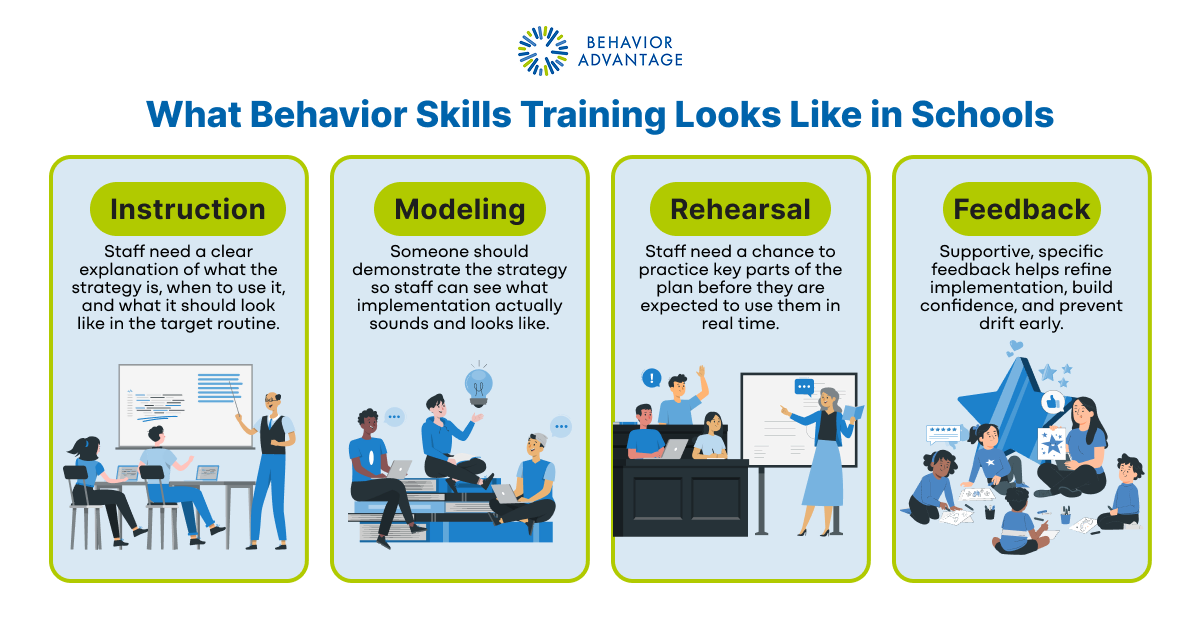
What Behavior Skills Training Looks Like in Schools
- Instruction
Staff need a clear explanation of what the strategy is, when to use it, and what it should look like in the target routine. - Modeling
Someone should demonstrate the strategy so staff can see what implementation actually sounds and looks like. - Rehearsal
Staff need a chance to practice key parts of the plan before they are expected to use them in real time. - Feedback
Supportive, specific feedback helps refine implementation, build confidence, and prevent drift early.
This matters because many behavior plans ask adults to change what they do. They may need to prompt a replacement behavior more consistently, adjust how reinforcement is delivered, use pre-corrections before a trigger, respond more neutrally to problem behavior, or implement a new routine with greater predictability. Those steps should not live only on paper. They should be demonstrated, practiced, and refined.
The good news is that this does not need to feel overly clinical or complicated. In schools, it can look like:
- a brief team walk-through before implementation starts
- a role-play during a planning meeting
- side-by-side coaching in the classroom
- modeling how to prompt, reinforce, or redirect during a specific routine
- a short booster check-in after the first few days
- feedback focused on one or two key actions rather than every detail at once
The goal is not perfection. The goal is clarity, confidence, and consistency.
And that becomes even more important when multiple adults are involved. Without shared training and practice, variation is almost guaranteed. When support varies by adult or setting, fidelity weakens, and student outcomes become harder to interpret.
Plans Rarely Fail All at Once. They Drift.
Most behavior plans do not collapse overnight. They gradually lose consistency.
A reinforcement routine becomes less predictable. A prompt is skipped during a busy transition. A visual support is no longer available where it is needed. A new staff member inherits part of the plan but not the full context. A strategy that felt manageable during week one becomes harder to sustain by week four.
This is exactly why follow-up cannot be left to chance.
If no one owns follow-up, it tends to happen inconsistently or not at all. Teams may assume everyone understands the plan, everyone is using the strategies, and everything is moving forward as expected. In reality, small implementation gaps often grow quietly until the plan is no longer being carried out in a way that can be fairly evaluated.
That is why schools need a simple follow-up structure with clear roles, timelines, and coaching support. Follow-up is not just about checking whether the plan is being used. It is also about helping staff refine implementation, problem-solve barriers, and stay aligned over time. In many cases, that ongoing coaching is what keeps a plan from drifting once the initial training is over.
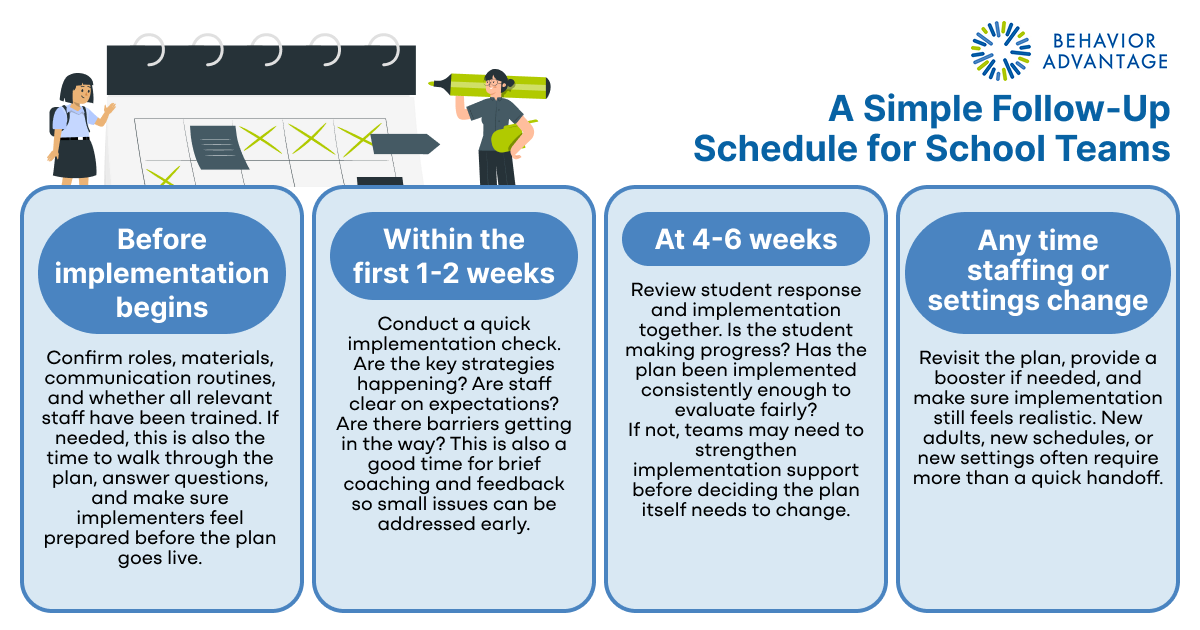
A Simple Follow-Up Schedule for School Teams
- Before implementation begins
Confirm roles, materials, communication routines, and whether all relevant staff have been trained. If needed, this is also the time to walk through the plan, answer questions, and make sure implementers feel prepared before the plan goes live. - Within the first 1-2 weeks
Conduct a quick implementation check. Are the key strategies happening? Are staff clear on expectations? Are there barriers getting in the way? This is also a good time for brief coaching and feedback so small issues can be addressed early. - At 4-6 weeks
Review student response and implementation together. Is the student making progress? Has the plan been implemented consistently enough to evaluate fairly? If not, teams may need to strengthen implementation support before deciding the plan itself needs to change. - Any time staffing, routines, or settings change
Revisit the plan, provide a booster if needed, and make sure implementation still feels realistic. New adults, new schedules, or new settings often require more than a quick handoff.
Just as important is deciding who owns the follow-up. Depending on the school or district structure, that may include:
- a school psychologist or behavior specialist supporting implementation and problem-solving
- an MTSS lead or student support coordinator managing timelines and review cycles
- a building administrator helping remove barriers and reinforce accountability
- a case manager or team lead making sure all implementers have access to the plan and understand their role
The purpose of follow-up is not to catch people doing something wrong. It is to keep implementation strong enough to support the student and clear enough to guide decision-making.
What This Looks Like in Practice
Consider a student whose team develops a behavior intervention plan to address task refusal during independent work. The plan includes pre-corrections, a break request card, reinforcement for task engagement, and a neutral response to refusal.
On paper, the plan makes sense.
But within two weeks, implementation starts to vary:
- the classroom teacher uses the break card inconsistently
- a paraeducator was not part of the planning meeting and is unsure when to prompt it
- reinforcement is delivered in one setting but forgotten in another
- a specialist pulls the student during the same routine and has not seen the full plan
- no one has checked whether the replacement behavior was explicitly taught
At that point, the team may be tempted to conclude that the plan is not working.
A stronger response would be to pause and ask:
- Were all implementers included?
- Was the replacement behavior actually taught and practiced?
- Did staff receive modeling and rehearsal?
- Is reinforcement happening consistently enough to compete with the payoff of refusal?
- Who is following up on implementation?
That is what implementation checks make possible. They help teams move from assumption to clarity before making high-stakes changes.
Fidelity Checks Help Teams See What Is Actually Happening
One of the biggest challenges in behavior planning is that implementation is often assumed rather than verified.
Teams may have student outcome data, but much less visibility into whether adult actions are occurring consistently across settings and staff. That creates a serious blind spot. Without implementation checks, it becomes difficult to distinguish between two very different problems:
- the plan is not effective
- the plan has not been implemented consistently enough to evaluate
That distinction matters at every level.
For school teams, it leads to better decisions about whether to continue, adjust, intensify, or reteach. For district leaders, it highlights where schools need stronger routines, training, or coaching. For school psychologists and behavior specialists, it creates a more useful consultation process grounded in what is actually happening, not just what was intended.
Implementation checks also support continuity. Like strong teams working from a shared playbook, schools need a clear, common structure so staff understand the plan, their role, and how to respond across situations. In that sense, implementation checklists can function like a playbook. They reduce reliance on memory, individual style, or informal communication, and they help plans survive staffing changes, schedule changes, and the natural pressures of a busy school year. Tools like the Behavior Advantage Implementation Checklist help make that process more concrete by clarifying roles, identifying training needs, and supporting follow through.
In that sense, implementation checks do not add unnecessary work. They protect the work teams have already done.
A Practical Tool for Keeping Plans Moving
Schools do not necessarily need more forms. They need stronger routines for turning plans into daily practice.
That is why fidelity checklists can be so useful. When used well, they help teams move from plan completion to plan execution. They make it easier to clarify responsibilities, identify what staff need in order to implement effectively, and create a predictable structure for monitoring and follow-up.
Simple questions can make a big difference:
- Who is responsible for each part of the plan?
- Were all relevant implementers included in the discussion?
- Were they trained and consulted about feasibility?
- Has the replacement behavior been explicitly taught?
- Have staff practiced the key routines or responses?
- Is there a follow-up schedule?
- Who is responsible for checking implementation?
Behavior Advantage’s Implementation Checklist was designed to support this kind of work. It helps teams focus not only on what the plan says, but on what needs to happen next: training, implementation, monitoring, and consistency over time.
That matters because many plans do not fail at the point of design. They fail in the gap between design and daily use.
Why Leaders Should Pay Attention
For school and district leaders, fidelity is not just an intervention issue. It is a systems issue.
When schools are seeing uneven implementation across teams or buildings, it can be helpful to step back and look at the larger system supporting behavior planning, staff training, and follow-up. The MTSS Behavior Systems Check can be a useful resource here, helping leaders examine whether the structures needed for consistency are actually in place.
Inconsistent implementation makes it harder to know whether teams need a different plan, clearer routines, stronger coaching, or better coordination across staff. Without that visibility, schools can spend time revising paperwork while missing the underlying implementation problem.
Leaders play an important role in making fidelity more achievable by:
- creating time for team-based planning
- clarifying who owns follow-up
- supporting staff training and coaching
- reinforcing predictable review cycles
- using implementation data alongside student outcome data
This matters because strong behavior support is not built on documents alone. It is built on the routines, communication structures, and shared practices that help plans stay alive after the meeting ends.
Without Fidelity, Even Strong Plans Can Fail
The fidelity crisis is not really about whether schools care about behavior support. We know schools do. The real issue is whether they have built the conditions that allow strong plans to be implemented clearly, consistently, and sustainably over time.
Behavior plans are more likely to work when they are:
- practical
- shaped by the people who will implement them
- supported with training, modeling, practice, and feedback
- followed up on through clear roles and predictable check-ins
- paired with implementation checks that make follow-through visible
Without those structures, even thoughtful plans can become inconsistent. And when implementation is inconsistent, teams are left making high-stakes decisions without a clear picture of what the student is actually experiencing.
For schools working to strengthen MTSS, improve Tier 3 supports, and build more effective function-based planning, fidelity deserves more attention. Not as a compliance exercise, but as a core part of implementation. A well-written behavior plan is important, but it is only the starting point. What matters next is whether the school has the systems, training, and follow-up in place to bring that plan to life.
If your team is looking for a practical way to strengthen implementation after a plan is written, the Behavior Advantage Implementation Checklist can help. It is designed to support role clarity, staff training, and follow-through so strong plans have a better chance of becoming consistent practice. Sometimes the difference between a plan that sits on paper and one that changes outcomes comes down to the support systems that help teams carry it out.