

De-escalation isn’t just for specialists. It’s for anyone who may respond to escalated behavior; teachers, support staff, administrators, counselors, paraprofessionals, and bus/duty teams.
And for leaders, the goal is bigger than “good de-escalation.” The goal is consistent de-escalation across adults, so students experience predictable responses throughout the day.
When people say “de-escalation,” they might mean:
- talking a student down in the moment,
- preventing a situation from escalating further,
- keeping the rest of the class learning,
- or restoring safety so problem-solving can happen.
De-escalation techniques are the adult moves that lower intensity and restore safety so a student can return to regulation and learning can resume. This isn’t the moment for a debate, a lecture, or a power struggle.
A question worth asking up front:
When a student escalates in your building, do adults have a common playbook or does everyone improvise?
Here’s a clear Top 10 list for staff huddles, coaching, and leadership alignment, broad enough for everyone, and practical enough to use tomorrow.
Leadership lens: If de-escalation depends on individual personalities, it won’t scale. It needs shared language, role clarity, and predictable routines so staff responses are consistent and students know what to expect across the day.
Our BIP Essentials template fits perfectly with what we are discussing here. Take a look and see for yourself.
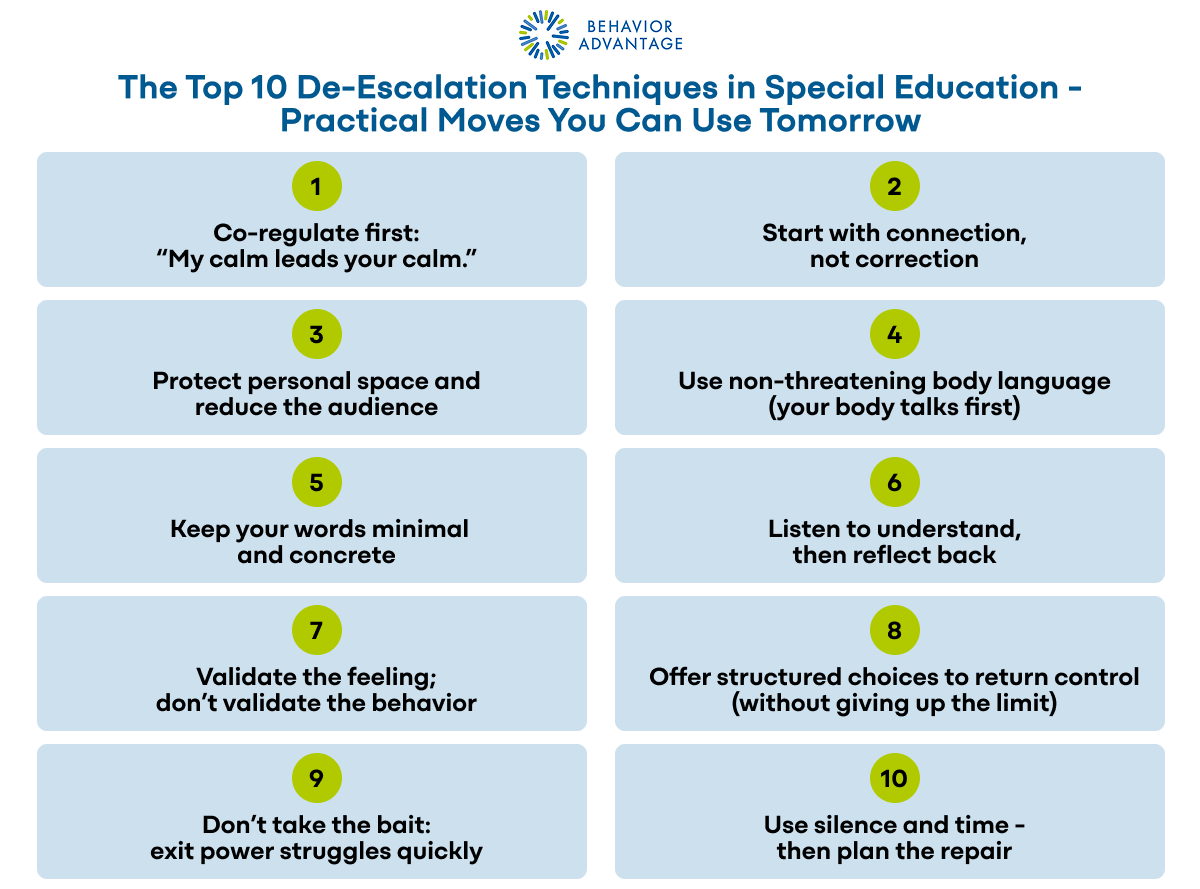
The Top 10 De-Escalation Techniques – Practical Moves You Can Use Tomorrow
1) Co-regulate first: “My calm leads your calm.”
If a student’s nervous system is overloaded, your job is to lend regulation before you expect self-regulation.
Do this:
- Slow your breathing and pace.
- Lower your voice.
- Relax your shoulders/jaw.
- Keep your face neutral (not annoyed, not shocked).
Avoid this:
- rapid-fire questions
- matching intensity (“Stop. Right now.”)
- moving closer while the student is activated
Leader question: Do staff know what “adult calm” looks like in observable terms (volume, distance, posture, pacing)?
2) Start with connection, not correction.
In escalation, students are scanning for threat. Before they can hear direction, they need to feel you’re not against them.
Do this:
- “I can see this is really hard right now.”
- “Okay, pause. We’re taking a minute.”
- “I hear you. Let’s take some space.”
Avoid this:
- Jump straight to correction (“Stop it right now.”)
- Rapid questions (“What’s wrong with you?” “Why would you do that?”)
- Lectures or consequences in the peak moment
Ask yourself: If the student could summarize your message in one sentence, would it be “I’m here to help you reset” or “I’m here to win this moment”?
3) Protect personal space and reduce the audience.
This is another very important de-escalation technique in special education. More attention raises the intensity. Standing too close can feel like pressure. Even supportive adults can unintentionally turn it into a “public moment.” Protect dignity by reducing the audience and giving space.
Do this:
- Step back and angle your body to safely and discretely monitor the student.
- Move the class routine forward (or clear peers quietly, if necessary for safety).
- Give the student space to breathe without feeling watched.
Avoid this:
- blocking doorways
- surrounding the student
- calling additional adults into the room without a purpose or plan
Team huddle prompt: Where do escalations most often happen because the environment is crowded, loud, or unpredictable?
4) Use non-threatening body language (your body talks first).
Students often respond more to what you project than what you say.
Use:
- open stance (not squared up)
- hands visible
- relaxed posture
- steady, low tone
Avoid:
- pointing
- hovering
- crossed arms + tight face
- quick movements (grabbing papers, stepping in fast)
Quick self-check: If you could watch yourself on video in this moment without sound, would your body language look supportive, or confrontational?
5) Keep your words minimal and concrete.
Escalation shrinks working memory. Too many words becomes noise or fuel. Keep instructions short and simple.
Use:
- “Pause.”
- “Take space.”
- “Sit or step to the side.”
Avoid:
- speeches
- explaining consequences
- “Why are you doing this?”
- sarcasm or “You know better.”
Leader question: Do staff feel pressure to “say the perfect thing,” or do they feel permission to say less?
We have created the De-escalation Cue Cards to help you try out different techniques. Make sure to check them out!
6) Listen to understand, then reflect back.
Students escalate when they feel misunderstood, trapped, or powerless. Listening is not agreeing; it’s lowering threat. This special education de-escalation technique requires the following:
Do this:
- “Tell me what happened.”
- “So you’re saying ___.”
- “You wanted ___, and it didn’t go that way.”
Avoid this:
- arguing details
- correcting their story mid-escalation
- “That’s not what happened.”
Ask yourself: Does the student feel heard or cross-examined?
7) Validate the feeling; don’t validate the behavior.
This is one of the most powerful “middle ground” skills for staff.
Examples:
- “I get that you’re frustrated.”
- “That felt unfair.”
- “You’re really angry right now.”
Then pair it with a boundary:
- “And I can’t let you throw things.”
- “And we’re going to keep everyone safe.”
Leader move: Coach staff to separate emotion validation from behavior permission.
8) Offer structured choices to return control (without giving up the limit).
Choice is not “negotiation.” It’s a regulated way to hand back agency.
Examples:
- “Do you want to sit here or take a break at the back table?”
- “Do you want to talk now or in two minutes?”
- “Do you want paper or Chromebook?”
Avoid:
- open-ended choices (“What do you want to do?”)
- too many options
- choices that you can’t actually honor
Consider: Are your choices designed to help the student regulate or to get compliance faster?
Looking for additional support? Try our Crisis Response Plan Template if you are having difficulties or are not sure which is the right approach for your situation.
9) Don’t take the bait: exit power struggles quickly.
Escalation often invites adults into a contest: Who’s in charge? Who’s right? Who gets the last word?
De-escalation says: don’t play.
Do this:
- repeat a neutral phrase (“I’m here to help. We’re taking a break.”)
- redirect to the next doable step
- keep your tone flat and consistent
Avoid:
- debating fairness
- matching sarcasm
- “Try me.”
- public reprimands
Leader question: Do students experience the same limits across adults or different versions of “firm”?
10) Use silence and time – then plan the repair.
Silence can feel awkward, especially in a hallway or classroom when everyone’s watching. But it often works because it reduces stimulation and removes pressure. When we keep talking, we can accidentally add demands (“explain it,” “answer me,” “decide now”). A brief pause gives the student’s nervous system a chance to settle and signals, “I’m not here to argue, I’m here to help you reset.”
Do this:
- pause
- wait
- give the student time to breathe and re-enter
Then, after regulation returns, shift to repair:
- “What happened?”
- “What helped you come back down?”
- “What should we do differently next time?”
- “How do we make this right?”
Avoid:
- demanding apologies in the peak moment
- delivering consequences while the student is still dysregulated
- skipping the debrief and calling it “done”
Ask: In your building, do students get a real repair process or do they just get removed and everyone moves on?
These strategies work best when staff don’t have to decide from scratch in the moment. A shared first 30 seconds routine creates consistency across adults and settings, so students experience the same stabilizing response no matter who is in the room.
To keep the response clear and doable, we created a downloadable lanyard-size “First 30 Seconds” card.
The First 30 Seconds: What Staff Should Do First.
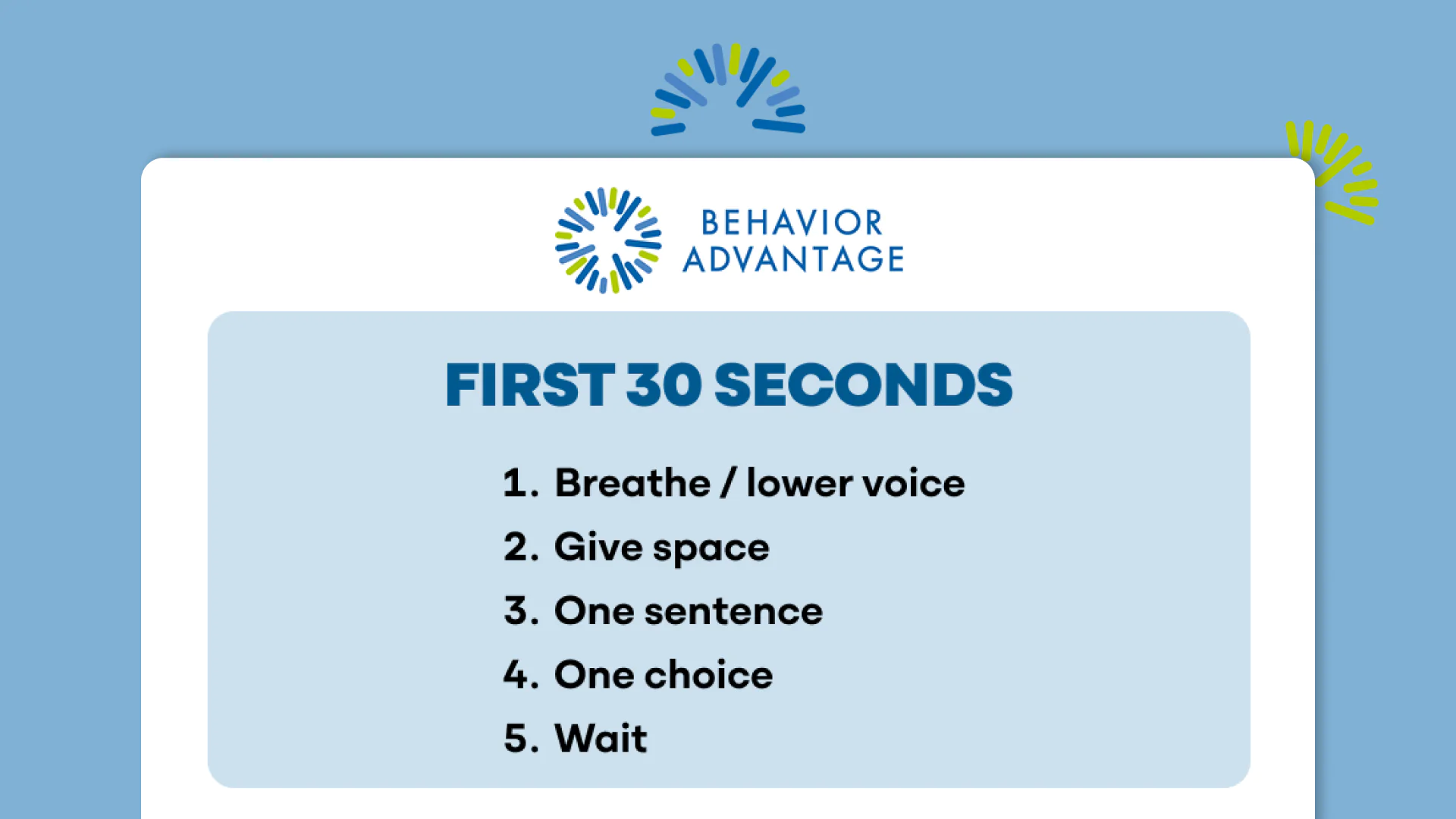
If you want something staff can remember under stress, use this sequence:
- Breathe + lower your voice
- Create space + reduce the audience
- One calm sentence (“I hear you. First we’re going to take a break.”)
- One choice (“Here or hallway?”)
- Wait (silence is allowed)
Leadership question: Have you ever practiced this as a team, out loud, when you’re not in crisis?
Common pitfalls that accidentally escalate students
These are the factors that lead to escalation to watch for in coaching:
- Too many adults talking at once
- Too many words too soon
- Public correction that triggers shame
- Cornering (physically or verbally)
- Consequences first, support later
- Inconsistent follow-through (the student learns the rule depends on the adult)
If your staff is experiencing frequent escalation, ask a systems question, not just an individual one:
What are we doing (as a building) that makes escalation more likely to happen here?
Leadership moves that make de-escalation consistent (not personality-dependent)
If you lead a building, your goal isn’t “more strategies.” It’s shared expectations + practice + support.
Consider:
- Define what staff should do in the first 30 seconds (and what not to do).
- Clarify roles (who leads, who clears space, who supports peers).
- Practice with quick role-plays in staff meetings (2 minutes, low stakes).
- Debrief patterns: Where/when does escalation spike? What routines need strengthening?
- Build the bridge back to instruction (repair, reteach, re-entry plan).
Ask: If a new staff member started tomorrow, could they learn your de-escalation expectations in one week or would they have to “pick it up” through trial and error?
Bring it to your next team huddle
Use these three questions to turn this into action:
- Where is escalation most likely right now? (routine, time, location)
- Which Top 10 technique do we want to get better at this month? (pick one)
- What would consistency look like across adults? (one shared phrase, one shared move, one shared boundary).
The Goal: Predictable Adult Responses
De-escalation techniques aren’t just about having the perfect words. They are a stabilizing practice, a set of predictable adult moves that lower intensity, protect dignity, and keep boundaries clear so a student can get back to a place where learning and problem-solving are possible.
If you want this to stick building-wide, don’t try to “do all ten.” Pick one technique your staff can practice consistently (the same way you’d practice a fire drill or a routine), and build from there. Consistency is what turns good intentions into real safety and follow-through.
Want help making de-escalation more consistent across adults, settings, and teams? Reach out to schedule a quick walkthrough of Behavior Advantage. We’ll show you how schools document clear responses, track what’s working, and build a system that doesn’t depend on who’s in the room.