

Behavior Intervention Plans (BIPs) are meant to support students, not overwhelm staff. Yet many plans become overly complex, hard to implement consistently, or disconnected from what actually happens in classrooms and common school settings.
The good news is that small, intentional adjustments can make a big difference.
Whether you are a teacher implementing a plan, a counselor or psychologist supporting multiple students, or a school team member reviewing BIPs across tiers, these five practical strategies can help improve the quality, usability, and impact of your behavior plans.
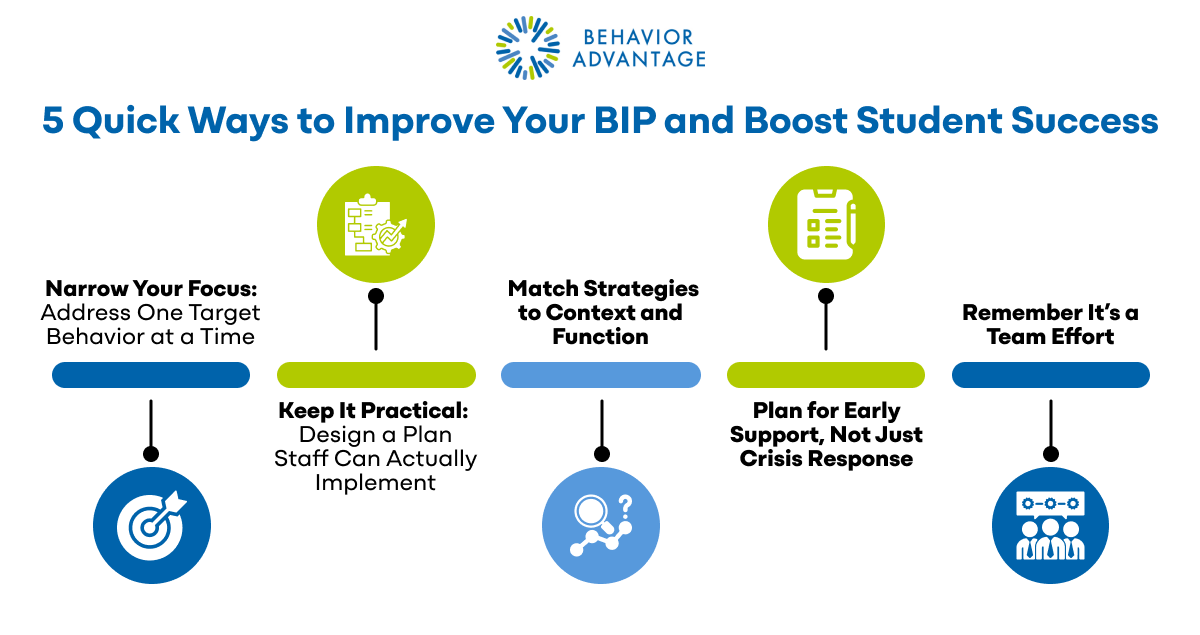
1. Narrow Your Focus: Address One Target Behavior at a Time
One of the most common challenges in BIPs is trying to fix everything at once.
When a plan targets multiple behaviors simultaneously (for example, noncompliance, aggression, work refusal, and disruption), it becomes harder to teach skills, reinforce progress, and know what is actually working.
A more effective approach:
Start with one clearly defined target behavior that is most impactful or most likely to improve access to learning and instruction.
What this looks like across grade levels:
- Pre-K/Kindergarten: Focus on “leaving the group during circle time” rather than every challenging behavior observed throughout the day.
- 1st/2nd Grade: Target “calling out during whole-group instruction” instead of all forms of classroom disruption.
- 3rd/4th Grade: Prioritize “work refusal during independent writing” rather than refusal across all subjects.
- Middle/High School: Focus on “skipping class after lunch” instead of general attendance concerns.
When teams narrow their focus, plans are clearer, data is more meaningful, and students are more likely to experience success early.
2. Keep It Practical: Design a Plan Staff Can Actually Implement
For a BIP to be effective, it needs to be implemented consistently over weeks, not just days. That consistency is far more likely when the plan feels doable.
A strong rule of thumb is to limit the number of strategies so staff can focus on quality implementation rather than remembering a long list.
Consider these practical limits:
- No more than 3 prevention strategies
- 1 replacement skill or behavior to teach initially
- Clear, simple reinforcement strategies
Examples in practice:
- Elementary classroom: Instead of listing six prevention strategies, select three that naturally fit the routine, such as previewing expectations, providing visual reminders, and offering brief check-ins.
- Middle school setting: Choose one replacement skill, like requesting a break appropriately, rather than multiple self-regulation strategies introduced at once.
When plans are simpler, staff are more confident using them, and students receive clearer, more consistent support.
Make sure to check out our comprehensive guide on how to write BIPs that work.
3. Match Strategies to Context and Function
Effective BIPs are not built around generic behavior strategies, they are grounded in understanding when, where, and why behavior is occurring.
Before selecting strategies, teams should ensure they have a clear picture of:
- The context (specific routines, settings, or times)
- The pattern (what typically happens before and after the behavior)
- The function (what the student may be trying to gain or avoid)
Align prevention strategies with real-world triggers:
- If behavior occurs during group work, strategies might include structured roles, adjusted seating, or increased adult proximity.
- If behavior happens during transitions, supports may include visual schedules, warnings before transitions, or peer escorts.
- If behavior is more likely during academic demand, consider instructional adjustments or pre-teaching expectations.
Across grade levels, the key question is the same:
Does this strategy actually address what the student experiences in that moment?
4. Plan for Early Support, Not Just Crisis Response
Many BIPs focus heavily on what staff should do after a target behavior occurs. While response strategies matter, the most effective plans also guide staff on how to respond before behavior escalates.
This means identifying and supporting early indicators of escalation, which often go unnoticed or unaddressed.
Examples of early indicators:
- Increased fidgeting or avoidance
- Withdrawing from peers
- Verbal complaints or sarcasm
- Putting head down or shutting down
Supportive, proactive responses might include:
- Brief check-ins
- Offering choices
- Prompting the replacement skill
- Adjusting demands temporarily
Across settings, this approach helps staff intervene earlier, reduces power struggles, and keeps students engaged in learning rather than discipline cycles.
We have also prepared a list of the 5 most common mistakes that you should avoid.
5. Remember It’s a Team Effort
A BIP should never be designed or implemented in isolation.
Plans are strongest when they reflect collaboration between:
- Teachers who know the classroom realities
- Support staff who can provide coaching and follow-up
- Students, when appropriate, who benefit from understanding and practicing new skill
Key team considerations:
- Involve teachers early to ensure strategies are feasible.
Rather than sharing the BIP with teachers only after it has been fully drafted or finalized, include their input from the beginning. This ensures their perspective is reflected and helps identify strategies that are realistic to implement. Teachers can support the selection and narrowing of proposed strategies, and brief interviews or forms can be used to efficiently gather their input on the context and patterns of behavior. - Identify at least one team member who can provide training or coaching beyond the classroom teacher.
For more pervasive or complex behaviors, a multidisciplinary team approach can be especially valuable. Even for an initial Tier 2 BIP, having at least one additional staff member involved can be critical for effective development, implementation, and monitoring. Teachers, including those highly skilled in behavior intervention, benefit from collaboration that provides support and promotes accountability. - Include student voice when possible to build motivation and ownership.
At its core, a BIP is a teaching plan designed to help students learn appropriate ways to meet their wants and needs. When students understand how new skills connect to better outcomes, they are more likely to engage. Whenever possible, incorporate their input, particularly when developing prompts and cues that serve as supportive reminders for when and how to use new skills.
For older students especially, involving them in goal-setting and reflection can significantly improve buy-in and accountability.
Download our Behavior Intervention Plan Template to start planning right away!
Bringing It All Together
High-quality BIPs do not need to be lengthy or complicated. They need to be clear, focused, and grounded in everyday school contexts.
By narrowing your target, keeping plans practical, aligning strategies with context and function, supporting early intervention, and leaning into teamwork, you can create behavior plans that are easier to implement and more likely to improve student outcomes.
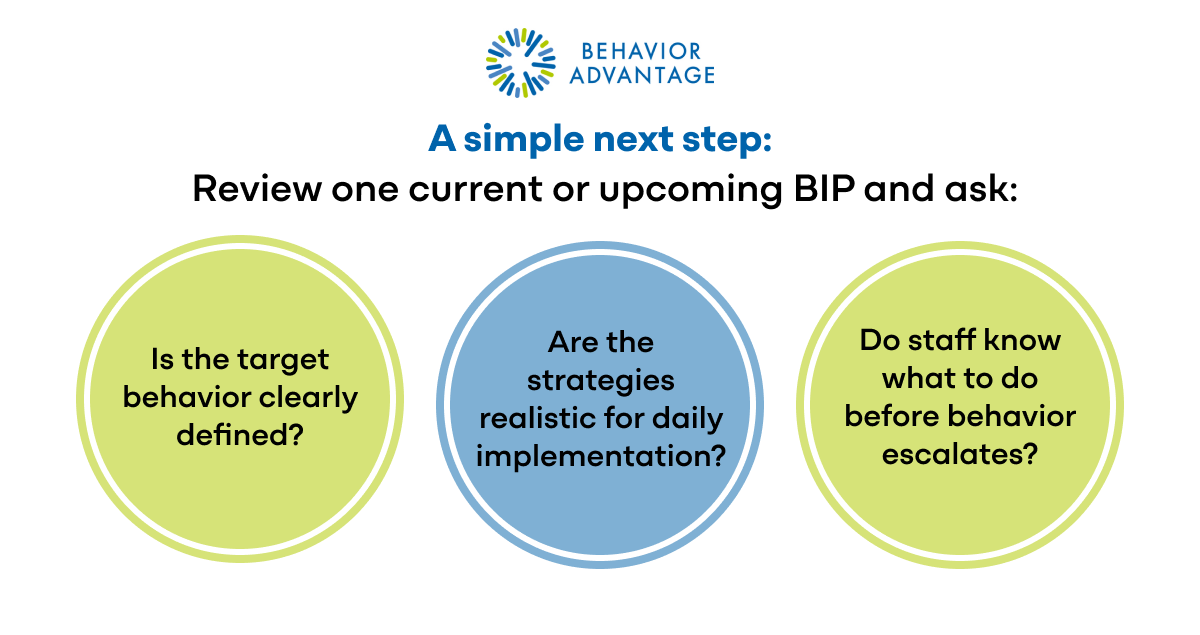
A simple next step:
Review one current or upcoming BIP and ask:
- Is the target behavior clearly defined?
- Are the strategies realistic for daily implementation?
- Do staff know what to do before behavior escalates?
If your school or district is looking for ways to streamline how BIPs are created, implemented, and monitored across teams, tools like Behavior Advantage can help bring consistency, clarity, and shared ownership to the process, while still keeping plans student-centered and practical.
Small changes add up, and when BIPs work better for staff, they work better for students too.
Interested in learning more about Behavior Advantage? Connect with a member of our team. Already a Behavior Advantage partner? We’re always here to help and answer questions, just email us at support@behavioradvantage.com.