

Your MTSS framework might look solid.
Three tiers. Referral processes. Progress monitoring. Team meetings on the calendar.
But here’s the uncomfortable truth many schools run into by winter:
If MTSS-B isn’t improving outcomes, the issue is rarely “not enough interventions.”
It’s almost always a systems problem showing up through students.
When MTSS isn’t working, it shows up in two places at once:
- an individual student who isn’t improving, and
- a system that quietly isn’t aligned, supported, or built for consistency.
You have to look at both.
If you are wondering where to start from – check out our MTSS-B Coordinator Checklist. It is full of useful tips that can help you and your team make progress!
When MTSS Isn’t Working for an Individual Student
Most teams first notice MTSS “isn’t working” when a student isn’t responding to support. The same behaviors continue. Progress plateaus. Plans get rewritten. Frustration builds.
At that point, the natural response is to add something else – another intervention, another check-in, another adult, another form.
But effective MTSS problem-solving doesn’t start with what to add.
It starts with what to understand.
Teams have to pause and ask:
- Do we actually understand why this behavior is happening?
- Are we changing the environment, or only reacting to behavior?
- Is the student being taught replacement skills? Or is the behavior simply being managed?
- Are adults responding in consistent, predictable ways across settings?
When behavior supports don’t work at the student level, it’s often not because teams aren’t trying hard enough. It’s because the system hasn’t yet created a shared understanding of what’s triggering and maintaining the behavior, supports aren’t clearly matched to student need, adult responses vary from classroom to classroom, or plans lack structures that make follow-through consistent.
A non-response to intervention is a signal. Something about the design, alignment, or implementation of support needs to change.
And that signal rarely belongs only to the student.
When MTSS Isn’t Working as a System
If multiple students are struggling, staff feel like they’re constantly reacting, and concerns escalate quickly, the issue is no longer the individual student. It’s systemic.
One of the most common breakdowns is misalignment. Tier 1 teaches schoolwide expectations and routines. Tier 3 relies on highly individualized plans. But Tier 2, the bridge between them, is often the least developed part of the system.
Instead of a strong layer of targeted, function-informed supports, teams jump quickly from Tier 1 frustration to Tier 3 plans.
What this looks like in practice:
Teachers refer students straight to individualized supports without first receiving targeted, skill-building interventions.
Meetings focus on writing plans instead of designing interventions.
Specialists carry large Tier 3 caseloads because Tier 2 structures don’t exist to absorb need.
Every concern feels urgent and intensive.
Without a functioning Tier 2, MTSS loses its bridge.
There’s no place for students to receive timely, targeted support. No space to test strategies, teach replacement skills, and adjust environments before individualization is required.
And Tier 3 becomes overloaded. This doesn’t happen because every student needs it, but because the system has nowhere else to respond.
That is not a Tier 3 problem.
That is a Tier 2 systems problem.
This breakdown is often compounded by fragile implementation. You may have strong forms, solid meeting structures, and thoughtful teams. But without clear ownership, shared language, and visible systems for follow-through, behavior plans live in folders instead of classrooms. And inconsistency quickly becomes the norm.
Why Behavior MTSS Stops Working
Many schools believe they have a Tier 1 issue, a Tier 2 issue, and a Tier 3 issue.
In reality, they often have one core issue:
the system does not consistently teach, reinforce, and respond to behavior in the same way across tiers.
So when students don’t improve, teams stack supports on top of a shaky foundation.
No amount of Tier 2 intervention can compensate for unclear expectations, unpredictable adult responses, weak fidelity, or a lack of function-based thinking.
Red Flags That MTSS Isn’t Working
Leaders often ask, “How do I know if our behavior MTSS is actually effective?”
The answer rarely comes from a single data point. Look for these patterns:
Tier 2 caseloads grow all year.
The same students rotate through different supports.
Behavior data stays flat despite more being added.
Teachers describe plans differently depending on who you ask.
Families receive inconsistent messages from the school.
Staff frustration rises and ownership feels unclear.
These are not compliance issues.
They are system design issues.
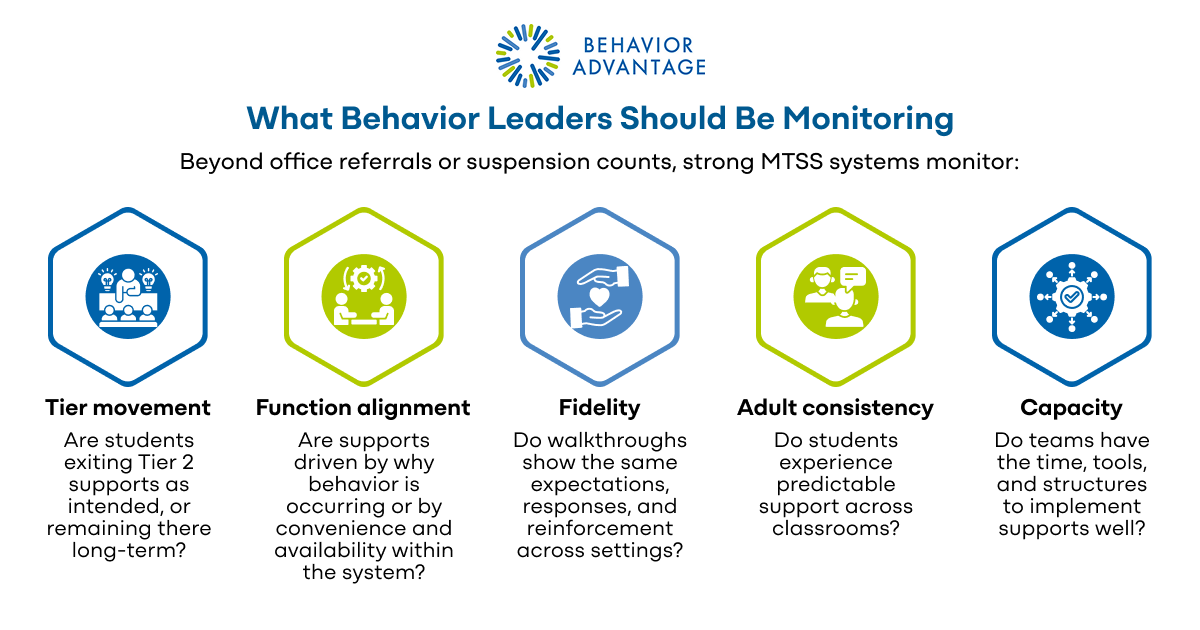
What Behavior Leaders Should Be Monitoring
Beyond office referrals or suspension counts, strong MTSS systems monitor:
- Tier movement: Are students exiting Tier 2 supports as intended, or remaining there long-term?
- Function alignment: Are supports driven by why behavior is occurring or by convenience and availability within the system?
- Fidelity: Do walkthroughs show the same expectations, responses, and reinforcement across settings?
- Adult consistency: Do students experience predictable support across classrooms?
- Capacity: Do teams have the time, tools, and structures to implement supports well?
The Questions That Shift Systems
Whether you’re in a data meeting, an MTSS review, or a walkthrough, these questions change the work:
- Are Tier 2 and 3 supports reinforcing what students experience in Tier 1 or replacing it?
- When students receive more support, are we focused on skill building or just increasing supervision?
- Do our systems make consistency easier… or harder?
- If we removed half our interventions tomorrow, what structures would still hold?
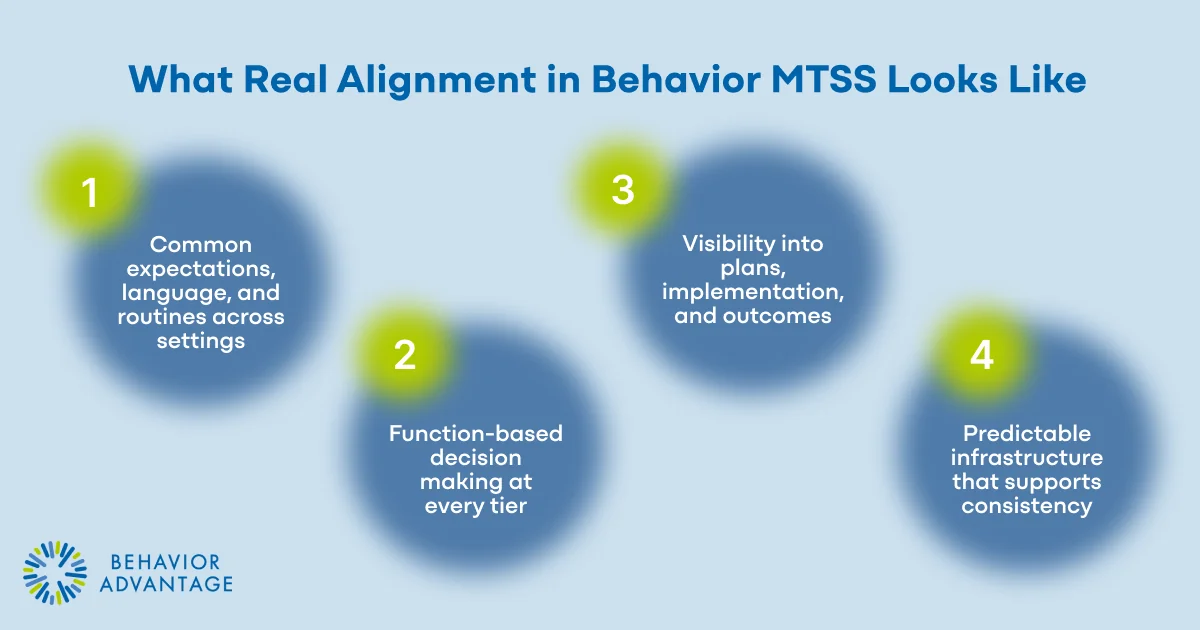
What Real Alignment in Behavior MTSS Looks Like
Aligned behavior systems are intentionally built. They don’t rely on individual effort to hold them together.
- Common expectations, language, and routines across settings
For example, hallway, classroom, and common-area expectations are the same for all students, regardless of where they fall on the MTSS Pyramid for behavior supports, Tier 1, Tier 2, or Tier 3. They are explicitly taught, practiced, and reinforced schoolwide so students experience predictability wherever they go. Additional supports don’t create a new behavior system; they strengthen the one already in place.
- Function-based decision making at every tier
Teams design supports based on why behavior is happening, not just what it looks like. Tier 2 interventions reinforce Tier 1 expectations and teach replacement skills connected to those expectations. Tier 3 plans provide individualized supports, while students continue working toward the same Tier 1 expectations. The system is individualized, not replaced.
- Visibility into plans, implementation, and outcomes
Teams can easily see what supports are in place, how they’re being implemented, who owns each piece, and whether they’re working. This visibility extends across classrooms, schools, and tiers.
- Predictable infrastructure that supports consistency
Clear systems and routines make expectations predictable and follow-through consistent. Teams know where plans live, how data is reviewed, and who owns next steps. These steps ensure that teams can actually implement supports consistently over time.
When alignment exists, Tier 2 and Tier 3 function as intended – temporary, targeted, and responsive. Students move through supports instead of getting stuck in them.
We have written a guide on How to Build a Schoolwide Behavior Monitoring System – give it a read and see if can give you some ideas.
When MTSS Isn’t Working, Start With a Systems Check

When students don’t respond, it’s tempting to immediately redesign the student plan.
Sometimes that’s needed.
But sustainable change happens when schools zoom out before they zoom in.
Many districts use tools like the Tiered Fidelity Inventory (TFI) to check and monitor the fidelity of their behavior systems. The TFI is a strong resource for understanding how closely implementation aligns with PBIS and MTSS-B best practices.
And not every team is there yet – or they’re ready to go deeper.
Some schools are still building foundations. Others are looking for a way to start (or deepen) the conversation now without launching a full fidelity cycle.
That’s why we built a Behavior MTSS Systems Check – a structured way for districts and schools to examine Tier 1 health, tier alignment, intervention design, data use, and implementation systems, and to see how student-level problem solving fits inside the larger picture.
Not as an audit.
As a conversation tool.
Because when MTSS isn’t working, the goal isn’t more layers.
It’s stronger foundations.
If you want to learn more about how you can improve MTSS, get in touch.