

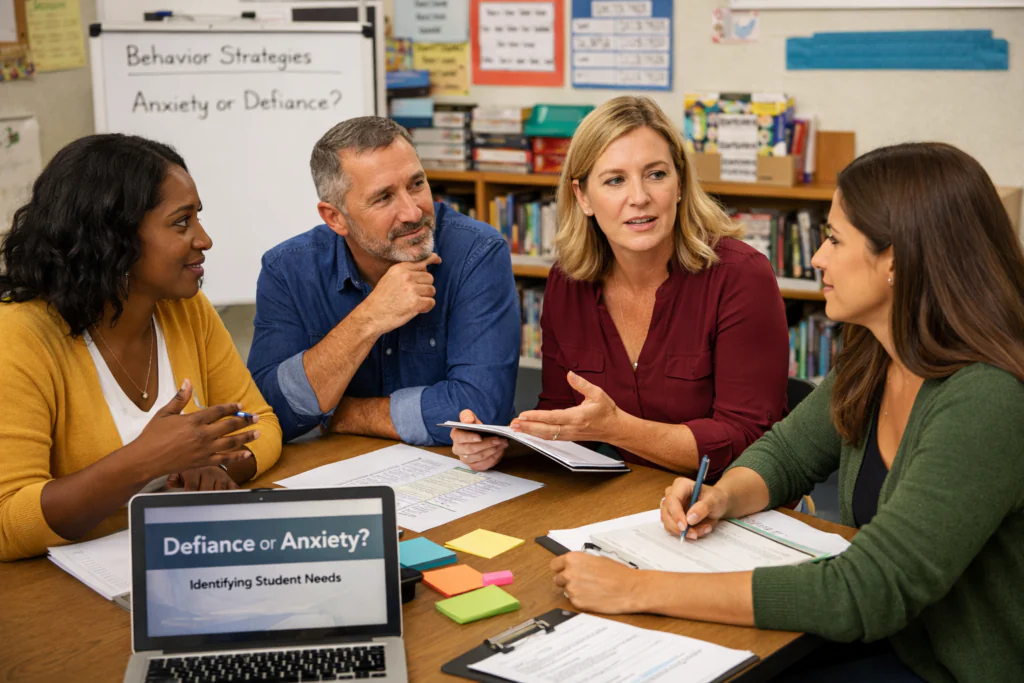
A student refuses to begin work. Another argues when corrected. Another puts their head down, shuts down, or asks to leave every time a task feels hard.
At some point, most school teams ask the question: Is this defiance, or is it student anxiety?
It is a fair question. But in practice, it is not always the most useful place to start.
The challenge is that “defiance” and “anxiety” are not directly observable in the classroom. What educators actually see are behaviors such as refusal, delay, shutdown, arguing, escape, emotional escalation, or ongoing efforts to avoid a task, transition, correction, or social situation. Even when the underlying experience is different, the behavior on the surface may look much the same.
In many cases, the better first question is this: What is the student trying to get away from, and what do we need to teach so they can respond more successfully?
That shift matters. It helps teams stay grounded in what is observable, measurable, and teachable. It also keeps the focus on building support plans that lead to consistency across staff, which is one reason strong behavior intervention plans matter so much in schools.
Start with what you can actually observe
When teams use terms like defiant or anxious too quickly, they can accidentally move away from precision. Those labels may reflect hypotheses, but they are not yet operational definitions.
Focusing too heavily on labels can also unintentionally promote the idea that a student is showing a fixed trait rather than a behavior pattern or skill deficit that can be shaped over time. When teams shift away from labels and back toward observable behavior, context, and teachable skills, they are more likely to find practical solutions instead of getting stuck in blame, confusion, or overwhelm.
A more useful starting point is to define the actual behavior in clear, objective, and measurable terms.
For example, a student described as “defiant” might be engaging in:
Verbal refusal or noncompliance, defined as saying “no,” arguing, pushing materials away, ignoring a teacher direction for more than 30 seconds, or leaving the assigned area within 10 seconds of a directive.
A student described as “anxious” might be engaging in:
Avoidance or withdrawal, defined as putting their head down, delaying task initiation for more than two minutes, repeatedly requesting reassurance, asking to leave, reporting physical discomfort, crying, freezing, or refusing to respond during an academic or social demand.
These behaviors may look different in some cases. But often, they overlap quite a bit. A student who argues may be trying to escape embarrassment. A student who shuts down may be trying to avoid failure. A student who becomes loud, rigid, or oppositional may be responding to overwhelm, uncertainty, or perceived threat.
That is why observable behavior matters so much. It gives teams something concrete to analyze, discuss, and monitor. It also supports more thoughtful decision-making about function, replacement skills, and next steps.
Does it actually matter whether it is defiance or student anxiety?
Sometimes, yes.
There are situations where it is important to consider whether anxiety may be playing a major role. Anxiety can warrant counseling collaboration, family partnership, broader mental health screening, or referral for additional support. It can also influence how a team interprets triggers, escalation patterns, and the pacing of intervention.
At the same time, school teams can get stuck if they treat this as a strict either-or question.
A student may be anxious and oppositional. A student may show a long history of escape-maintained noncompliance that now includes genuine worry, panic, or shame. Another student may appear defiant when they are actually overwhelmed, under-skilled, or uncertain how to begin.
So yes, the distinction can matter. But it is often not the first thing that matters.
The first task is usually to identify the pattern:
- What situations reliably trigger the behavior?
- What does the student do?
- What happens right after?
- What might the student be escaping or avoiding?
- What skill is missing?
- What more appropriate behavior could serve a similar purpose?
When teams begin there, they are more likely to build plans that are practical, teachable, and aligned across staff. In many cases, students benefit most when the strategies taught in counseling are reinforced consistently in the classroom, with clear staff responses and shared expectations across settings.
The short-term relief of avoidance can create long-term problems
This is one of the most important ideas for teams to understand.
Whether a student is escaping because of anxiety, frustration, low confidence, task difficulty, social stress, or a history of power struggles, avoidance often “works” in the moment. The task goes away. The discomfort drops. The adult backs off. The student experiences relief.
That is exactly why avoidance becomes so powerful.
In the short term, escape can reduce distress. But when avoiding hard tasks or uncomfortable situations becomes the student’s main coping strategy, the pattern often grows stronger over time. The student gets more practice escaping than coping. The task becomes more loaded. The anxiety may increase. The adult response may become less consistent. And the student’s confidence in handling the situation independently may continue to shrink.
This does not mean schools should force students through overwhelming situations with no support. It does mean that repeated removal of the demand, without teaching a better way to cope and re-engage, can accidentally reinforce the very pattern the team is trying to reduce.
That is why a supportive plan should go beyond simply helping the student escape more appropriately. The goal is not just to reduce disruption. The goal is to help the student gradually tolerate, manage, and participate in situations that have become difficult.
That perspective also fits well within trauma-informed behavior support, where the focus is not on forcing compliance, but on reducing threat, increasing predictability, teaching regulation, and helping students safely build capacity over time.
The replacement behaviors may be more similar than teams expect
This is where the conversation becomes especially useful.
Even when adults disagree about whether a student is “being defiant” or “feeling anxious,” the replacement behaviors we teach may be very similar.
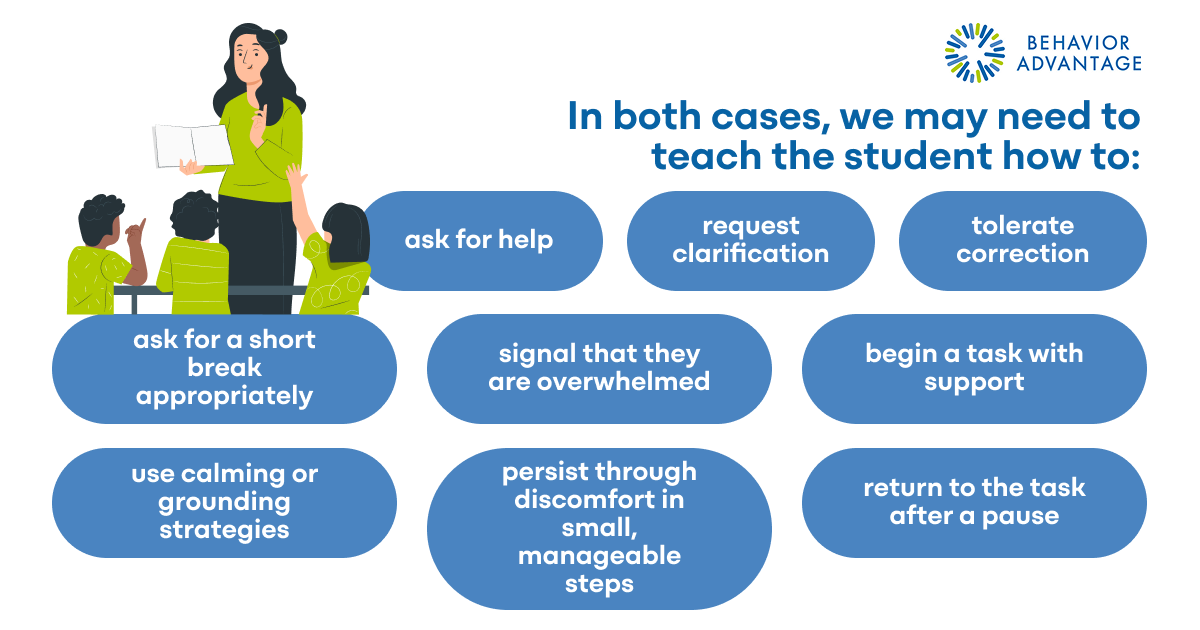
In both cases, we may need to teach the student how to:
- ask for help
- ask for a short break appropriately
- request clarification
- signal that they are overwhelmed
- begin a task with support
- tolerate correction
- use calming or grounding strategies
- return to the task after a pause
- persist through discomfort in small, manageable steps
That is one reason function-based thinking is so valuable. It helps the team move beyond guessing at why the behavior is happening and toward identifying the skills, supports, and replacement behaviors the student actually needs.
A student who currently argues to avoid writing may need to learn how to say, “Can you help me get started?” A student who shuts down during group work may need to learn how to request a role, use a script, or participate for a shorter interval before gradually doing more. A student who leaves class during difficult moments may need a structured routine for requesting a brief regulated break and then returning.
In each case, the replacement behavior is not just “ask to get out of it.” It should help the student get their needs met in a socially appropriate way while also moving toward participation rather than long-term avoidance.
This is also where CICO as a Tier 2 intervention can play a helpful role for some students. When a student is struggling with work completion, transitions, emotional regulation, or classroom expectations, CICO can provide structure, encouragement, feedback, and coaching around a small set of clearly defined goals throughout the day.
Support should include both accommodation and skill-building
For many students, especially when behavior is already highly disruptive or avoidance is well established, the plan may need to begin with short-term supports that lower the immediate level of difficulty.
That might include:
- chunking assignments
- reducing the response effort needed to begin
- providing previewing or priming
- offering brief adult check-ins
- using a visual task sequence
- allowing an appropriate break request
- changing the format of the initial demand
Those supports can be important. But they should not become the entire intervention.
If the student only gets better at delaying, escaping, or avoiding, the core challenge remains. So the plan also needs a path toward building tolerance, coping, and perseverance.
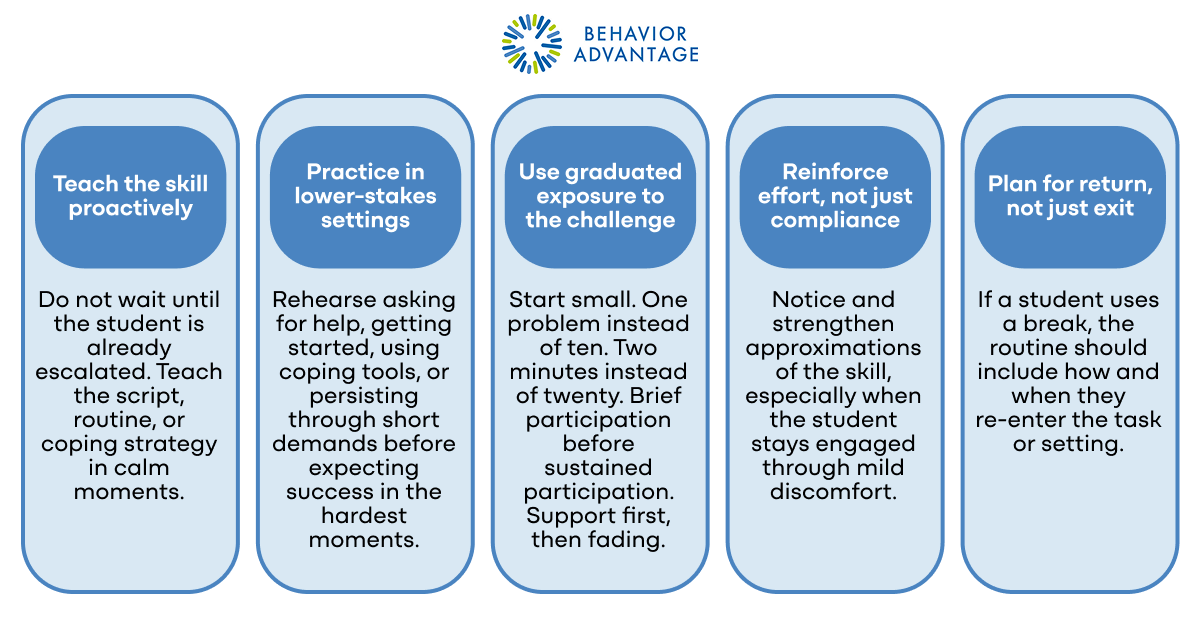
That often means:
- Teach the skill proactively.
Do not wait until the student is already escalated. Teach the script, routine, or coping strategy in calm moments. - Practice in lower-stakes settings.
Rehearse asking for help, getting started, using coping tools, or persisting through short demands before expecting success in the hardest moments. - Use graduated exposure to the challenge.
Start small. One problem instead of ten. Two minutes instead of twenty. Brief participation before sustained participation. Support first, then fading. - Reinforce effort, not just compliance.
Notice and strengthen approximations of the skill, especially when the student stays engaged through mild discomfort. - Plan for return, not just exit.
If a student uses a break, the routine should include how and when they re-enter the task or setting.
This is often the heart of meaningful behavior support. We are not just trying to stop the visible behavior. We are teaching students how to handle hard things more successfully, which is why teaching replacement behaviors in a BIP is such an important part of turning plans into practice.
The real goal is not a better label. It is a better plan.
In schools, the label matters less than people sometimes think, and the plan matters more.
If a student’s behavior is best understood as a result of anxiety, that should inform the team’s empathy, collaboration, and pacing. If a student’s behavior is more oppositional, that may shape how the team thinks about consistency, adult responses, and escalation patterns. But in both cases, teams still need to define the behavior clearly, understand the context, identify the likely function, and teach replacement behaviors that move the student toward success. A well-designed plan can also support broader social-emotional and mental health goals by helping teams respond consistently and teach the skills students need in challenging moments.
So when teams ask, “Is it defiance or student anxiety?” the most practical answer may be:
Possibly both. But either way, what is the student trying to avoid, and what do we need to teach so they can cope, participate, and persevere more successfully?
That is where meaningful support begins. And that is where schools are most likely to move beyond labels and toward behavior plans that actually change practice.
If your team is looking for practical ways to strengthen functional thinking, build consistent support across staff, and create behavior plans that lead to real implementation, the Behavior Advantage team of experienced school-based BCBAs would be glad to connect. Schedule a demo to learn more about how we partner with schools and districts to promote practical, skill-based behavior support.