


How Coaches and Leaders Can Help Educators Respond with Calm, Clarity, and Consistency
Most challenging behaviors don’t appear out of nowhere – they tend to follow a predictable escalation cycle.But here’s the part we often overlook when supporting adults:
How adults respond can escalate or de-esclate a student’s behavior.
When you’re coaching teachers, paras, or support staff, your role isn’t to “fix” student behavior in the moment. It’s to help adults understand the cycle, regulate themselves, and respond in ways that prevent challenging moments from becoming crises. That shift – from reacting to responding – builds schoolwide consistency and emotional safety.
Teaching the escalation cycle is about building shared understanding, common language, and predictable responses that lower stress for everyone. Below is a practical, coaching-centered breakdown of each phase, with examples you can use during training sessions, modeling, or side-by-side coaching.
Alternatively, if you want to learn more about de-escalation techniques, read our comprehensive guide.
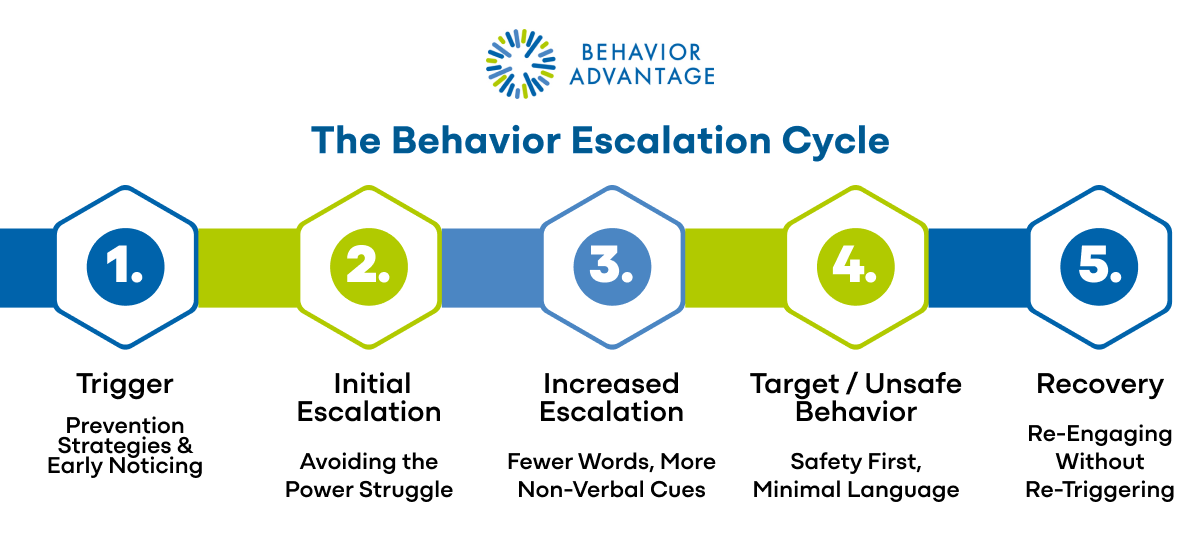
The Behavior Escalation Cycle
For clarity and consistency, we’ll use five stages:
- Trigger – early cues that signal rising stress
- Initial Escalation – pushback or protesting behavior
- Increased Escalation – heightened behavior and reduced verbal processing
- Target/Unsafe Behavior – peak behavior which may require safety-focused responses
- Recovery – the calming period where students begin to settle
While the cycle is often presented sequentially, escalation is not always linear. Some students – or adults – move through each stage in order. Others may shift quickly from a trigger to unsafe behavior with very little warning.
Understanding those patterns is essential when coaching staff to respond with flexibility, steadiness, and clarity.
Phase 1. Trigger – Early Noticing & Low-Key Support
The Trigger Phase is where coaching has an enormous impact. These are the subtle moments that, if noticed and supported early, may prevent escalation from occurring.
Example 1 (Coaching Moment – Identifying the Trigger)
Trigger:
During independent work time, the classroom becomes noisier and more active. As the environment shifts, Maya begins fidgeting, sighing, and withdrawing – early signs that the increased noise and movement are overwhelming her. Maya begins fidgeting, sighing, and withdrawing during independent work – early signs of frustration.
Coach prompt:
“Did you notice how Maya’s signs of frustration started right when the room got louder during independent reading? That environmental change is the trigger. Knowing this pattern gives you a chance to make a small shift before she escalates – either by adjusting her environment or reminding her of the choices available to her. You might say, ‘Maya, remember – if it starts to feel too loud in here, you and a friend can work in the hallway, just let me know.”
Why It Works:
When teachers recognize that a student’s behavior is tied to an environmental trigger – like increased noise – they can intervene before frustration turns into escalation. Offering a simple choice or adjusting the student’s workspace reduces sensory and cognitive overload, helping the student stay regulated and engaged. This approach also reinforces that effective support doesn’t require a major intervention; it’s about noticing patterns and responding with calm, timely adjustments. Over time, teachers begin to interpret early behaviors not as defiance, but as communication – signals that the student needs a small change to remain successful.
Example 2 (Planning With Teacher – Predictable Trigger)
Trigger:
Transitions from recess consistently create resistance for a particular student.
Coach Guidance:
“We’ve identified the transition as the trigger, let’s build a quick transition script. Something like, ‘Take a breath and grab water, then meet me at your seat.’ Addressing the trigger early prevents the escalation you’re seeing later.”
Why It Works:
Predictable stress points deserve predictable supports. Building a simple routine helps regulate the student and gives the teacher a clear, repeatable plan. This reduces transition stress and builds trust and consistency across the day.
Phase 2: Initial Escalation – Avoiding the Power Struggle
Initial Escalation involves early pushback – students testing boundaries or signaling discomfort more clearly.
Example 1 (Reframing for Teacher – Initial Escalation)
Initial Escalation:
A student mutters, “I’m not doing this,” and closes their notebook forcefully.
Coach Reflection Prompt:
“When you hear that first pushback – that’s the initial escalation. Instead of correcting the tone, try acknowledging the feeling: ‘Sounds like this feels tough. Take a minute, and we’ll work on the first part together.’”
Why It Works:
Acknowledging emotion signals safety and reduces the need for students to escalate to be heard. It also helps teachers step out of the power struggle before it begins. The combination of empathy + choice gives students an off-ramp without losing dignity.
Example 2 (Role-Play – Initial Escalation)
Initial Escalation:
A student slams a notebook during work time.
Coach Correction:
“That slam is an indication for early escalation. Drop your volume and slow your pace. Try: ‘I see this is frustrating. Take a short break then come back when you’re ready.’”
Why It Works:
Lowering voice and pace communicates calm when the student’s nervous system is speeding up. This models regulation, keeps the adult from escalating alongside the student, and gives the student a safe exit point from the moment.
Phase 3: Increased Escalation – Fewer Words, More Non-Verbal Cues
Example 1 (Real-Time Modeling – Increased Escalation)
Increased Escalation:
A student starts pacing and raising their voice.
Coach Whisper Prompt:
“Pacing like this often signals increased escalation. Use short, calm directions: ‘Pause the work. Break space over here.’ Then point. Keep the tone slow and steady.”
Why It Works:
When students are overwhelmed or becoming dysregulated, verbal processing drops. Short, neutral statements reduce cognitive demand and prevent misinterpretation. Pairing verbal and visual cues creates clarity while lowering the adult’s verbal footprint.
Example 2 (Pre-Teaching Visual Tools – Increased Escalation)
Increased Escalation:
A student frequently begins yelling or pacing when overwhelmed by difficult tasks.
Coach Explanation:
“When yelling or pacing begins, the student has moved into increased escalation and can’t take in long or complex directions. Pre-teaching the ‘Take a Break’ card ensures that in these moments, you’re offering something familiar rather than introducing new information. That familiarity reduces stress, limits verbal demands, and helps the student move toward a more regulated state.”
Why It Works:
Pre-teaching gives students a familiar cue to follow when their ability to process language is limited. In moments of overwhelm or dysregulation, the brain prioritizes safety – not new learning – so introducing a strategy in the moment can increase confusion and escalation.
When the meaning of the “Take a Break” card is taught ahead of time, it removes uncertainty and reduces cognitive load. The cue becomes predictable, non-threatening, and easy to access. It also supports teachers by providing a ready routine rather than requiring on-the-spot explanations.
Pre-teaching transforms a potentially chaotic moment into a practiced, familiar step that helps students move toward regulation without additional verbal demands.
Looking to build coaching capacity in your district? This recent article offers practical steps to help you get started: Grow Your Own Behavior Coach: A Practical Approach for Supporting Teachers With Behavior
Phase 4: Target / Unsafe Behavior – Safety First, Minimal Language
This is the peak of escalation – when behavior becomes unsafe or disruptive. Safety – not instruction – is the top priority.
Example 1 (Preparing Before an Incident – Target Behavior)
Target Behavior:
A student begins throwing objects or flipping a chair.
Coach Instruction:
“When unsafe behavior occurs, that signals the Target/Unsafe phase. Provide a single, calm direction – ‘Walk to the calm area.’ Say only that. Keeping language minimal prevents further escalation and communicates safety and clarity.”
Why It Works:
Minimal language reduces demands on a dysregulated brain and keeps the adult’s tone neutral. In peak escalation, safety – not explanation -is the priority. One clear direction prevents accidental escalation and preserves student dignity.
Example 2 (Debriefing With Teacher – Target Behavior)
Target Behavior:
A student kicks a chair after being redirected.
“That chair kick was the point of target behavior. In those moments, a simple, neutral cue like ‘Take space’ is most effective. Your calm tone made a real difference in reducing escalation.”
Why It Works:
Debriefing shifts the focus from blame to skill-building. Reinforcing calm, concise language helps adults feel more confident and prepared for future incidents.
Phase 5 Recovery – Re-Engaging Without Re-Triggering
The Recovery Phase is when students are calming but not yet fully regulated. This stage determines whether re-engagement is smooth or whether escalation restarts.
Example 1 (In-the-Moment Coaching – Recovery)
Recovery:
A student sits quietly with their head down after an outburst – calmer but still not fully regulated.
Coach Prompt:
“When you see this quiet, withdrawn posture, that’s your cue they’re in recovery. They’re not ready to talk yet. Start with: ‘I’m glad you’re feeling calmer. Take a few more minutes.’”
Why It Works:
Recovery is a vulnerable period. Gentle acknowledgment supports safety without demanding interaction. This helps rebuild trust and prepares the student for a successful return to learning.
Example 2 (Restorative Conversation – Recovery)
Recovery:
A student shows steady breathing and readiness to reconnect after taking space.
Coach Prompt:
“When their body softens and they seem more grounded, that’s your sign they can handle a brief reflection. Then you can ask questions like: ‘What made today hard?’ ‘What helped you calm?’ ‘What should we try next time?’”
Why It Works:
Restorative conversations build emotional insight and problem-solving skills, strengthening the relationship and reducing the likelihood of repeated escalation.
Putting It All Together
The primary goal in supporting student behavior is to prevent crises before they occur and build the skills students need to thrive in and out of school. Prevention is really about creating environments where students feel safe, supported, and understood. Documenting clear preventative strategies helps adults do this consistently.
Our Behavior Intervention Plan (BIP) template emphasizes prevention first and includes a response strategies section that guides teams in responding predictably when escalation does occur:
If a streamlined option is preferred, our standalone Crisis Response Plan offers a simple, focused template for consistent response across staff: Both tools help teams act proactively – and respond consistently – so students experience support, clarity, and safety throughout the escalation cycle.
Final Thought: Coaching the Cycle Is Coaching Regulation
The escalation cycle is a process to actively teach adults so they know how to respond with consistency. In many ways, the adult response is the intervention. When staff understand the stages and have practiced what to say, how to say it, and when to step back, they are far more likely to stay regulated in moments that would normally feel overwhelming.
Teaching the cycle is really about supporting adult behavior change. We’re helping teachers replace instinctive reactions with deliberate, steady responses. We’re giving them a roadmap they can trust when emotions rise – one that keeps them grounded, predictable, and aligned with the team.
Every time a teacher slows down, notices early cues, uses fewer words, or protects the Recovery Phase, they’re not just responding to a student – they’re modeling regulation and shaping a safer environment for everyone. These are the moments that help students return to learning not ashamed, but supported and understood.
And that’s the real power of teaching the escalation cycle:
A consistent, team-wide approach that strengthens adult skill, protects student dignity, reduces stress, and builds the conditions for lasting positive behavior change.
Want to equip your staff with the tools and support they need to respond with clarity and confidence?
Let’s talk. Reach out to learn how Behavior Advantage can partner with your team.