

When behavior support works well, it rarely belongs to just one team.
Students with ongoing behavior needs are often discussed by MTSS teams, IEP teams, or both – sometimes in the same month, sometimes in the same week. When those conversations are disconnected, support becomes fragmented. When they’re aligned, teams move faster, plans make more sense, and students experience consistency instead of confusion.
The challenge isn’t that educators don’t want to collaborate. It’s that systems, data, and communication structures often make collaboration harder than it needs to be.
This article focuses on how MTSS teams and IEP teams can work together effectively around behavior, using shared data, clear roles, and consistent implementation – and how the right behavior planning system can make that collaboration sustainable.
Understanding the Difference – Without Creating a Divide
The Role of the MTSS Team in Behavior Support
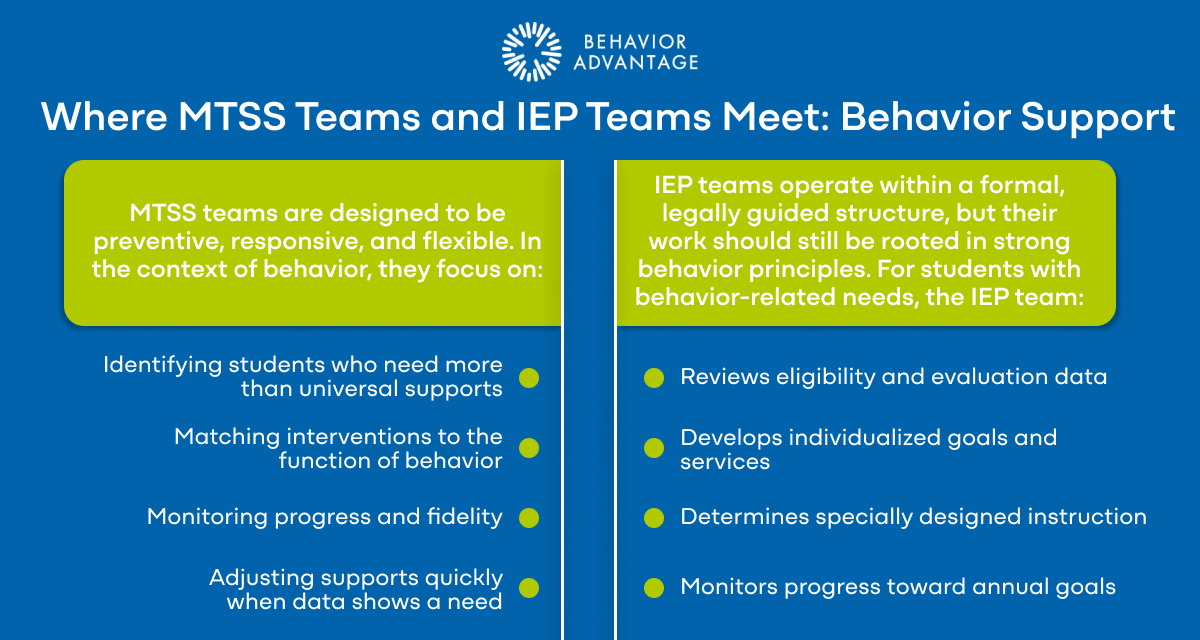
MTSS teams are designed to be preventive, responsive, and flexible. In the context of behavior, they focus on:
- Identifying students who need more than universal supports
- Matching interventions to the function of behavior
- Monitoring progress and fidelity
- Adjusting supports quickly when data shows a need
Behavior-focused MTSS work answers questions like:
- What is happening in the routine where the behavior occurs?
- What support can be tried now?
- Is the intervention being implemented as intended?
- Is the student responding?
This team often holds the most actionable, day-to-day behavior data.
Make sure to download our MTSS-B Coordinator Checklist, which includes many useful tips!
The Role of the IEP Team
IEP teams operate within a formal, legally guided structure, but their work should still be rooted in strong behavior principles. For students with behavior-related needs, the IEP team:
- Reviews eligibility and evaluation data
- Develops individualized goals and services
- Determines specially designed instruction
- Monitors progress toward annual goals
Want to learn more about IEP teams? Our comprehensive guide outlines the five key members every IEP team should have.
The IEP team depends heavily on quality intervention data, which is often generated during the MTSS process, to make sound decisions.
Where MTSS and IEP Teams Must Connect
The most successful schools don’t treat MTSS and IEP teams as separate silos. They treat them as connected problem-solving spaces that share information, language, and expectations.
Strong collaboration shows up when:
- MTSS behavior data informs IEP eligibility and goal development
- Function-based interventions don’t disappear once a student qualifies
- Teams use the same behavior definitions, routines, and data tools
- Implementation and fidelity are discussed and planned, not assumed
When this alignment is missing, teams often end up:
- Recreating plans that already exist
- Relying on anecdotal updates instead of data
- Debating interventions instead of evaluating effectiveness
Practical Strategies for Successful Collaboration
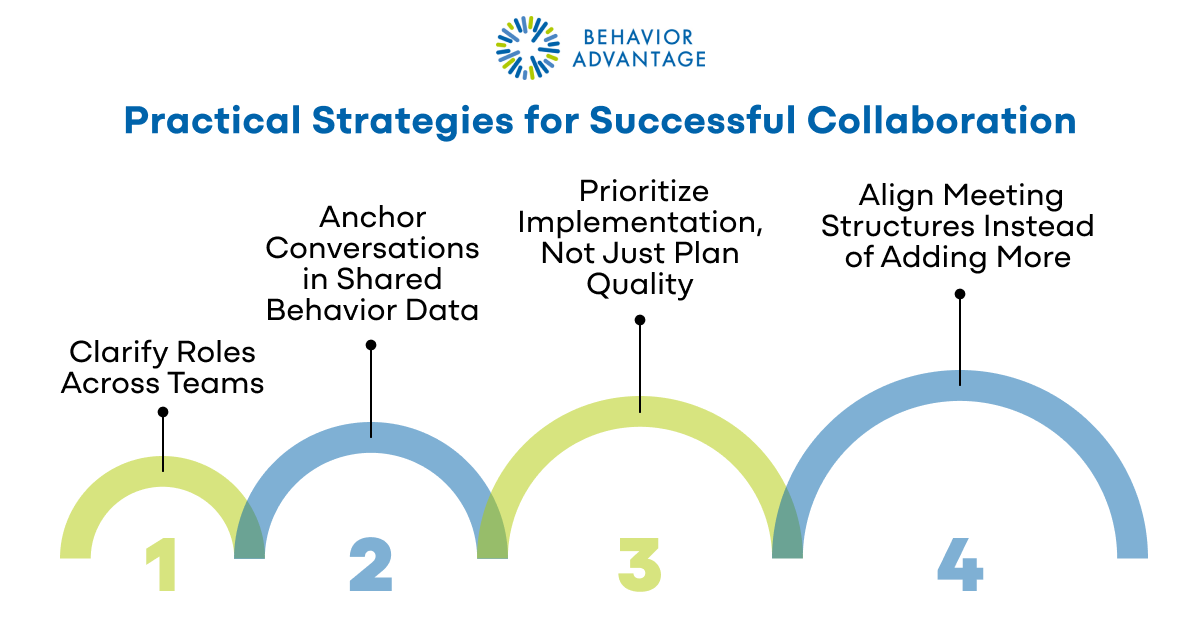
1. Clarify Roles Across Teams
Role confusion is one of the most common barriers to effective collaboration.
Helpful guiding questions:
- Who owns intervention data collection?
- Who facilitates MTSS vs IEP behavior discussions?
- Who monitors and supports fidelity?
- Who ensures follow-through between meetings?
When roles are clearly defined and documented, collaboration becomes predictable instead of dependent on memory or personalities.
Many districts benefit from using a shared behavior planning system, like Behavior Advantage, so roles, responsibilities, and next steps are visible to everyone, not buried in meeting notes or email threads.
2. Anchor Conversations in Shared Behavior Data
Collaboration improves dramatically when MTSS and IEP teams are looking at the same data.
Effective teams:
- Review intervention progress and fidelity together
- Use visuals or dashboards to guide discussion
- Focus on trends over time, not isolated incidents
- Ask, “Is this plan being implemented as designed?” before changing it
This is where systems matter. When behavior plans, data, and progress monitoring live in one place, teams don’t have to translate information between meetings – it’s already there.
3. Prioritize Implementation, Not Just Plan Quality
A strong behavior plan is only effective if it’s implemented consistently.
Too often, teams move from MTSS to IEP decisions without examining:
- Whether interventions were implemented with fidelity
- Which components were effective
- What supports staff needed to carry out the plan
Fidelity tools help teams distinguish between:
- A plan that isn’t working
- A plan that wasn’t implemented consistently
- A plan that needs refinement, not replacement
Behavior Advantage supports this work by providing a structured implementation plan for every behavior plan created, linking fidelity monitoring and targeted professional development so teams aren’t just writing plans – they’re implementing them consistently and adjusting based on real data.
4. Align Meeting Structures Instead of Adding More
Time constraints are real. Collaboration doesn’t require more meetings, it requires smarter, more intentional alignment.
Some practical approaches:
- Use MTSS behavior data as a standing agenda item in IEP meetings – it’s there if you need it!
- Schedule brief joint check-ins during transition points
- Align MTSS data review cycles with IEP progress monitoring timelines
When teams use a shared digital platform, these transitions are smoother because information doesn’t need to be recreated or re-explained.
Access Matters: Who Can See the Plan?
A critical, and often overlooked, question is:
Does everyone responsible for implementing the behavior plan actually have access to it?
If behavior plans live in PDFs, binders, or restricted systems:
- Implementation becomes inconsistent
- Fidelity is difficult to monitor
- Communication breaks down across settings
Behavior support improves when:
- Teachers, specialists, and support staff can view current plans
- Data entry is simple and role-appropriate
- Updates are visible in real time
Digital behavior planning platforms like Behavior Advantage are designed to solve this exact problem – ensuring that the right people have the right access, without increasing compliance burden.
Supporting the MTSS → IEP Transition with Strong Systems
The MTSS to IEP transition should feel like a continuation, not a reset.
That happens when:
- Behavior plans evolve instead of restarting
- Data collected during MTSS directly informs IEP decisions
- Teams speak a shared language around function and intervention
- Professional development reinforces consistent practices and shared language
Behavior Advantage supports this transition by combining:
- Function-based behavior planning
- Progress monitoring and fidelity tools
- Clear documentation across tiers
- Accessible and relevant PD to support implementation
This allows leaders and clinicians to focus on decision-making – not chasing paperwork or rebuilding plans.
The Role of Professional Development in Collaboration
Even the best systems fall apart if teams aren’t supported, and confident, in how to use them.
Effective professional development goes beyond explaining expectations. It shows teams what implementation looks like in real classrooms, building shared understanding and confidence so everyone is working from the same playbook.
Strong PD supports collaboration by helping teams:
- Translate behavior plans into daily practice
- Clarify roles and responsibilities for implementation
- Use data and fidelity tools consistently
- Practice reviewing data and making decisions as a team
When PD is embedded and ongoing, teams are more confident implementing plans with fidelity and discussing data productively. Collaboration no longer depends on a single expert – it becomes part of the system.
Behavior Advantage supports this work by pairing behavior planning tools with implementation-focused professional development, helping teams move from plan creation to consistent follow-through. This ensures MTSS and IEP teams aren’t just aligned on paper, but confident and consistent in practice – where student outcomes actually change.
The Bottom Line
Successful collaboration between MTSS and IEP teams isn’t about doing more. It’s about doing things together, on purpose, and with clarity.
When teams:
- Share behavior data
- Clarify roles
- Focus on implementation and fidelity
- Use systems that support access and communication
students experience consistent, responsive support – and educators gain confidence that their efforts are aligned and effective.
Behavior support works best when systems make collaboration easier, not harder.
See how Behavior Advantage supports consistent, collaborative behavior planning across MTSS and IEP teams.
Explore how shared data, implementation supports, and embedded professional development help teams move from plans to practice – with clarity and confidence.