


Schools gather a wide range of information about student behavior -attendance patterns, minor concerns, ODRs, and climate data – yet many teams are still searching for a clear way to make sense of it collectively. Without a structured, predictable system for reviewing key indicators, it becomes difficult to recognize early signs of need, strengthen Tier 1 practices, or respond proactively when students begin to struggle. A well-designed behavior monitoring system ensures that data is not just collected, but used consistently to surface trends, identify hotspots, and support students and staff before challenges intensify.
A strong behavior monitoring system is not defined by the platform you use. It’s defined by how consistently teams review data, what routines they follow, and how they turn information into action. This guide offers a conceptual approach for K–12 educators and leaders who want to build systems that identify patterns early and strengthen MTSS implementation across Tier 1, Tier 2, and Tier 3.
Why a Behavior Monitoring System Matters
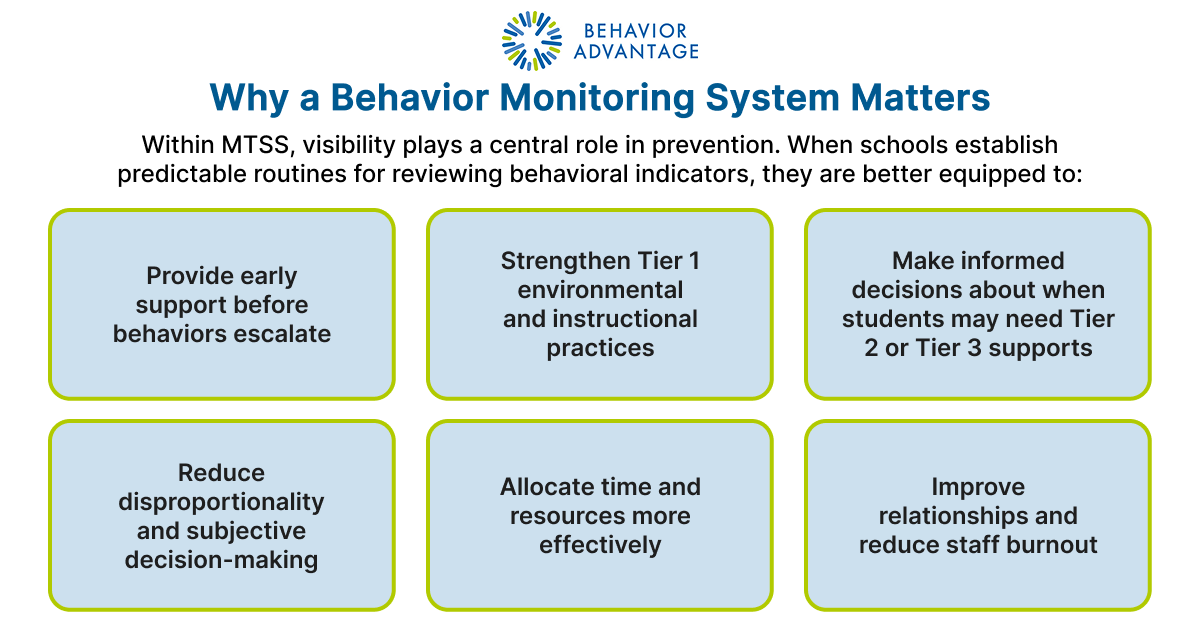
Within MTSS, visibility plays a central role in prevention. When schools establish predictable routines for reviewing behavioral indicators, they are better equipped to:
- Provide early support before behaviors escalate
- Strengthen Tier 1 environmental and instructional practices
- Make informed decisions about when students may need Tier 2 or Tier 3 supports
- Reduce disproportionality and subjective decision-making
- Allocate time and resources more effectively
- Improve relationships and reduce staff burnout
Assessment precedes intervention, and without a schoolwide system for assessing behavior, teams risk relying on anecdotes rather than trends.
The Core Components of a Schoolwide Monitoring System
A monitoring system should feel practical, predictable, and relevant to the everyday experiences of students and staff. Below are the foundational elements that make it work.
1. Clear Indicators to Watch
Schools don’t need to track everything – they need to track the right things consistently. Common behavioral indicators include:
- Attendance
- ODRs and minor referrals
- Suspensions or major incidents
- Universal screeners (e.g., SAEBRS, BESS, SRSS)
- Teacher-reported concerns
- Participation in Tier 2 supports
- Climate or supervision notes from staff
What matters is clarity and consistency. All staff should understand what each indicator means, how it is entered, and why it matters.
2. Defined Review Cycles
This is the backbone of an effective monitoring system. Schools often struggle not because they lack data, but because they lack rhythms for reviewing it.
Examples of effective review cycles include:
- Weekly: brief attendance and ODR scan
- Biweekly: Tier 2 checks and early-intervention discussions
- Monthly: schoolwide or grade-level trend review
- Quarterly: screener analysis and larger MTSS adjustments
Predictable cycles build habits and ensure that data translates into timely action.
3. Decision Rules That Drive Action
Decision rules help teams move from “data viewing” to “data doing.” They promote fairness, transparency, and consistency.
Examples of decision rules include:
- Attendance: 3+ absences in 15 days triggers Tier 1 outreach
- ODRs: 2 referrals in 30 days prompts teacher consultation or reteaching plan
- Screeners: Moderate or high-risk scores require follow-up
- Classroom Management: 2–4 weeks of enhanced Tier 1 practices (e.g., reteaching routines and expectations, using a 5:1 ratio of positive to corrective feedback) without improvement signals the need for a more targeted plan or additional support
Decision rules eliminate guesswork and help teams take action with confidence.
4. Clear Roles and Communication Routines
A monitoring system relies on shared responsibility. Roles might include:
- Principal or assistant principal
- MTSS or behavior team lead
- Counselor or school psychologist
- Dean or behavior specialist
- Grade-level or content-area teacher teams
- Attendance team
- Paraeducators or campus supervisors (e.g., recess, lunch teams)
Each role should be clear about:
- What data they bring
- What trends they watch for
- How information is communicated back to staff
- What follow-up looks like
When responsibilities are defined, teams can work collaboratively and efficiently.
Why Minor Behaviors Matter More Than You Think
Many schools unintentionally overlook early signs of behavioral need because low-level behaviors (e.g., off-task moments, noncompliance, mild disruption, or disrespect) are often:
- Managed informally
- Not entered into referral systems, or
- Viewed as too small or too frequent to record
This underreporting creates one of the biggest gaps in schoolwide monitoring systems.
Minor behaviors matter because:
- They are early indicators of disengagement or emerging skill deficits
- Patterns form quickly and become harder to change when unaddressed
- Teachers experience the strain first, long before it appears in data
- Underreporting delays targeted support and increases the likelihood of Tier 2 or 3 referrals later
- Equity suffers when only major behaviors are formally recorded
A monitoring system is only as strong as its ability to capture and reflect the everyday behaviors that shape learning environments.
Identifying Schoolwide Hotspots and Trends
Once data is consistently collected, schools can begin to see meaningful patterns. These might include:
- Locations or routines with higher frequencies of incidents
- Times of day when transitions or fatigue increase behavior challenges
- Grade-level patterns that reflect developmental needs
- Supervision gaps in recess or lunch routines
- Seasonal fluctuations such as early-fall or post-break escalation
Nearly every school has predictable hotspots. A strong monitoring system helps teams identify them early enough to adjust practices, staffing, instruction, or routines before challenges escalate.
Using Multiple Data Sources Without Overwhelming Staff
When educators hear the phrase “multiple data sources,” they often assume it means more work. But in a strong MTSS system, reviewing multiple indicators actually reduces workload by preventing repeated incidents and avoiding last-minute, high-stakes crises.
Each data source offers a different lens:
- Attendance shows disengagement
- ODRs reveal environmental or expectation-related needs
- Screener data uncovers internalizing concerns
- Teacher reports highlight early concerns before formal referrals
- Tier 2 data shows whether students are responding to intervention
The goal is not to track more, it is to track meaningfully.
Common Pitfalls Schools Experience
Even well-designed systems can struggle without consistent routines. Common pitfalls include:
- Data is collected but not regularly reviewed.
Without predictable cycles, early trends go unnoticed. - Review routines vary across teams or months.
This undermines consistency and prevents habits from forming. - ODRs are inconsistently entered, especially for minor behaviors.
Underreporting prevents teams from identifying emerging patterns, delays support, and often results in more intensive intervention needs later – when teachers are already overwhelmed. - No decision rules guide next steps.
Without thresholds, decisions become subjective and inconsistent. - Teachers don’t receive feedback on trends.
When staff are left out of the loop, buy-in decreases and progress stalls.
Building a Culture of Proactive Support
A behavior monitoring system is ultimately about supporting students and staff, not surveillance or documentation compliance. When teams commit to consistent routines, predictable cycles, and clear communication, schools create an environment where:
- Students receive help sooner
- Tier 1 practices strengthen
- Tier 2 supports become more effective
- Relationships improve
- Equity increases
- Behavioral crises decrease
Monitoring schoolwide behavior is ultimately about the systems and routines your team follows. Software can support this work, but it will only be as valuable as the processes your school uses to gather, review, and act on data. You need clarity, consistency, and a set of routines that your school commits to using year-round.
Final Thoughts
Creating a schoolwide behavior monitoring system isn’t about adding new tasks – it’s about creating clarity. Start with a few key indicators, build predictable review cycles, clarify roles, and use decision rules to guide action. When schools shift from reacting to recognizing, everything changes. Students feel supported sooner, teachers gain confidence, and schoolwide systems grow stronger.
If your schoolwide data indicates that certain students need additional support and you’re seeking a more efficient process for delivering that support, we’d love to connect. Get in touch explore systems and tools that leverage your data to help teams design, implement and monitor effective, targeted interventions.