

Teaching a classroom full of students all day is incredibly demanding work.
Teachers are asked to deliver strong academic instruction, monitor student understanding, respond to emotional needs, maintain engagement, manage transitions, support students with disabilities, communicate with families, and keep the classroom moving forward — often all at the same time.
And behavior is not separate from instruction.
When classroom behavior is going well, instruction is easier to deliver. Students participate more, transitions are smoother, relationships feel stronger, and teachers have more energy to focus on teaching. When behavior is not going well, even the best lesson plan can be hard to implement.
That is why classroom management is not a side issue. It is deeply connected to academic instruction.
And it is also why teachers often need behavior support that is practical, respectful, and doable.
The Student Who Gets the Most Attention
When we work with teachers around behavior, one situation comes up again and again.
A teacher is trying to deliver instruction, but one student’s behavior is making that extremely difficult. The student may be calling out, refusing work, arguing, moving around the room, distracting peers, or escalating during key parts of the day.
From the teacher’s perspective, the concern is completely understandable:
“If we could just get this student under control, everything would be better.”
And often, that student does need support. The teacher is not imagining the problem. The behavior may be intense, disruptive, and exhausting. It may be impacting the teacher, the student, and the rest of the class.
So a referral is made. Maybe the student is referred for additional behavior support. Maybe the team begins considering a Functional Behavior Assessment (FBA), a Behavior Intervention Plan (BIP), or another Tier 3 level response.
Not sure what those are? Check out our dedicated guies
- What Is a BIP? What Every Behavior Intervention Plan Should Include
- How to Write a Behavior Intervention Plan that Works?
Then a behavior specialist, school psychologist, counselor, or other clinician comes into the classroom to observe.
And sometimes, something important becomes clear very quickly.
Yes, the referred student is struggling.
But they are not the only one.
Several students may be off-task. A small peer group may be feeding off one another. The classroom routine may be losing structure at the same point each day. Expectations may be unclear during a specific activity. The referred student may be the most visible concern, but the overall classroom temperature is already high.
In those moments, the clinician is placed in a difficult position.
They have been asked to help the teacher support one student. But what they are seeing is a broader pattern that may require support for the classroom, the routine, or a group of students.
The Challenge of Trying to Make One Student the Most Regulated Student in the Room
This is where behavior support can get tricky.
Sometimes, without meaning to, teams begin using a Tier 3 process to solve a Tier 1 or classroom-wide problem.
A student’s name goes at the top of the FBA or behavior plan. The team identifies the student’s challenging behaviors, hypothesizes the function, teaches replacement skills, and builds supports around that student.
Those steps may be appropriate and necessary.
But if the broader classroom routine is still unpredictable or difficult for many students, an individual plan can unintentionally place too much responsibility on the referred student. The student may be working on new skills while the routine around them continues to make those skills difficult to use.
That is a very high bar.
It is especially difficult when the student is surrounded by peers who are also off-task, joking, refusing, calling out, or escalating. It is hard to teach one student to consistently raise their hand when calling out is common across the room. It is hard to teach one student to begin work independently when several nearby peers are avoiding the same task. It is hard to teach one student to stay calm when the overall routine is unpredictable, noisy, or reactive.
In other words, the student may need individual support, but the environment may also need support.
Both can be true.
When Tier 1 Gets Hidden Inside a Tier 3 Plan
Many clinicians recognize this pattern because they have lived it.
A Tier 3 referral comes in for one student, but the observation suggests that class-wide or routine-specific support is also needed. Because the clinician’s assigned role is to support the individual student, the FBA or BIP becomes the place where broader classroom strategies get added.
The plan may include things like:
- Clearer expectations
- More practice with classroom routines
- Increased positive feedback
- Behavior-specific praise
- Precorrection before difficult transitions
- Active supervision
- More opportunities to respond
- Brief, calm redirection
- Visual reminders
- Movement breaks
- Relationship-building strategies
These are all excellent strategies.
But many of them are not only Tier 3 strategies. They are also strong classroom support practices that can be used with an entire class, a small group of students, or one challenging routine. The Behavior Advantage Classroom Support Plan helps teams select from strategies such as classroom rules and expectations, practicing and rehearsing skills, consistent routines, high rates of positive feedback, opportunities to respond, active supervision, precorrection, behavior-specific praise, redirection and correction, and the 2 x 10 Strategy.
You can read and learn more about Behavior Intervention Strategies here.
So what sometimes happens is that we “Trojan horse” classroom-wide support into a Tier 3 plan. We write the plan for one student, but we quietly build in practices that would actually benefit the whole class.
This can help.
But it is not always ideal.
It can make the individual student appear to be the sole problem when the pattern is broader than one child. It can also place too much pressure on the student-specific plan. As more classroom-wide supports get added to the BIP, the plan can become long, complex, and overwhelming for the teacher to implement consistently. And it can miss an opportunity to support the teacher with a simpler, more practical class-wide strategy that could improve the routine for many students at once.
A Different Starting Point: Bring the Temperature Down First
A more helpful starting point may be a collaborative coaching conversation.
Not a conversation that says:
“This is really a classroom management problem.”
And not a conversation that dismisses the teacher’s concern about the referred student.
Instead, the conversation starts with alignment.
“You’re right. This student is making it very difficult to teach during this routine. They do need support. We are seeing that too.”
That matters.
Teachers need to know that their concerns are being taken seriously. They need to feel supported, not judged. Before a clinician can offer a broader perspective, they usually need to connect with the teacher, build trust, and communicate that they are on the same team.
From there, the conversation can gently widen.
“We’re also noticing that this routine is challenging for several students. What if we used a simple Classroom Support Plan for a few weeks to bring the temperature down for the whole group? It may not solve everything, but it might help us see what level of support this student truly needs once the routine is more stable.”
That is a very different frame.
It does not deny the individual student’s needs. It simply recognizes that before we can accurately understand how intensive the student’s needs are, we may need to strengthen the environment around them.
A Simple Classroom Support Plan
A Classroom Support Plan does not need to be complicated.
In fact, it should be simple enough that a teacher and coach can actually use it during a busy school week.
The Behavior Advantage Classroom Support Plan is being designed around four basic decisions:
One expectation.
One routine.
One or two evidence-based strategies.
A short timeframe to implement and monitor.
That order matters.
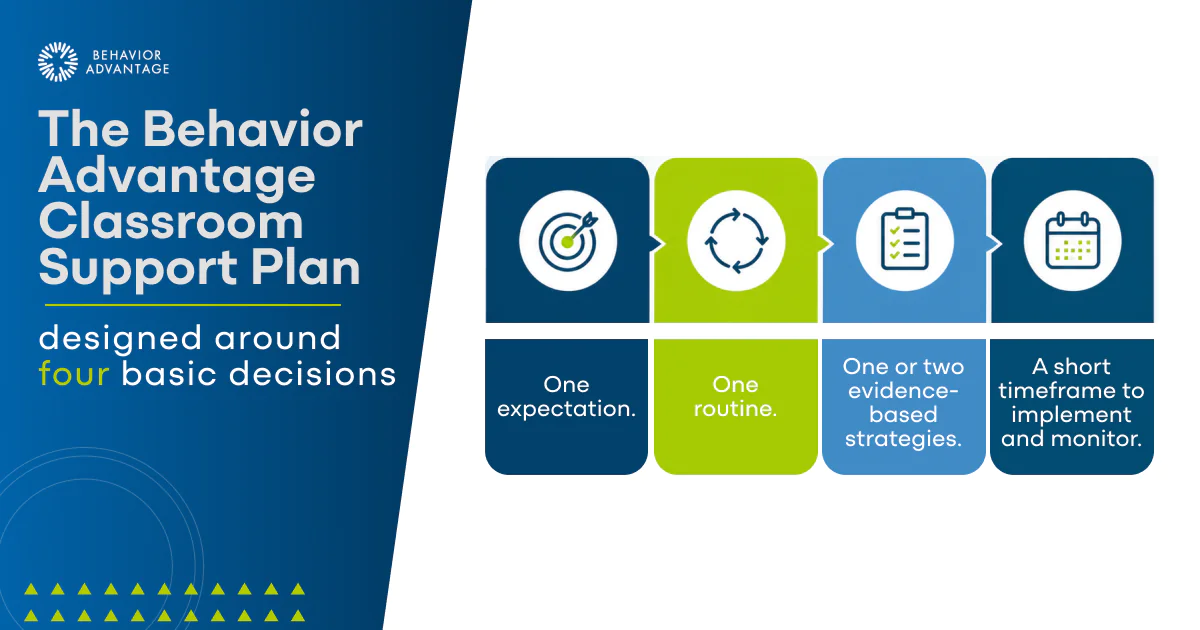
Start with the expectation or behavior the team wants to strengthen. Then identify where and when that expectation is most needed. Then select a small number of strategies that are likely to help. Then implement and monitor the plan long enough to learn whether it is making a difference.
For example:
- Respectful participation during math instruction using behavior-specific praise
- Responsible work completion during ELA using opportunities to respond
- Safe and calm transitions after lunch using precorrection
- Active engagement during small-group rotations using active supervision
- Following directions during independent work using brief redirection
This approach is manageable because it does not ask the teacher to change everything all day.
It asks the teacher and coach to identify one high-impact routine and layer in one or two strategies with intention.
The goal is not perfection.
The goal is to reduce friction, increase successful behavior, and make the routine more teachable.
You can learn more about the difference betweeen Behavior Support Plans and BIPs here.
Example 1: Respectful Participation During Math
Imagine a teacher is struggling during whole-group math instruction.
Several students are calling out, making side comments, interrupting peers, and reacting when corrected. One student is the most disruptive and has been referred for additional behavior support.
A Tier 3-only approach might focus exclusively on that student: teach hand raising, provide reinforcement for appropriate participation, and use corrective feedback when the student blurts out.
That may be needed.
But if many students are calling out, the student-specific plan may not be enough.
A simple Classroom Support Plan might look like this:
Expectation: Respectful participation
Routine: Whole-group math instruction
Strategies: Behavior-specific praise and high rates of positive feedback
Timeframe: Two weeks, then reassess
The teacher and coach might define what respectful participation looks like during math:
- Raise your hand or use the agreed-upon signal before speaking.
- Listen while others are sharing.
- Use respectful words when agreeing or disagreeing.
- Stay with the group during instruction.
The teacher and coach briefly clarify what they are looking for, but the main implementation focus stays on two strategies: behavior-specific praise and a high rate of positive feedback.
Instead of only correcting blurting, the teacher looks for and names the behavior students are already doing well:
“Thanks for raising your hand before sharing.”
“I appreciate how this table is waiting while someone else is talking.”
“Nice job disagreeing respectfully and explaining your thinking.”
“I see several students tracking the speaker and staying ready.”
The goal is not to ignore the student with the most challenging behavior.
The goal is to make respectful participation more visible, more frequent, and more reinforced across the whole class.
As the routine improves, the team can reassess.
Is the referred student still showing a level of behavior that requires a Tier 3 plan? Maybe.
Or, once the classroom routine is more stable, is the student’s behavior now more responsive to Tier 2 supports? Possibly.
Either way, the team has better information.
Example 2: Calm and Safe Transitions After Lunch
Transitions are another place where class-wide support can make a big difference.
Imagine students return from lunch loud, energized, and slow to settle. A few students run ahead, several students talk over the teacher, and one student frequently escalates when corrected.
The referred student may need additional support, especially if the transition regularly leads to conflict or removal from class.
But before building the entire plan around that one student, the team might ask:
“Is this transition predictable, practiced, and reinforced for the whole group?”
A simple Classroom Support Plan might look like this:
Expectation: Safe and calm transition
Routine: Returning from lunch to the classroom
Strategies: Precorrection and active supervision
Timeframe: Two weeks, then reassess
The teacher and coach briefly clarify the transition routine so students know what success looks like. Then the main implementation focus stays on two strategies: precorrection before the transition and active supervision during the transition.
Before students leave lunch, the teacher or support staff provides a brief precorrection:
“When we walk back, remember: calm body, quiet voice, straight to the room. When we enter, go right to the warm-up.”
During the transition, the adult uses active supervision: moving, scanning, interacting, and giving quick positive feedback.
“This group is walking safely.”
“Thanks for going straight to your seat.”
“I appreciate the quiet voices as we enter.”
The plan is not complex. But it creates predictability, reduces uncertainty, and increases the chances that all students can be successful.
And again, after a few weeks, the team can reassess whether the individual student still needs more intensive support during that transition.
This Is Not About Blaming Teachers
It is important to be very clear.
This approach is not based on the assumption that teachers are failing to use good classroom management.
Most teachers are already using many strong practices every day. They are greeting students, giving reminders, correcting behavior, building relationships, adjusting instruction, encouraging participation, and trying to keep the classroom moving.
The purpose of a Classroom Support Plan is not to suggest that nothing good is already happening.
The purpose is to layer support strategically.
A teacher may already have many strong practices in place, but one routine may still be difficult. One peer group may still be escalating. One part of the day may still be too unstructured. One expectation may need to be retaught, reinforced, practiced, or made more visible.
That is where coaching can help.
Not by asking the teacher to do more everywhere, but by helping the teacher do one high-impact thing more intentionally in one high-need routine.
The Role of the Clinician as Coach
This kind of work also gives behavior specialists, school psychologists, counselors, and other clinicians a more flexible role.
Instead of only entering the process when a student is already being considered for Tier 3 support, the clinician can help the teacher strengthen the classroom context around the concern.
That might sound like:
“Let’s still keep an eye on this student’s individual needs. But before we finalize a Tier 3 plan, let’s try a classroom plan for this routine and see what changes.”
Or:
“This student may still need individualized support, but several students are struggling during this same part of the day. Let’s support the routine first, then reassess.”
Or:
“We don’t need to overhaul the whole classroom. Let’s pick one expectation, one routine, and one or two strategies we can implement consistently for the next few weeks.”
This approach allows clinicians to support teachers without taking over the classroom and without reducing the issue to one student’s behavior.
It also helps teams make better decisions.
Sometimes the class-wide support will be enough to stabilize the routine.
Sometimes it will reveal that a small group of students needs Tier 2 support.
Sometimes it will confirm that one student still needs a more individualized Tier 3 plan.
All of those outcomes are useful.
Reassess After a Few Weeks
A Classroom Support Plan does not need to last forever.
In many cases, a two-to-four-week window is enough to learn something useful.
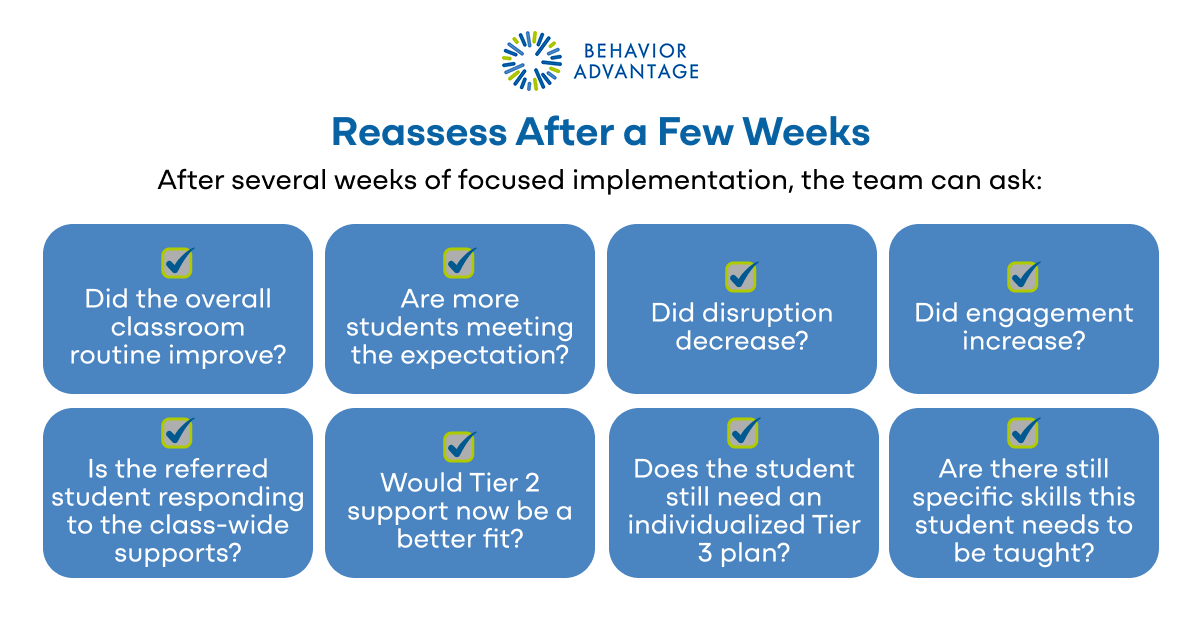
After several weeks of focused implementation, the team can ask:
- Did the overall classroom routine improve?
- Are more students meeting the expectation?
- Did disruption decrease?
- Did engagement increase?
- Is the referred student responding to the class-wide supports?
- Does the student still need an individualized Tier 3 plan?
- Would Tier 2 support now be a better fit?
- Are there still specific skills this student needs to be taught?
The plan should also include a simple way to monitor progress.
This does not need to be complicated. A quick daily rating can often tell the team whether the routine is improving and whether the strategy is being implemented consistently.
For example:
- 0 = Not yet / significant difficulty
- 1 = Some progress / inconsistent
- 2 = Met expectation / implemented well
The Behavior Advantage Classroom Support Plan includes this kind of simple plan-and-scorecard structure, with space to identify the expectation, context, selected strategies, and brief monitoring ratings across the week.
The point is not to create more paperwork.
The point is to help teams notice whether the plan is actually being used and whether student behavior is actually improving.
A Wider Net Helps More Students
When one student’s behavior is loud, disruptive, or emotionally intense, it naturally pulls attention.
That is human.
But sometimes the most effective first move is not to narrow the focus. Sometimes the better move is to widen the support.
By using a Classroom Support Plan in a targeted routine, teams can support the referred student while also helping other students who may be drifting toward more significant concerns.
This is the power of casting a wider net.
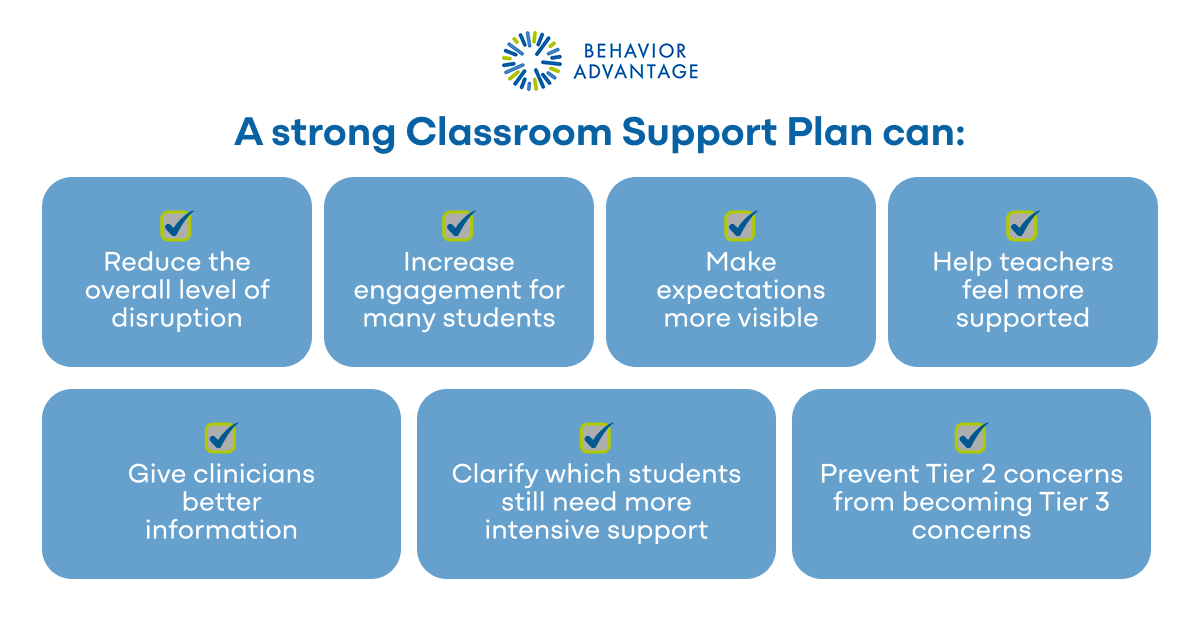
A strong Classroom Support Plan can:
- Reduce the overall level of disruption
- Increase engagement for many students
- Make expectations more visible
- Help teachers feel more supported
- Give clinicians better information
- Clarify which students still need more intensive support
- Prevent Tier 2 concerns from becoming Tier 3 concerns
And importantly, it can do all of this without requiring a complete classroom overhaul.
Just one expectation.
One routine.
One or two evidence-based strategies.
A few weeks of focused support.
Then reassess.
Try It: Download the Behavior Advantage Classroom Support Plan
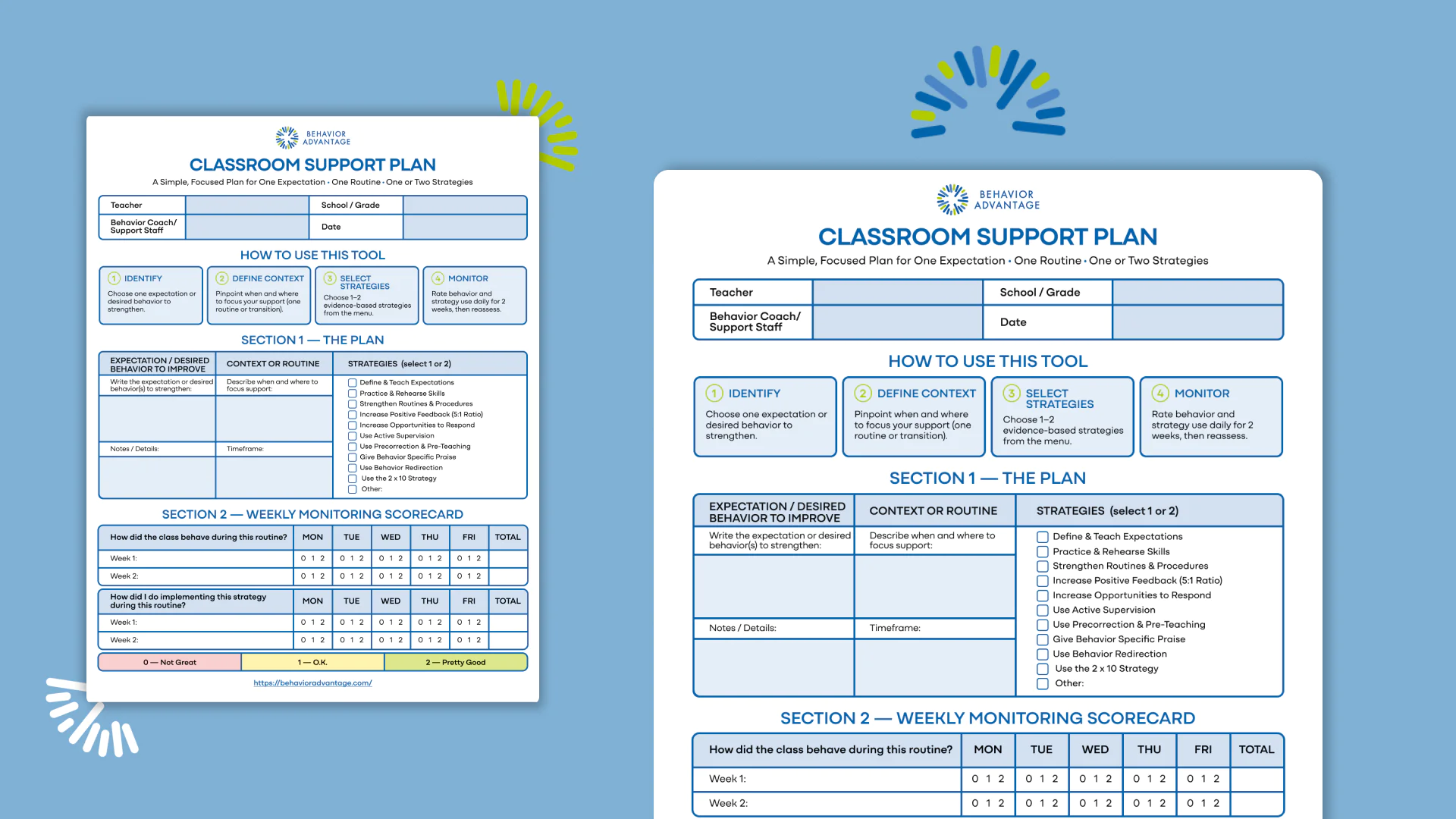
To help teams put this idea into practice, we recommend using the Behavior Advantage Classroom Support Plan.
The template should help teams answer four basic questions:
- What expectation or desired behavior are we trying to strengthen?
- Where and when do we want to focus our support?
- Which one or two evidence-based strategies will we use?
- How will we monitor whether the plan is helping?
A downloadable version of this tool can be used by teachers, coaches, school psychologists, behavior specialists, counselors, administrators, or school teams.
The goal is not to delay needed support for an individual student. The goal is to give teams a simple way to strengthen the classroom routine around that student while they continue to monitor what level of support is needed.
Because sometimes the best way to help one student is to bring the temperature down for the whole room.
If you want to continue the conversation, get in touch.