


When addressing student behavior, knowing where to start, how much information is needed, and what to do next isn’t always clear.
A student is struggling, concerns are growing, and the team agrees that additional support is needed. But what does that support look like?
Should the team strengthen classroom practices? Introduce a targeted intervention? Develop an individualized Behavior Intervention Plan (BIP)? Or conduct a comprehensive Functional Behavior Assessment (FBA)?
And perhaps most importantly, how can we ensure the time and effort invested lead to meaningful progress for the student?
At Behavior Advantage, we believe effective behavior support begins with understanding the student, matching the level of support to their needs, and developing practical plans that teams can implement consistently.
That’s why we’ve developed two complementary resources to help school teams navigate these decisions with greater clarity and confidence:
- Behavior Support Pathways: A framework for determining the appropriate level of behavior support and functional assessment.
- The FBA Step-by-Step Guide: Practical guidance for conducting and documenting a comprehensive FBA when one is needed.
Together, these guides help teams move from identifying a concern to understanding behavior and developing meaningful, function-based support.
Start With the Right Question: What Level of Support Is Needed?
When a student experiences behavioral challenges, school teams can feel pressure to move immediately toward a formal assessment or individualized behavior plan.
In some situations, that’s exactly what’s needed. But in others, the team may already have enough information to begin implementing effective support.
The November 2024 guidance from the U.S. Department of Education, Using Functional Behavioral Assessments to Create Supportive Learning Environments, reinforces the value of functional assessment across a tiered system of support.
Rather than treating functional assessment as an all-or-nothing process, schools can match the depth of assessment and intervention to the student’s needs, the complexity of the behavior, and applicable procedural requirements.
This is the foundation of our first resource.
Federal guidance highlights the role of functional behavioral assessment across a continuum of school supports.
Download Resource 1: Behavior Support Pathways
A practical framework for determining where to start and how far to go.
The Behavior Support Pathways guide helps teams consider whether a behavior concern is best addressed through classroom-wide, small-group, or individualized support.
For example, if several students struggle during the same classroom routine, the most effective starting point may be strengthening classroom expectations, instructional practices, or environmental supports.
If a smaller group of students shares a similar need, a targeted intervention such as Check-In/Check-Out may provide the structure, encouragement, and feedback they need.
When concerns are specific to an individual student, the team can consider how much is already understood about the behavior and whether additional assessment is needed.
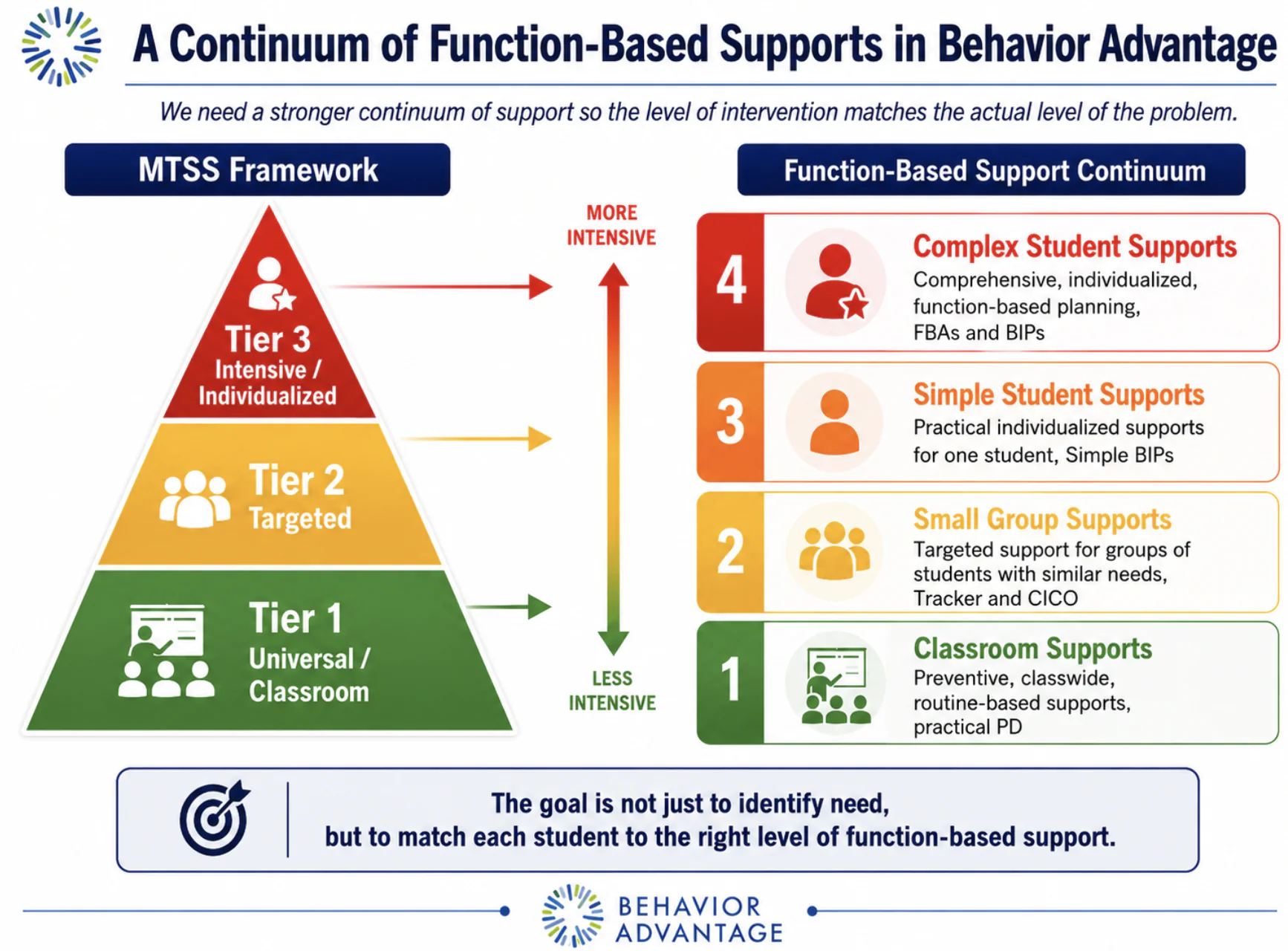
Behavior Advantage supports a continuum of function-based interventions, from preventive classroom strategies to comprehensive individualized planning.
The guide introduces a simple decision-making process built around two questions:
- Is a full FBA required?
Some circumstances involve specific legal or procedural requirements. Teams must first confirm whether federal, state, or district procedures require a full FBA.
- How well does the team understand the behavior?
Can the team clearly describe the behavior? Do they understand when and where it occurs, what tends to happen before and after it, and what the student may be trying to obtain, avoid, communicate, or regulate?
Does the team understand the student’s strengths, motivation, and existing skills?
The answers point the team toward one of three pathways:
- Path A: Document and Plan. The team has enough information to develop a function-based BIP now.
- Path B: Plan and Gather. The team begins a BIP while gathering targeted information to fill remaining gaps.
- Path C: Full FBA. A comprehensive assessment is completed before the BIP is developed.
The guide also reinforces three essentials that apply regardless of the pathway selected:
- Have a plan. Use what is known about the student and the behavior to develop appropriate strategies.
- Implement the plan. Ensure staff understand the strategies and can carry them out consistently.
- Monitor progress. Collect meaningful information to determine whether the plan is being implemented and whether the student is responding.
The goal is to help teams make thoughtful, timely decisions and avoid unnecessary delays in providing support.
Download Behavior Support Pathways to use during student support meetings, referral reviews, MTSS discussions, or collaborative problem-solving conversations.
Download Resource 2: The FBA Step-by-Step Guide
A practical roadmap for conducting a comprehensive Functional Behavior Assessment.
When a full FBA is required or determined to be the appropriate next step, teams face another challenge: organizing the assessment process and gathering enough meaningful information to develop an effective intervention.
An FBA involves much more than completing forms, conducting interviews, or collecting behavior data.
A useful assessment should help the team answer three connected questions:
What is happening, and in what context?
Understanding the behavior means looking beyond how often it occurs. Teams need to identify the settings, activities, demands, interactions, and other circumstances that make it more or less likely.
What is the behavior doing for the student?
Behavior serves a purpose, even when that purpose isn’t immediately apparent. Understanding what a behavior helps a student obtain, avoid, communicate, or regulate is essential to developing effective, function-based strategies.
What does the student need to be successful instead?
Understanding behavioral function is only part of the picture. Teams must also identify the student’s current communication, coping, regulation, and problem-solving skills, including skills that may need to be taught, strengthened, or supported across different settings.
Our FBA Step-by-Step Guide walks teams through seven steps of a comprehensive assessment:
- Identify the team and plan the assessment.
- Define the behavior and establish a baseline.
- Review existing information.
- Gather input from people who know the student.
- Observe directly.
- Determine the context and likely function.
- Review the findings and prepare to develop the BIP.
Each step includes practical guidance, considerations for assessment quality, and suggestions for documenting the process within Behavior Advantage.
The guide addresses questions that frequently arise during an FBA, including how much observation is enough, how to interpret conflicting information, when additional expertise may be needed, and how to distinguish skill deficits from difficulties using existing skills.
It also emphasizes collaboration with families, school staff, and students when appropriate, without assuming that every part of the assessment requires a formal team meeting.
Finally, the resource includes an FBA Completion and Quality Check checklist to help teams review whether their assessment is sufficiently complete, supported by evidence, and ready to guide intervention.
Download The FBA Step-by-Step Guide to help organize an upcoming assessment, support staff who are newer to conducting FBAs, or review the quality and completeness of an assessment already underway.
From Assessment to Action
Both resources reinforce an important principle: the purpose of assessment is to guide effective intervention.
A comprehensive FBA should provide enough information to develop a meaningful plan, but more assessment is not automatically better assessment.
Similarly, completing a BIP is only the beginning. The same three essentials apply here: have a plan, implement it consistently, and monitor whether it is working, adjusting when the data say it is time.
Our software, professional development, and coaching resources are designed to support this work, from classroom-wide practices to comprehensive individualized planning.
Whether you’re using Behavior Advantage or another system, the underlying principles remain the same: understand the student, match support to the need, implement consistently, and use meaningful data to guide decisions.
Download Both Guides and Put Them to Work
These resources are designed to be used, shared, and revisited with your team. Our hope is that they make the work a little more manageable, strengthen collaboration, and help teams spend less time wondering what to do next and more time providing effective support.
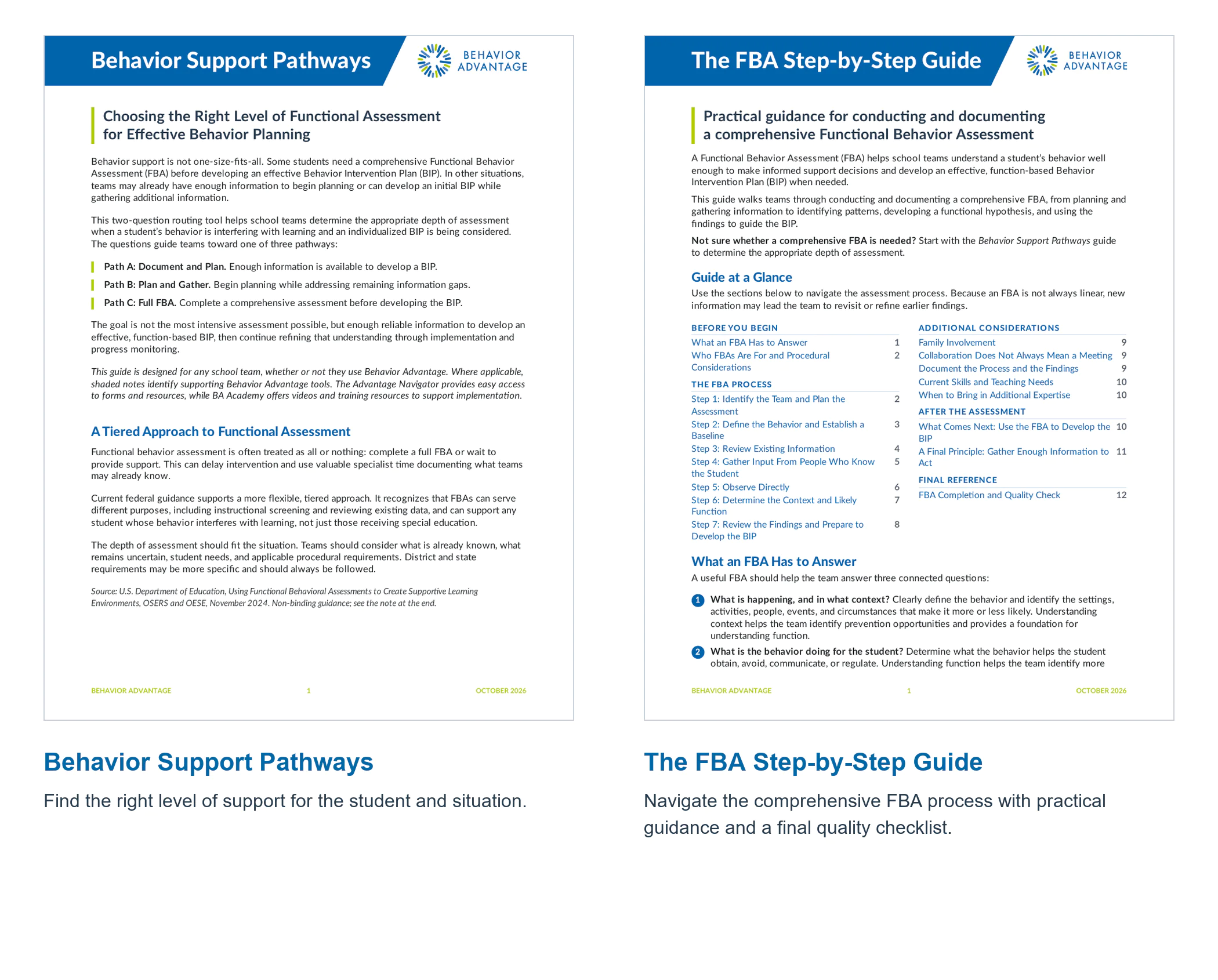
Already partnering with Behavior Advantage? Log in to your Behavior Advantage account to download these and other tools and resources directly from BA Academy.
Questions About Applying These Resources With Your Team?
Every school and district has its own processes, priorities, and challenges when it comes to supporting student behavior.
Whether you’re looking to strengthen your existing behavior support practices, clarify when an FBA is needed, or help your team use these resources more effectively, we’re happy to help.
Have questions or want to explore how these resources might fit within your school’s or district’s behavior support process?
Reach out to us at support@behavioradvantage.com. We’d welcome the opportunity to connect and support your team’s work.
Both resources are informed by the U.S. Department of Education’s November 2024 nonbinding guidance. They are intended as practice resources and do not replace applicable federal, state, or district requirements.